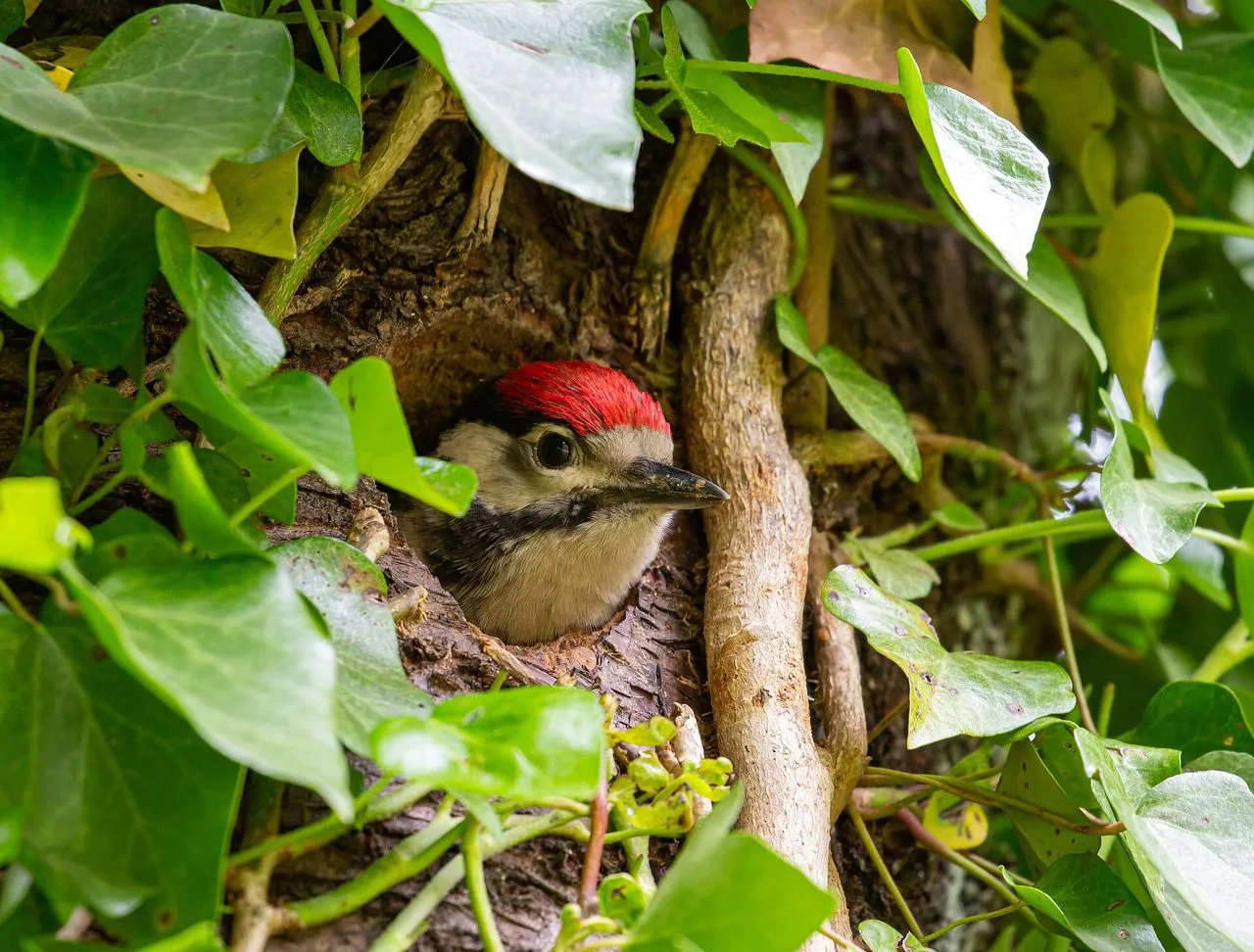
Dendrocopos major (Linnaeus, 1758), the Great Spotted Woodpecker, is Britain's standard pied woodpecker and the species most likely to drum from a resonant dead limb in February. Its drum is short, fast, and abrupt, commonly 10–16 strikes in about 0.5–0.8 seconds, often repeated after several seconds from the same post.
Part of the Complete Woodpeckers Guide.
Identification at a glance
| Character | Great Spotted (D. major) | Lesser Spotted (D. minor) |
|---|---|---|
| Body length | 22–23 cm (8.7–9.1 in) | 14–16 cm (5.5–6.3 in) |
| Body mass | 70–95 g (2.5–3.4 oz) | 17–25 g (0.6–0.9 oz) |
| Back pattern | Large white shoulder patches | Barred black-and-white back |
| Red under tail | Present | Absent |
| Drum | Short, hard burst, 0.5–0.8 sec | Weaker roll, 1–2 sec |
Identification
Visual
Great Spotted Woodpeckers are 22–23 cm long and about 70–95 g, with black upperparts, large white shoulder patches, barred wings, buff-white underparts, red undertail coverts, and a strong black-and-white head pattern. Adult males show a red patch on the nape; females lack it. Juveniles have a red crown, which is a common source of confusion for observers expecting adult head patterns.
The species is much larger and heavier-billed than Lesser Spotted Woodpecker. It has bold white shoulder patches rather than a barred back, red under the tail, and a forceful trunk posture. It is smaller and more compact than Green Woodpecker, and it lacks green plumage entirely. At feeders, the black-and-white body and red vent are usually enough.
Drumming is a key spring field mark. The roll is brief and accelerative in impression, ending cleanly rather than running on. A Great Spotted may drum many times in a morning, selecting dead branches, telegraph poles, or other resonant surfaces.
Audio
The common call is a sharp kik, often given singly in flight or alarm. Excited birds produce repeated kik-kik-kik notes. The call is harder and more metallic than most passerine alarm calls in the same woodland. Juveniles in the nest can be noisy near fledging, producing persistent begging calls from the cavity.
Distribution
Great Spotted Woodpeckers occur across most of Europe and much of temperate Asia, with a wide range of subspecies. In Britain they are widespread in England, Wales, and much of Scotland where woodland and mature trees occur, and they have colonised Ireland only recently and locally. Most populations are resident, though northern and eastern continental birds may move in response to cone and seed crops.
Habitat
The species uses deciduous, mixed, and coniferous woodland, parks, orchards, gardens, shelterbelts, and wooded farmland. It requires trees large enough for cavities and foraging but is not restricted to old-growth forest. Mature gardens with feeders can support regular visits, especially in winter when peanuts, suet, and sunflower hearts supplement natural food.
Diet and Foraging
The diet includes beetle larvae, ants, caterpillars, spiders, seeds, nuts, berries, sap, and, seasonally, eggs and nestlings of small birds. It forages by probing bark, chiselling into dead wood, gleaning branches, and using anvils: cracks or crevices where cones or nuts are wedged and hammered open. Such anvil sites accumulate cone scales or shell fragments beneath a favoured branch.
Nest predation is a real component of the species' ecology. Great Spotted Woodpeckers can enlarge nest-box holes or natural cavities to take tits and other small birds. This is not aberrant behaviour, but its visibility in gardens makes it controversial. Metal entrance plates on nest boxes reduce losses where predation is recurrent.
Breeding Biology
Pairs excavate cavities in dead wood or softened heartwood of living trees, often 2–12 m above ground. Entrance diameter is around 5–6 cm, with cavity depth about 25–35 cm. Excavation takes one to three weeks. Clutches usually contain four to seven eggs. Incubation lasts 10–12 days and is shared by both sexes. Young fledge after about 20–24 days. One brood is typical.
Both adults feed young, bringing insects and other prey to the cavity. After fledging, juveniles may remain dependent for a short period while they learn foraging technique.
Notes
For British observers, the main separation is from Lesser Spotted Woodpecker. Size is decisive when seen well: Great Spotted is starling-sized, Lesser Spotted is sparrow-sized. The Great Spotted has red undertail coverts and white shoulder patches; Lesser Spotted has a barred back and lacks the red vent. Drumming differs too: Great Spotted gives a short explosive burst, while Lesser Spotted drums longer and weaker. In a garden, the odds also favour Great Spotted heavily.
Feeder behaviour has changed its visibility. Peanuts and suet bring Great Spotted Woodpeckers into gardens throughout winter, and adults often bring juveniles after fledging. A juvenile with a red crown can be mistaken for Middle Spotted Woodpecker by inexperienced observers, but Middle Spotted is a scarce continental species in Britain and has a different face pattern, streaked flanks, and no black line enclosing the cheek in the same way. Location and structure matter: in a British garden, a red-crowned juvenile pied woodpecker is almost always Great Spotted.
Drumming surveys should be done early, before leaf-out and before general bird song masks short rolls. The bird may drum from the same resonant branch for several consecutive mornings.
The species also leaves characteristic feeding sign at anvils. A favoured crack in bark or fork of a branch may be surrounded by shredded pine cone scales, hazelnut shells, or fragments of beech mast. These accumulations are not nests and not squirrel middens when they are tight beneath a repeated hammering point on a trunk. An anvil can be used through much of winter, making it a reliable sign even when the bird is not present.
See Also
Frequently Asked Questions
How do I identify a Great Spotted Woodpecker?
Look for a starling-sized pied woodpecker with black upperparts, large white shoulder patches, barred wings, and red undertail coverts. Adult males have red on the nape; females lack it. Juveniles have a red crown. Compare with Lesser Spotted (sparrow-sized, barred back, no red vent).
Do Great Spotted Woodpeckers use bird feeders?
Yes, they regularly visit garden feeders, especially in winter. Peanuts, suet, and sunflower hearts attract them. They are the most frequent woodpecker at British feeders. Adults often bring juveniles after fledging.
Do Great Spotted Woodpeckers predate bird nests?
Yes, they are known to predate nests of small birds including tit species. They can enlarge nest-box holes or natural cavities to access nestlings. This is natural behavior, not aberrant. Metal entrance plates on nest boxes can reduce losses.
What is the drumming pattern?
The drum is short, fast, and abrupt: typically 10-16 strikes in about 0.5-0.8 seconds, ending cleanly rather than running on. Males drum from February to establish territories, often from dead branches or telegraph poles.
Sources & References
- Ehrlich, P.R., Dobkin, D.S. & Wheye, D. (1988). The Birders Handbook. Simon & Schuster.
- Cornell Lab of Ornithology. (2024). All About Birds: Great Spotted Woodpecker. birds.cornell.edu
- Sibley, D.A. (2014). The Sibley Guide to Birds (2nd ed.). Knopf.
- Winkler, H., Christie, D.A. & Nurney, D. (1995). Woodpeckers: A Guide to the Woodpeckers of the World. Houghton Mifflin.