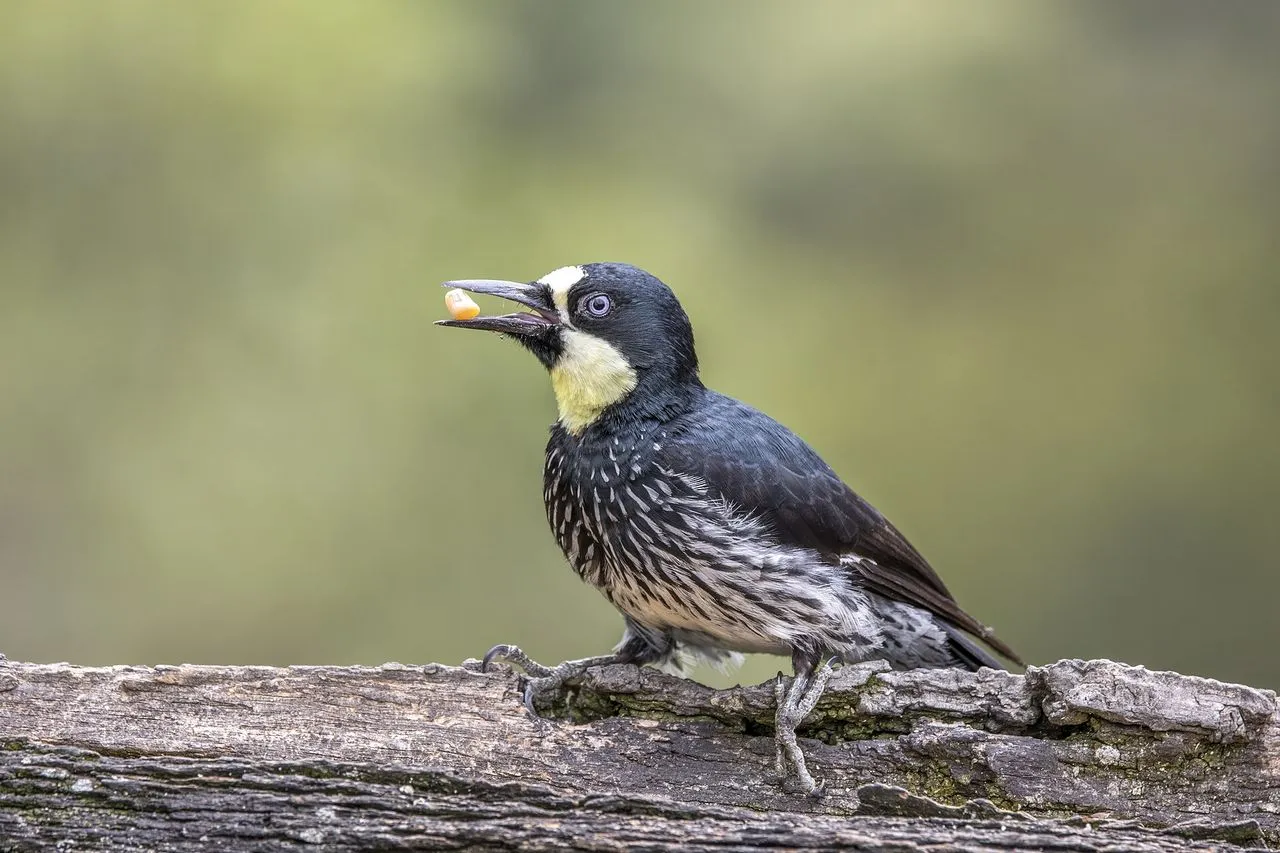
Melanerpes formicivorus (Swainson, 1827), the Acorn Woodpecker, is the granary specialist of western oak woodland. A single granary tree may contain several thousand acorns, each hammered into an individually fitted hole and moved as the nut dries and loosens. Its drum is a short, rolling woodpecker drum, but the social calls from a group around a granary are usually the first sound a field observer hears.
Part of the Complete Woodpeckers Guide.
Identification at a glance
| Character | Acorn Woodpecker (M. formicivorus) | Field use |
|---|---|---|
| Body length | 20–23 cm (8–9 in) | Medium Melanerpes size |
| Body mass | 65–90 g (2.3–3.2 oz) | Heavier than Downy, lighter than Lewis's |
| Head pattern | White forehead and throat, black mask, red crown | Most useful close-view mark |
| Social sign | Groups around granary trees | Often found by behaviour before plumage |
| Main substrate | Oak woodland, granary trees, poles, posts | Storage holes identify active territories |
Identification
Visual
The Acorn Woodpecker is a medium-sized Melanerpes, about 20–23 cm long and 65–90 g, with a black back, white belly, white rump, black chest patch, and a face pattern that looks almost theatrical: white forehead and throat, black mask, and red crown. Adult males have red reaching the white forehead. Adult females show a black band between the white forehead and red crown. Juveniles are duller but retain the bold facial contrast.
In flight, the white rump and white wing patches flash against the black body. On a granary tree the birds often perch upright on exposed limbs, fence posts, telephone poles, or the trunk surface itself, moving between storage holes and lookout posts. The combination of clown-like face, group behaviour, and oak habitat is distinctive.
Drumming is not the primary field clue. The species drums in territorial contexts, but vocal group activity and granary maintenance are more conspicuous.
Audio
The typical call is a loud, nasal, laughing waka-waka or ja-cob ja-cob series, delivered by one or several group members. Groups can be noisy for long periods, especially during boundary disputes or predator alarm. The sound is harsh, social, and carries through open oak woodland.
Distribution
Acorn Woodpeckers occur from the western United States south through Mexico and into Central America and northern South America, tracking oak and pine-oak systems. In the United States they are characteristic of California oak woodland, the Southwest, and parts of Oregon, Arizona, New Mexico, and Texas where suitable oaks occur. They are generally resident because their stored food ties them to defended territories.
Habitat
The essential habitat is not simply woodland but mast-producing oak woodland with suitable storage substrate. Granaries may be dead trees, thick-barked living trees, utility poles, fence posts, wooden buildings, or even artificial structures. The best territories combine several oak species, which reduces failure risk when one species has a poor acorn crop. Open canopy and exposed perches aid group defence and aerial detection of intruders.
Diet and Foraging
Acorns are central, but the species is not a seed-eater alone. It also takes flying insects, ants, beetles, sap, fruit, nectar, and occasionally eggs. Acorns are stored whole in drilled holes, not buried. Each hole must be tight enough to hold the nut, and stored acorns shrink as they dry, so birds spend considerable time moving them to smaller holes. A large granary can represent years of labour and thousands of storage decisions.
Granary defence is intense. Groups repel jays, squirrels, other Acorn Woodpeckers, and any bird investigating the stored crop. The store functions as winter insurance and as the economic base of the social system.
Breeding Biology
The species is famous for cooperative breeding. A group may include multiple breeding males, multiple breeding females, and non-breeding helpers, often close relatives. Joint nesting can produce egg destruction when females remove each other's eggs before synchrony is established. Once laying is synchronised, incubation and feeding are shared. Clutches vary because more than one female may lay in the same cavity; total egg numbers can exceed those of a simple pair.
Nest cavities are excavated in dead limbs, snags, or softened wood, often near the granary. Entrance diameter is around 5 cm, with cavity depth roughly 20–35 cm. Incubation is about 11–14 days, and young fledge after roughly 30–32 days. One brood is typical, though group structure and food supply influence attempts.
Notes
The granary is the species' centre of gravity. Remove the granary tree and a territory may collapse even if oaks remain nearby. The holes themselves are not random damage; they are a storage matrix built over years. Some granaries contain tens of thousands of holes, though not every hole is filled at once. Few North American birds show the link between food storage, social organisation, and territory defence as plainly as M. formicivorus.
Group composition can change abruptly after breeder death or territory takeover. Coalitions of males or females may compete for vacancies, and infanticide or egg destruction can occur during social upheaval. This is not incidental aggression; it is part of a system in which breeding positions, stored food, and inherited territories are valuable resources. Helpers gain indirect fitness by raising relatives and may later inherit a breeding position. The granary therefore functions as more than a pantry. It anchors kin structure, conflict, inheritance, and winter survival in one physical site.
Observers should avoid interpreting every perforated wooden building as current occupancy. Active granaries show fresh acorns, recent drilling, guarding birds, and frequent movement among holes.
The species' dependence on mast also makes oak diversity important. A territory with coast live oak, valley oak, blue oak, or other local oak combinations is buffered against a poor crop in any one species. Where development removes the largest oaks and leaves only scattered young trees, the birds may still visit but the storage economy weakens. Granaries require both production and continuity: annual acorn supply and a substrate that can remain useful for decades.
See Also
Frequently Asked Questions
How do I identify an Acorn Woodpecker?
Look for the distinctive face pattern: white forehead and throat, black mask, and red crown (males have red reaching the forehead; females have a black band between white and red). Also note the black back, white belly, white rump, and dark chest patch. They are often found in groups around oak trees with granary holes.
What are granary trees and why are they important?
Granary trees are dead trees, dead limbs, or wooden structures where Acorn Woodpeckers drill individual holes and store acorns. A single granary may contain thousands of acorns, representing years of labour and serving as winter food storage - the economic base of their social system.
Do Acorn Woodpeckers have cooperative breeding?
Yes, they are famous for cooperative breeding. Groups include multiple breeding males, multiple breeding females, and non-breeding helpers (often close relatives). All group members help with incubation, feeding, and territory defence. This is one of the most complex social systems among North American birds.
What do Acorn Woodpeckers eat?
While acorns are central, they also eat flying insects, ants, beetles, sap, fruit, nectar, and occasionally eggs. Acorns are stored whole in drilled holes, not buried. The birds spend considerable time moving acorns to smaller holes as they dry and shrink.
Sources & References
- Ehrlich, P.R., Dobkin, D.S. & Wheye, D. (1988). The Birders Handbook. Simon & Schuster.
- Cornell Lab of Ornithology. (2024). All About Birds: Acorn Woodpecker. birds.cornell.edu
- Sibley, D.A. (2014). The Sibley Guide to Birds (2nd ed.). Knopf.
- Winkler, H., Christie, D.A. & Nurney, D. (1995). Woodpeckers: A Guide to the Woodpeckers of the World. Houghton Mifflin.