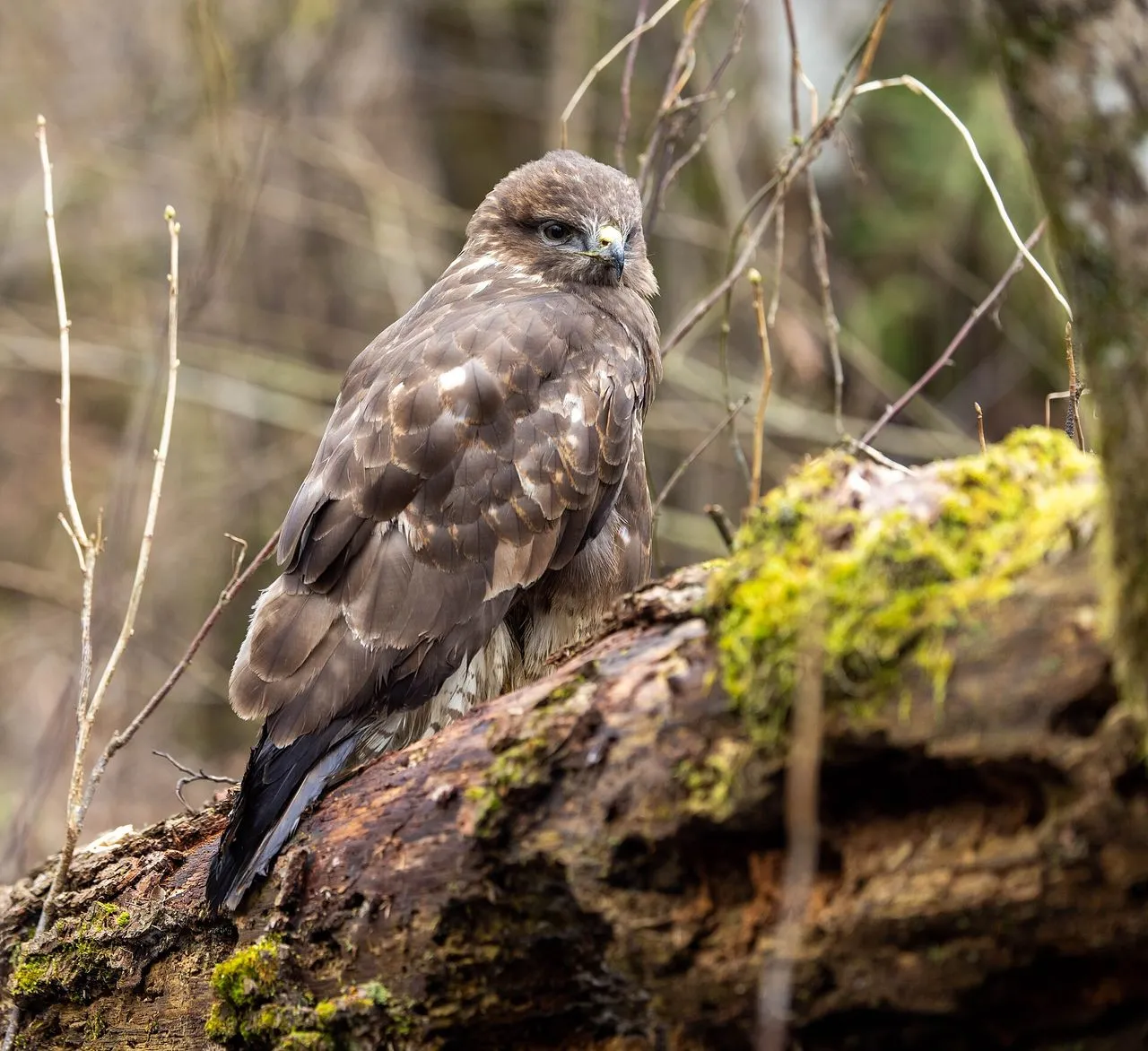
Buteo buteo Linnaeus, 1758, the Common Buzzard, is Britain's most numerous raptor, with a recovered population now measured in tens of thousands of breeding pairs after historical persecution and pesticide pressure.
Part of the Complete Raptors Guide.
Identification
| Character | Common Buzzard (B. buteo) | Red Kite (M. milvus) | Honey-buzzard (P. apivorus) |
|---|---|---|---|
| Wings | Broad, rounded | Long, angled, narrower | Long, even, less bulky |
| Tail | Short, broad, fanned | Deeply forked, constantly twisting | Longer and rounded |
| Head | Short-necked, bulky look | Slim body, pale head | Small pigeon-like head |
| Flight | Steady soar on level or raised wings | Buoyant drift with active tail | More elastic wing action |
Visual
Common Buzzard is a medium-sized buteo with broad wings, a short neck, compact body, and fanned tail. In soaring flight it circles on raised or level wings, often giving a slightly hunched profile. Plumage is extremely variable. Many birds are brown above with pale underwing panels, dark carpal patches, and a streaked belly. Others are very pale below, almost cream, while dark individuals can appear uniformly brown.
This variation is the principal identification difficulty. The structural pattern is more reliable than colour: broad rounded wings, short broad tail, and steady soaring. Red Kite has longer narrower wings and a forked tail. Honey-buzzard has a longer tail, smaller pigeon-like head, and different wing action. Rough-legged Buzzard, a winter visitor, shows a pale tail base with dark terminal band and often hovers more persistently.
Perched Common Buzzards look bulky and short-necked, often on fence posts, trees, telegraph poles, or low roadside perches. They frequently sit for long periods scanning grassland.
Audio
The call is a drawn-out mewing pee-oo, one of the familiar sounds of British open countryside. Birds call most often in display, territorial interactions, and family groups. Away from breeding territories they may be quiet, but voice is still more useful for Common Buzzard than for many raptors.
Distribution
Common Buzzard occurs across much of Europe and into western Asia, with resident and migratory populations depending on latitude. In Britain, it was formerly restricted largely to the west and north after persecution by game interests and the effects of organochlorines. Since the late twentieth century it has recolonised eastern and lowland areas and is now widespread across England, Wales, Scotland, and parts of Ireland.
The expansion has changed baseline expectations for British birders. A large circling raptor over lowland farmland is now more likely to be Common Buzzard than a rarity, whereas older county avifaunas often treated the species as local or scarce. Population recovery has altered the meaning of an everyday sky view.
European populations vary in migratory behaviour. Northern and eastern birds move south in winter; western European birds are often resident. Winter influxes can increase numbers in farmland and coastal lowlands.
Habitat
The species uses mixed landscapes: woodland for nesting, open ground for hunting, and perches for scanning. Pasture, rough grassland, arable margins, moorland edge, clear-fells, road verges, and valley farmland all support birds where prey is available. It is not a deep-forest specialist, nor is it tied to wilderness. The classic buzzard landscape is a patchwork of woods and fields.
In upland areas, sheep pasture and moorland edges provide hunting ground but fewer nest trees, so territories may be arranged around wooded gullies, plantations, or shelterbelts. In lowland arable districts, mature hedgerow trees and small copses can be enough for nesting if surrounding fields retain prey-rich margins.
Road verges are important feeding areas because they provide short grass, carrion, and exposed small mammals. Buzzards seen beside motorways are often hunting or scavenging rationally, though vehicle collision is an associated risk.
Diet and Hunting
Common Buzzard is a generalist. Rabbits are important where available, especially juveniles and carrion. Voles, mice, rats, moles, young birds, reptiles, amphibians, earthworms, beetles, and carrion all feature. In wet weather, birds may walk in fields taking earthworms. This flexibility explains part of the species' success in modern agricultural landscapes.
Carrion use is especially visible in winter. Buzzards feeding on roadkill may be mistaken for birds that killed the animal, but many are simply exploiting a reliable food source. The distinction matters in predator-conflict discussions, where scavenging evidence is often converted too quickly into claims of live predation.
Hunting is usually sit-and-wait. The buzzard watches from a perch, then drops to the ground in a short attack. It also soars while scanning, follows ploughs, and feeds at carcasses. It is less specialised than Red Kite in scavenging and less aerially agile, but its willingness to take almost any profitable prey makes it resilient.
Breeding Biology
Nests are stick platforms in trees, usually in woodland or mature hedgerow trees. Pairs may reuse nests or alternate among sites. Clutch size is commonly two or three eggs. Incubation lasts about five weeks, and young fledge after six to seven weeks. Adults perform conspicuous display flights in spring, circling and calling above territories.
Breeding success varies with prey abundance, weather, and disturbance. Rabbit decline from myxomatosis and viral haemorrhagic disease can affect local food supply, but buzzards compensate with other prey where habitat remains diverse.
Notes
The Common Buzzard's recovery in Britain is not simply a feel-good abundance story. It demonstrates how quickly a medium-sized raptor can recolonise when persecution declines, contaminants are regulated, and woodland-field mosaics remain. It also explains why conflict with some gamebird interests persists: a recovered visible predator is often blamed for losses without proportional evidence. Local predation occurs; population-level claims require data, not impression.
Its abundance also creates a useful calibration species. Learning the variable plumages and flight shapes of Common Buzzard makes genuine scarcity easier to recognise. Many reports of unusual eagles, kites, or honey-buzzards begin as pale, dark, or oddly angled Common Buzzards seen under poor light.
See Also
Frequently Asked Questions
How do I identify a Common Buzzard in flight?
The structural pattern is more reliable than colour. Look for broad rounded wings, a short broad tail, and steady soaring on level or slightly raised wings, giving a slightly hunched profile. Plumage varies widely: many birds are brown above with pale underwing panels and dark carpal patches; others are very pale or dark chocolate-brown. Red Kite has longer narrower wings and a deeply forked tail. Honey-buzzard has a longer tail and different wing action.
Why has the Common Buzzard recovered in Britain?
The recovery followed the decline of organochlorine pesticides and legal protection from historical gamebird persecution. The species expanded from western and northern strongholds to recolonise eastern and lowland England, Wales, Scotland, and parts of Ireland. Mixed landscapes with woodland for nesting and open farmland for hunting, combined with legal protection, allowed rapid recolonisation. This demonstrates how quickly a medium-sized raptor can recover when persecution declines and habitat remains.
What do Common Buzzards eat?
The species is a generalist. Rabbits are important where available, especially juveniles, and carrion is heavily used in winter. Voles, mice, rats, moles, young birds, reptiles, amphibians, earthworms, and beetles all feature. In wet weather, buzzards walk in fields taking earthworms. This flexibility explains much of the species' success in modern agricultural landscapes and its tolerance of varied habitats.
How do I separate Common Buzzard from other large soaring raptors?
Against Red Kite: Common Buzzard has a short broad tail, broader shorter wings, and no fork. Against Honey-buzzard: Common Buzzard has a more compact body, shorter tail, and different head shape. Against Rough-legged Buzzard: Rough-legged shows a pale tail base with dark terminal band, white underwing with dark carpal marks, and hovers more persistently. The variable plumage of Common Buzzard is a bigger identification challenge than the structure.
Sources & References
- Darel, G. (1993). The Common Buzzard. Otter Trust.
- Dennis, R.H. (1996). A Future for the Buzzard. Scottish Bird Review.
- Ferguson-Lees, J. & Christie, D.A. (2001). Raptors of the World. Helm Identification Guides.
- Cramp, S. & Simmons, K.E.M. (Eds.) (1980). The Birds of the Western Palearctic, Vol. 2. Oxford University Press.