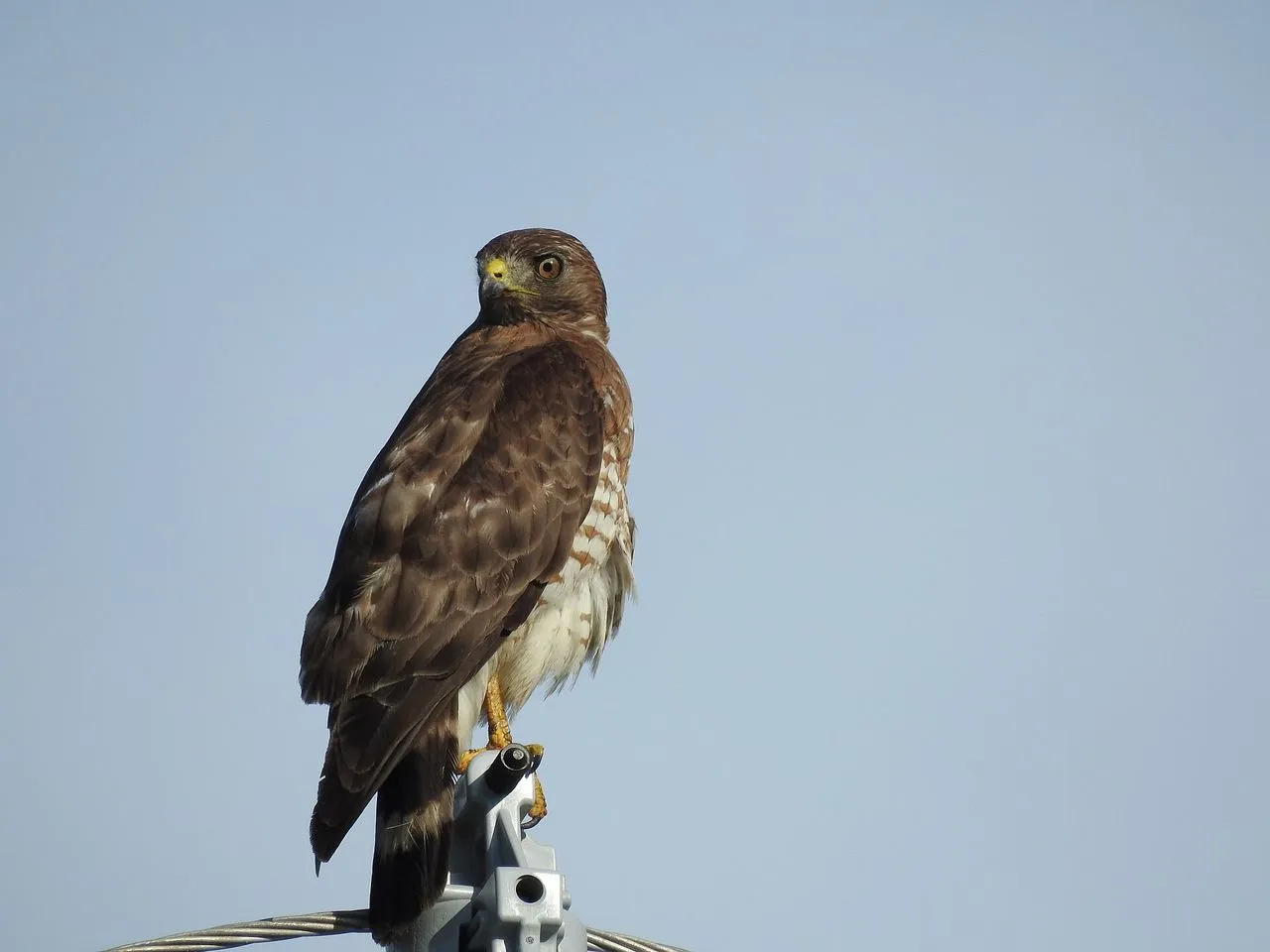
Buteo platypterus Vieillot, 1823, the Broad-winged Hawk, is a compact forest buteo whose autumn migration can move tens of thousands of birds past a single ridge watchpoint in one day.
Part of the Complete Raptors Guide.
Identification
| Character | Broad-winged Hawk (B. platypterus) | Red-shouldered Hawk (B. lineatus) | Red-tailed Hawk (B. jamaicensis) |
|---|---|---|---|
| Structure | Compact buteo; short tail | Longer-tailed forest buteo | Heavy-chested, broad-winged buteo |
| Adult tail | Broad black-and-white bands | Narrower black-and-white bands | Brick-red in adults |
| Underwing | Lacks pale crescent panels | Translucent crescent panels near wingtips | Dark patagial marks usually present |
| Migration | Often in kettles; high thermal flight | Usually smaller movements | Common ridge migrant in autumn |
Visual
Broad-winged Hawk is smaller and more compact than Red-tailed Hawk, with broad pointed-looking wings, a short tail, and a neat buteo shape. Adults are brown above and pale below with barred underparts. The adult tail shows broad black-and-white bands, usually one broad white central band bordered by dark bands when seen well. Juveniles have thinner tail banding and streaked underparts, making them more difficult.
In spring and summer, the species is often detected by voice rather than sight inside forest. In migration, identification relies on structure: small buteo, short tail, wings held flat or slightly raised, often travelling in groups. At high altitude in kettles, plumage may vanish entirely and only shape and flocking behaviour remain.
Confusion with juvenile Red-shouldered Hawk and small Red-tailed Hawk occurs. Broad-winged has a shorter tail than Red-shouldered, lacks the translucent crescent panels of Red-shouldered, and is generally more compact. Compared with Red-tailed, it lacks the large heavy chest and long-winged bulk.
Audio
The call is a high, thin, piercing whistle, often rendered pee-teee. It carries through deciduous forest and is one of the best ways to locate breeding birds. Away from breeding territories and during migration, birds are often silent.
Distribution
Broad-winged Hawks breed across eastern North America, from southern Canada through the eastern United States, with additional Caribbean populations. Most continental birds migrate to Central and South America for winter. The autumn movement is highly concentrated because birds use thermals and avoid long water crossings, funnelling around the Great Lakes, along the Appalachian ridges, through Texas and eastern Mexico, and into Central America.
Spring migration is less spectacular at many northern watchpoints because birds return on a broader front and under different wind regimes. The same species can therefore seem abundant in September and almost invisible in April to an observer using only one ridge site. That seasonal asymmetry is an observation-bias problem, not a contradiction in the bird's biology.
Hawk Mountain in Pennsylvania, Veracruz in Mexico, and several Central American watchpoints document the scale of the movement. Kettles of hundreds or thousands form when birds circle in a thermal, gain altitude, then stream out toward the next lift source.
Habitat
Breeding habitat is mature deciduous or mixed forest, often near openings, wetlands, or streams. This is not a roadside pole buteo. During the breeding season it spends much time under or just above canopy level, hunting from concealed perches and moving through woodland edges. Fragmented forest can support pairs if enough interior structure remains, but heavy fragmentation increases disturbance and may reduce nesting success.
During migration the bird becomes a creature of air columns and ridges. Habitat on the ground matters less than atmospheric structure: thermals, slopes, and wind direction determine where birds appear.
Diet and Hunting
Diet is varied and strongly local. Small mammals, frogs, snakes, lizards, young birds, large insects, and crayfish are all taken. In moist eastern forests, amphibians can be important. The bird hunts from perches, dropping to the ground or low vegetation after prey. It also captures insects and small vertebrates opportunistically along forest edges.
Because much hunting occurs below canopy, prey capture is easily missed. A calling bird circling above a woodlot may be the only visible sign of a pair whose feeding activity takes place in shaded understory, along stream margins, or at small openings. This is one reason breeding Broad-winged Hawks feel scarcer to casual observers than they are in suitable forest.
The compact body and broad wings suit short movements within woodland rather than prolonged open-country soaring during the breeding season. On migration, the same wing plan permits efficient thermal use. Broad-winged Hawks minimise flapping over long distances by chaining thermals; crossing large water bodies, where thermals are weak or absent, is costly and avoided when possible.
Breeding Biology
The nest is a stick platform in a tree, often below the canopy in mature forest. Clutch size is usually two or three eggs. Incubation lasts about a month, and young fledge after five to six weeks. Adults are defensive near nests but often remain inconspicuous unless calling. Many nesting territories are overlooked by observers who expect raptors to be visible over fields.
Nest success depends on prey supply, weather, and forest condition. Because the species winters far to the south, breeding population trends can be affected by conditions on migration and wintering grounds as well as by North American forest management.
Notes
The Broad-winged Hawk is the species that teaches why raptor migration counts are not simple abundance counts. A peak day may reflect population size, but it also reflects wind, thermal strength, observer coverage, and geography. Ten thousand birds over a ridge in September are a biological event and a meteorological event occurring simultaneously.
The kettling itself is not social coordination in any complex sense. Birds are independently exploiting the same rising column of warm air. The flock forms because the atmosphere is structured, not because the hawks have agreed to travel together.
See Also
- Red-tailed Hawk
- Swainson's Hawk
- Common Buzzard
- Osprey
- The Complete Raptors Guide
- Red-tailed vs Red-shouldered Hawk: the two larger eastern buteos compared; useful context for the smaller Broad-winged.
Frequently Asked Questions
How do I identify a Broad-winged Hawk in flight?
Look for a small buteo with broad pointed wings, a short tail, and wings held flat or slightly raised. Adults show broad black-and-white bands on the tail visible in good light. At distance, when plumage details vanish, the compact buteo shape and habit of travelling in loose groups are the best characters. Kettles of circling hawks in autumn are a strong indicator species.
How do I separate Broad-winged Hawk from Red-shouldered Hawk and Red-tailed Hawk?
Broad-winged has a shorter tail than Red-shouldered, lacks the translucent crescent panels in Red-shouldered wings, and is generally more compact. Against Red-tailed, it lacks the large heavy chest and long-winged bulk. The tail banding and small size are the clearest separators for Broad-winged.
Why are autumn Broad-winged Hawk counts so much larger than spring counts at the same watchpoint?
Spring migration follows a broader front under different wind regimes, while autumn concentration funnels through specific thermal corridors around the Great Lakes and Appalachian ridges. This asymmetry reflects observation bias and geographic funneling, not a real contradiction in the bird's biology. The same number of birds may pass in spring but spread across a wider front.
What do Broad-winged Hawks eat?
Diet is varied and local: small mammals, frogs, snakes, lizards, young birds, large insects, and crayfish. In moist eastern forests, amphibians can be important. Most hunting occurs below canopy level from concealed perches, which is why breeding pairs are often detected by voice rather than sight. The compact body suits short movements within woodland rather than prolonged open-country soaring.
Sources & References
- Cornell Lab of Ornithology. (2024). All About Birds: Broad-winged Hawk. birds.cornell.edu
- Sibley, D.A. (2014). The Sibley Guide to Birds (2nd ed.). Knopf.
- Bildstein, K.L. (2006). Migrating Raptors of the World: Their Ecology and Conservation. Cornell University Press.
- Ferguson-Lees, J. & Christie, D.A. (2001). Raptors of the World. Helm Identification Guides.