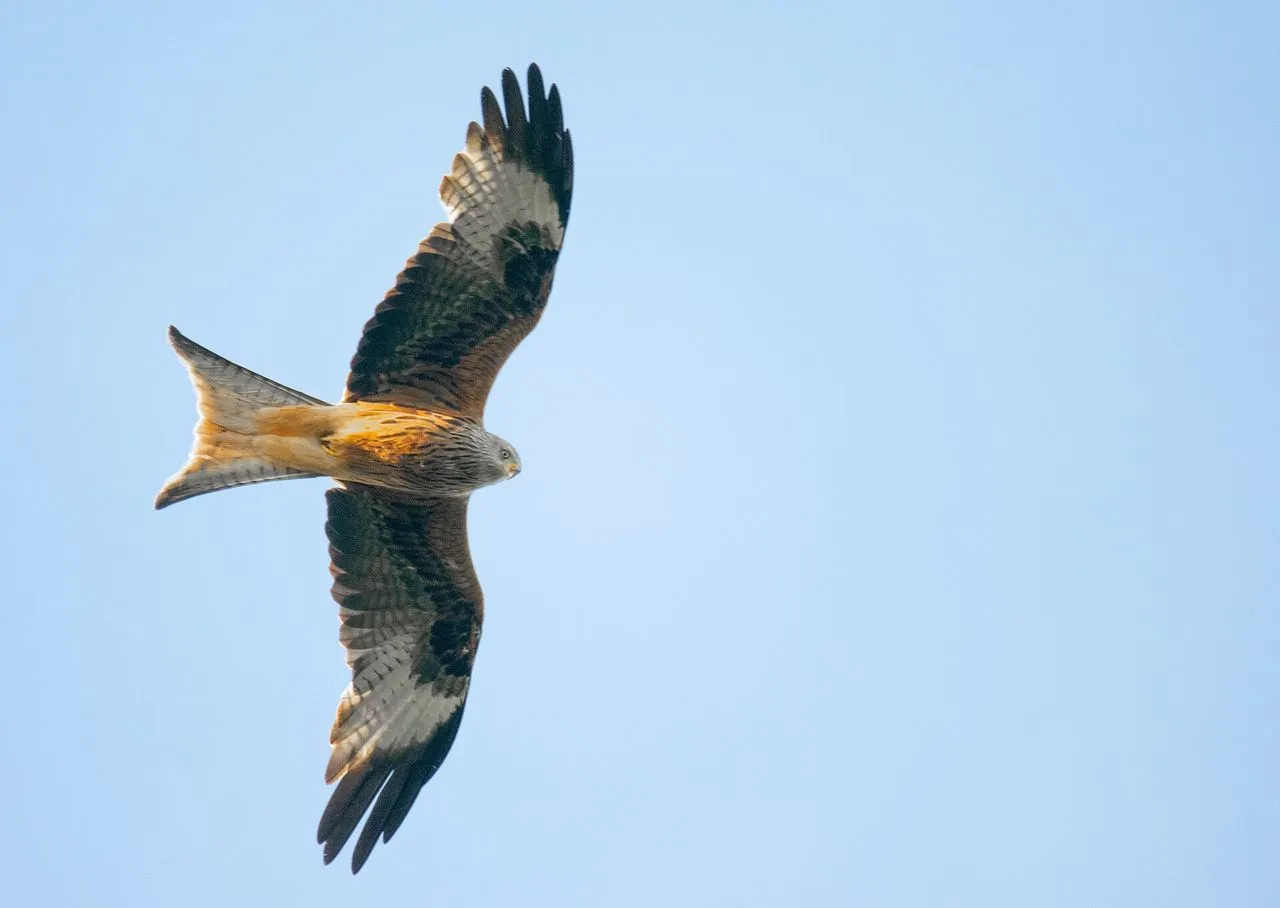
Milvus milvus Linnaeus, 1758, the Red Kite, is a European kite with a deeply forked tail and a British population rebuilt from a remnant Welsh nucleus and reintroductions beginning in 1989.
Part of the Complete Raptors Guide.
Identification
| Character | Red Kite (M. milvus) | Common Buzzard (B. buteo) | Black Kite (M. migrans) |
|---|---|---|---|
| Tail | Deeply forked, active rudder | Short, broad, unforked | Shallower fork |
| Wings | Long, angled, narrow | Broad and rounded | Long, but darker overall |
| Plumage | Reddish-brown, pale primary patches | Highly variable brown to pale | Darker, less rufous |
| Foraging | Low buoyant scavenging, small prey | Perch-hunting and soaring | Scavenging; scarcer in Britain |
Visual
Red Kite is one of the most distinctive European raptors in flight. The wings are long and angled, the body slim, and the tail deeply forked, twisting continuously as a rudder. Adults are reddish-brown with pale primary patches and dark wingtips. The head is pale greyish. The whole bird looks lighter and more elastic than Common Buzzard, with slower wingbeats and constant tail adjustment.
At distance the forked tail is the key character, but it is not merely a shape. Red Kites use the tail actively, flexing and rotating it while drifting over fields, villages, and roads. Black Kite has a shallower fork and darker, less rufous plumage, but it is scarce in Britain. Common Buzzard lacks the fork and has broader, shorter wings.
Juveniles are paler and more streaked, with a less clean head and tail pattern, but the silhouette remains diagnostic. Perched Red Kites can look surprisingly slight for their wingspan, with long folded wings and a narrow body.
Audio
The voice is a thin, whistling, descending call, often tremulous. Birds call around nests, roosts, and food disputes. Away from social situations they may drift silently for long periods.
Distribution
Red Kite is primarily European, with strongholds in Germany, France, Spain, Sweden, Switzerland, and the United Kingdom. It is scarce or declining in parts of its former range and has a restricted global distribution compared with many raptors. In Britain, the species survived persecution in a small Welsh population while disappearing from most of England and Scotland.
That restricted global range gives Britain disproportionate responsibility for the species. A bird that feels common along the M40 corridor is not globally secure in the way a cosmopolitan Osprey or Peregrine is. Local abundance after reintroduction can conceal international vulnerability.
Reintroduction projects began in the Chilterns and Scotland in 1989, followed by additional releases in England, Scotland, and Ireland. The Chilterns population expanded rapidly and is now one of the most visible raptor recoveries in Europe. Welsh birds also increased under protection, though with a different genetic and demographic history from the reintroduced populations.
Habitat
Red Kites use mixed lowland and upland landscapes with woodland for nesting and open ground for foraging. Farmland, pasture, road corridors, villages, rubbish tips, edge habitats, and wooded valleys can all be used. The species is not a deep-forest hunter. It needs airspace for searching and trees for nesting and roosting.
Communal roosts form in winter, sometimes holding dozens or hundreds of birds where food is predictable. Supplementary feeding stations have influenced local distribution and public visibility in Britain, but they are not a substitute for broad landscape recovery.
Diet and Hunting
Red Kite is a scavenger and opportunistic predator. Carrion is central: road-killed rabbits, pheasants, corvids, small mammals, lambing afterbirth, and discarded meat are used. Live prey includes earthworms, beetles, small mammals, young birds, and occasionally reptiles or amphibians. The feet are weaker than those of a buzzard or eagle relative to body size, reflecting a diet built around small prey and carrion rather than overpowering large live animals.
Foraging flight is low, buoyant, and searching. The kite quarters fields and roadsides, drops lightly to pick up food, and often eats small items in flight. It will pirate food from other birds and join loose feeding groups. Around feeding stations, competition can be intense, but this should not be mistaken for the full ecology of the species.
The feet are used more for collection than combat. A Red Kite can take live prey, but its morphology and behaviour are those of an aerial searcher and scavenger. The bird's success depends on finding dispersed small food items efficiently, not overpowering large animals.
Breeding Biology
Nests are built in trees, often in woodland edges or mature hedgerows. Red Kites characteristically decorate nests with wool, paper, plastic, cloth, and other found material. Clutch size is usually two or three eggs. Incubation lasts about a month, and young fledge after six to eight weeks. Pairs may reuse nest areas across years, though not always the same structure.
Productivity depends on food supply, weather, disturbance, and adult experience. Because the British recovery involved released birds from continental populations, post-release survival, recruitment, and local persecution rates were closely monitored. The success of the Chilterns release reflected suitable habitat, adequate food, legal protection, and strong survival after release.
Notes
The Red Kite is a conservation success, but not a solved problem. Illegal poisoning remains a serious threat in parts of Europe and Britain, especially where poisoned baits are used against foxes or corvids. Secondary poisoning from rodenticides and lead exposure also occur. The species' habit of feeding on carrion makes it exceptionally vulnerable to toxins placed in the landscape. Its recovery shows what protection can do; its mortality records show how quickly old pressures can return under new chemical names.
Supplementary feeding has helped public engagement but can complicate interpretation of density. High local numbers around feeding stations do not necessarily indicate equally high natural carrying capacity. Conservation success should be measured by breeding distribution, survival, and reduced illegal killing, not by spectacle alone.
See Also
Frequently Asked Questions
How do I identify a Red Kite in flight?
The forked tail is the key character. Red Kites use it actively, flexing and rotating it while drifting over fields, villages, and roads. Wings are long and angled, body is slim, and the tail is deeply forked, twisting continuously. Adults are reddish-brown with pale primary patches and dark wingtips. At distance, the forked tail separated from the body silhouette is the most reliable mark. Black Kite has a shallower fork and darker plumage.
How did the Red Kite recover in Britain?
A small Welsh population survived historical persecution while the species disappeared from most of England and Scotland. Reintroduction projects began in the Chilterns and Scotland in 1989, followed by releases in England, Scotland, and Ireland. The Chilterns population expanded rapidly under legal protection, adequate food supply, and strong post-release survival. The Welsh population also increased under protection, though with a different genetic history.
What do Red Kites eat?
Carrion is central: road-killed rabbits, pheasants, corvids, small mammals, and discarded meat. Live prey includes earthworms, beetles, small mammals, young birds, and occasionally reptiles or amphibians. Feet are weaker than in buzzards or eagles relative to body size, reflecting a diet built around small prey and carrion rather than overpowering large animals. Foraging is low and buoyant, often eating small items in flight.
What threats does the Red Kite still face?
Illegal poisoning from poisoned baits set for foxes or corvids is a serious ongoing threat across parts of Europe and Britain. Secondary poisoning from rodenticides and lead exposure also occur, and the species is exceptionally vulnerable to toxins placed in the landscape because it feeds on carrion. High numbers around feeding stations do not necessarily indicate equally high natural carrying capacity. Conservation should be measured by breeding distribution and survival, not spectacle.
Sources & References
- Eagle, G. (1992). Red Kite. RSPB/Brewer.
- Ferguson-Lees, J. & Christie, D.A. (2001). Raptors of the World. Helm Identification Guides.
- Cramp, S. & Simmons, K.E.M. (Eds.) (1980). The Birds of the Western Palearctic, Vol. 2. Oxford University Press.
- Snow, D. & Perrins, C.M. (1998). The Birds of the Western Palearctic: Concise Edition. Oxford University Press.