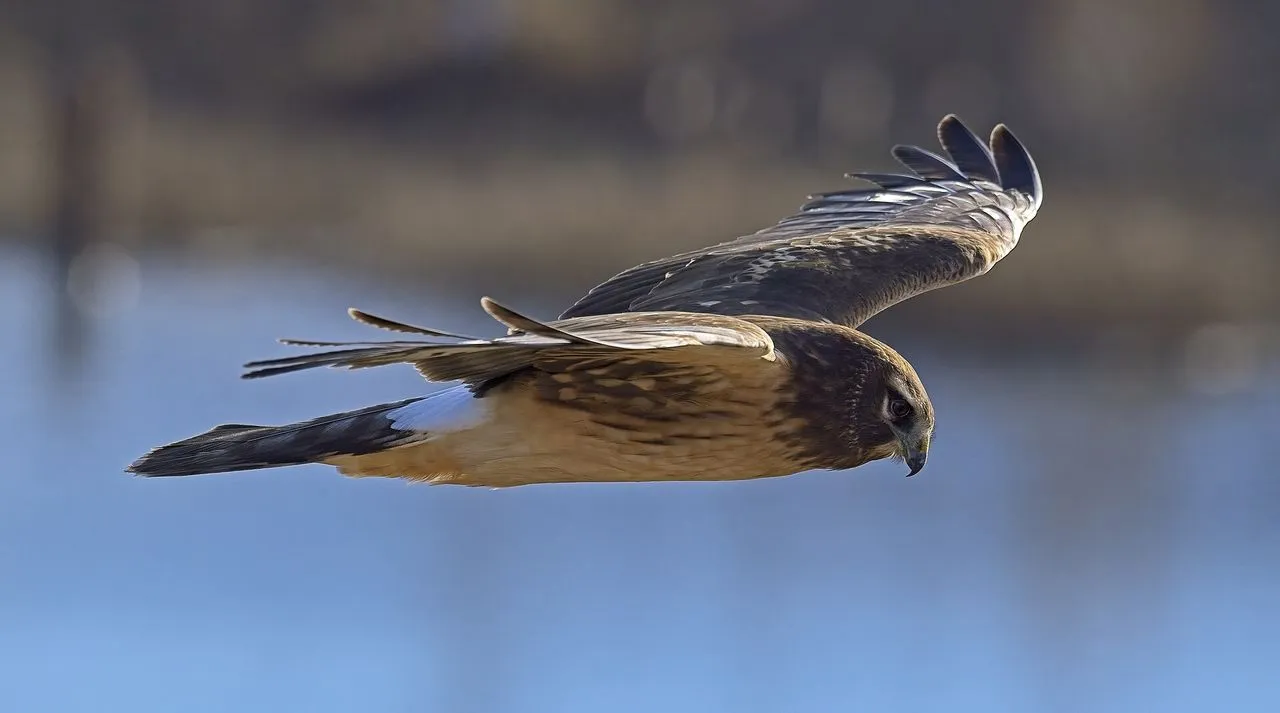
Circus hudsonius Linnaeus, 1766, the Northern Harrier, is the only regular North American harrier and combines long low wings with a facial disc that improves acoustic detection of prey in dense grass.
Part of the Complete Raptors Guide.
Identification
| Character | Northern Harrier (C. hudsonius) | Red-tailed Hawk (B. jamaicensis) | Short-eared Owl (A. flammeus) |
|---|---|---|---|
| Flight height | Low over marsh or grass, often 1–5 m (3–16 ft) | Higher perch-hunt or thermal soar | Low, buoyant, often crepuscular |
| Wings | Long, narrow, shallow V | Broad, rounded buteo wings | Broad, rounded owl wings |
| Rump | White rump patch obvious at range | No white rump patch | Pale patches variable, no harrier rump |
| Hunting cue | Rocks while quartering | Drops from perch or height | Moth-like wingbeats over open ground |
Visual
Northern Harrier is identified first by flight. It quarters low over marsh, prairie, pasture, or rough grassland, holding long wings in a shallow V and rocking continuously in wind. The tail is long, the body slim, and the white rump patch is visible at great range. No buteo or accipiter routinely hunts at one to five metres above vegetation in this tilting, buoyant manner.
Adult males are grey above and pale below with black wingtips, the source of the old name "grey ghost". Females are brown above and warm buff below with streaking. Juveniles resemble females but are often richer orange below with less distinct streaking. The owl-like face is visible on perched or close birds: a partial facial ruff surrounds the eyes and channels sound toward the ear openings.
Audio
Harriers are mostly silent away from breeding territories. Around nests they give chattering alarm calls and thin whistles. The visual hunting style is far more useful than voice for field identification.
Distribution
Northern Harriers breed across northern North America, the northern United States, and suitable open habitats farther south. Many northern birds migrate to winter across the United States, Mexico, and Central America. Wintering concentrations occur in coastal marshes, wet meadows, fallow agricultural land, prairie remnants, and managed wetlands.
Communal winter roosts form on the ground in marshes, rough grass, or dense low vegetation. Several harriers may arrive near dusk, quarter briefly, then drop into cover at separate points. These roosts are vulnerable to drainage, burning, and recreational disturbance because they are rarely obvious in daylight.
The Eurasian Hen Harrier, Circus cyaneus, was formerly treated with Northern Harrier by many authorities; modern treatments often separate them. The North American bird is therefore best understood as the New World member of a Holarctic harrier complex rather than simply as an American population of the Hen Harrier.
Habitat
Harriers require open ground with enough vegetation to hold prey but not so much woody cover that low flight is obstructed. Freshwater marsh, saltmarsh, wet meadow, prairie, hayfield, moor-like grassland, tundra edge, and fallow fields all qualify. Nesting occurs on the ground, usually in dense vegetation, which makes the species vulnerable to mowing, grazing pressure, flooding, and ground predators.
Habitat quality can change within a season. A hayfield suitable in May may become lethal if cut during incubation or nestling stages. Wetland drainage, conversion of rough grass to row crop, and succession of open fields into shrubland all reduce local suitability.
Diet and Hunting
Small mammals dominate in many regions, especially voles, mice, and young rats. Birds are also important, including meadowlarks, sparrows, blackbirds, shorebirds, and young waterfowl. Reptiles, amphibians, and large insects are taken opportunistically. Diet shifts with season and prey cycles; vole abundance can strongly affect breeding productivity.
The hunting method is low quartering. The harrier flies repeated transects over vegetation, using vision and hearing to locate movement. On detecting prey it stalls, turns sharply, and drops with legs extended. The facial disc does not make the bird an owl, but it is functionally analogous: it improves the directional capture of sound. This matters when prey is moving under grass and not visible from above.
Flight height changes with vegetation and wind. Over short wet meadow a harrier may work at one or two metres; over taller reed or rank grass it may rise higher and make steeper drops. Strong wind exaggerates the rocking motion but can also improve hunting by allowing the bird to hang over a patch with little forward speed.
Males and females differ in hunting range and prey size because of size dimorphism. During breeding the male supplies much food early, sometimes transferring prey to the female in mid-air. The pass is a field event worth recognising: the female rises from cover, rolls, and takes the dropped prey with her feet.
Breeding Biology
The nest is a ground platform of grasses and stems, placed in marsh or dense grass. Clutch size is commonly four to six eggs but varies with food supply. Incubation is mainly by the female. The male may provision more than one female in polygynous systems where prey is abundant, though this is variable and not the rule in all populations.
Young leave the nest before they can fly well, hiding in surrounding vegetation. This behaviour reduces risk at a fixed nest cup but increases vulnerability to mowing and trampling. Conservation management often requires delaying hay cuts or leaving uncut refuge blocks around known nests.
Notes
The white rump patch should not be treated as a decorative field mark; it is the single most efficient identification character at range. A slim raptor rocking low over winter marsh with a bright white rump is a Northern Harrier even when plumage, sex, and age are unresolved. The same observation also tells you something about the site: open-ground prey and cover structure are still functioning there.
See Also
Frequently Asked Questions
How do I identify a Northern Harrier in the field?
The flight is the primary character. Northern Harrier quarters low over marsh, prairie, or rough grassland, holding long wings in a shallow V and rocking continuously in wind. The white rump patch is the most efficient identification character at range, visible long before plumage details. No buteo or accipiter routinely hunts at one to five metres above vegetation in this tilting, buoyant manner. Perched birds show an owl-like facial ruff.
What does the facial disc do for a Northern Harrier?
The partial facial ruff surrounding the eyes channels sound toward the ear openings, improving directional sound capture analogous to owl hearing. This matters when prey is moving under grass and not visible from above, allowing the harrier to locate voles and small birds by sound as well as sight. The disc does not make the harrier an owl, but it is a functional auditory adaptation.
Where do Northern Harriers nest?
Nests are placed on the ground in marshes, dense grass, or rank vegetation. Clutch size is commonly four to six eggs but varies with food supply. The nest is a platform of grasses and stems, vulnerable to mowing, grazing, flooding, and ground predators. Young leave the nest before they can fly well, hiding in surrounding vegetation, which makes them vulnerable to hay cutting during the breeding season.
What is the 'grey ghost' nickname?
The name refers to adult male Northern Harriers, which are pale grey above and white below with black wingtips. The ghostly pale appearance against dark marsh or prairie vegetation in low angled light is memorable. Males are significantly smaller than females, and the reversed size dimorphism means the male provides much food early in breeding, sometimes transferring prey to the female in mid-air.
Sources & References
- Cornell Lab of Ornithology. (2024). All About Birds: Northern Harrier. birds.cornell.edu
- Ehrlich, P.R., Dobkin, D.S. & Wheye, D. (1988). The Birders Handbook. Simon & Schuster.
- Sibley, D.A. (2014). The Sibley Guide to Birds (2nd ed.). Knopf.
- Ferguson-Lees, J. & Christie, D.A. (2001). Raptors of the World. Helm Identification Guides.