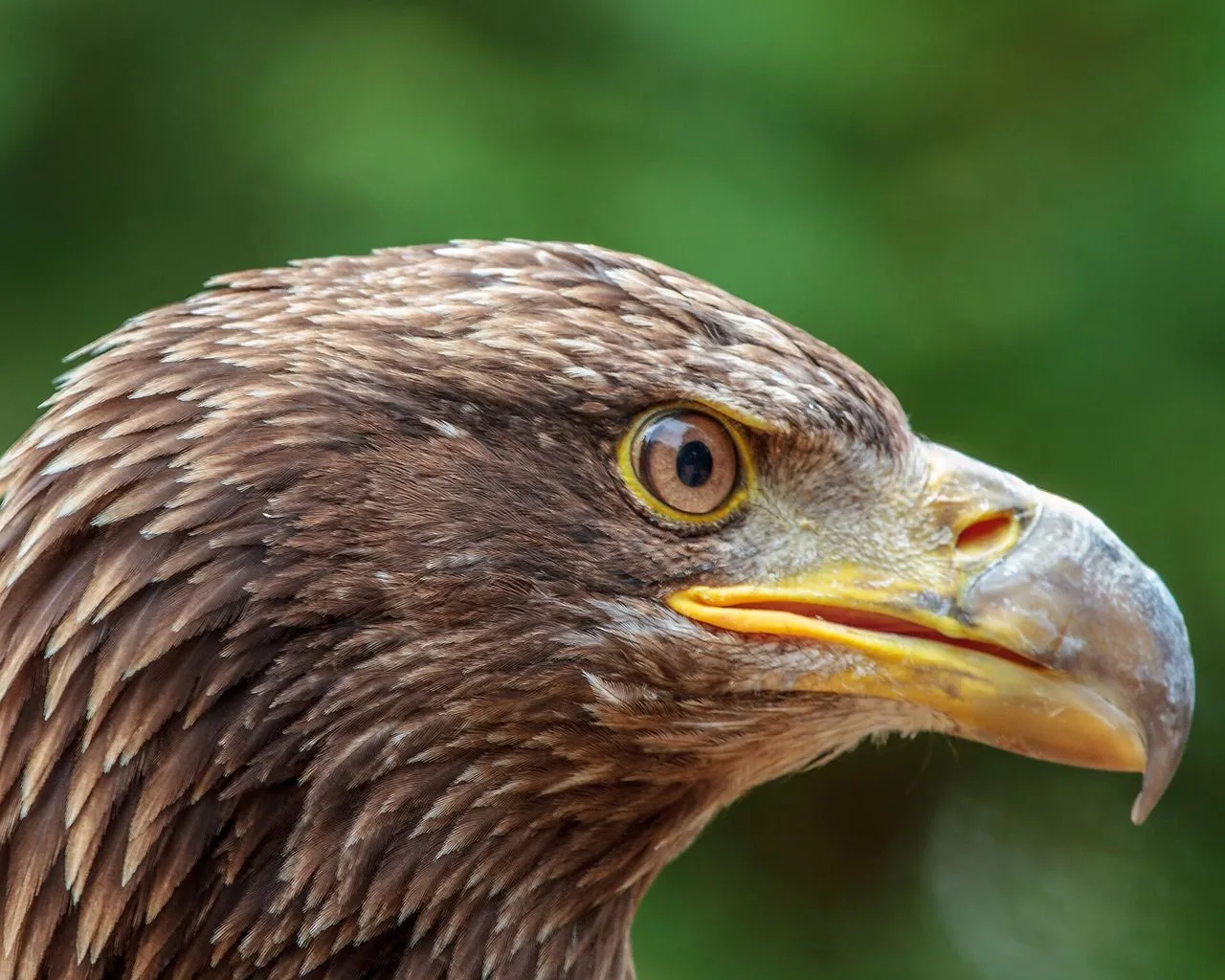
Haliaeetus leucocephalus Linnaeus, 1766, the Bald Eagle, declined to 417 known nesting pairs in the lower 48 United States in 1963 and recovered to more than 70,000 individuals there by the early twenty-first century.
Part of the Complete Raptors Guide.
Identification
| Character | Bald Eagle (H. leucocephalus) | Golden Eagle (A. chrysaetos) |
|---|---|---|
| Adult head | White head and tail | Golden-brown nape on dark head |
| Immature white | Irregular mottling on belly and wing linings | Crisp white primary panels and tail base |
| Flight profile | Broad flat wings; large projecting head | Slight dihedral; smaller head, longer tail |
| Typical setting | Lakes, rivers, coasts; fish and carrion | Mountains, moorland, steppe; mammal prey |
Visual
Adult Bald Eagles are structurally and plumage-wise straightforward: dark brown body and wings, white head, white tail, large yellow bill, and long broad wings held flat in soaring flight. Wingspan commonly exceeds 2 metres in large females. The head projects strongly in flight, giving a plank-winged, long-fronted outline. Adults acquire the full white head and tail only after several years; definitive adult plumage is usually reached in the fifth calendar year.
Immatures are the identification challenge. First-year birds are dark brown with variable white mottling in the wing linings, belly, and underwing. Second- and third-year birds can show extensive pale patches, dark eye stripe effects, and partially pale tails. They are often miscalled Golden Eagles, especially when seen at distance. Bald Eagle immatures have larger heads and bills, flatter wings, and more irregular white mottling than Golden Eagles. Golden Eagles show a smaller head, slightly raised wings in glide, and in juveniles crisp white wing patches and a white tail base rather than blotchy mottling.
Audio
Bald Eagles are vocal near nests, communal roosts, and food sources, but the call is not the cinematic scream assigned to them in films. The usual voice is a thin, high, chattering series, sometimes described as weak for the bird's size. Away from social contexts they may be silent for long periods.
Distribution
The species is restricted to North America, breeding from Alaska and Canada south through the contiguous United States into northern Mexico in suitable habitat. Alaska and coastal British Columbia hold particularly high densities. Northern birds may move south when water freezes; southern adults are often resident. Winter concentrations form along ice-free rivers, reservoirs, coasts, and below dams where fish and waterfowl are accessible.
Subadult dispersal is extensive. Young birds wander hundreds or thousands of kilometres before settling into breeding territories, which explains unexpected records far from established nest clusters. These wandering immatures are also the birds most likely to create identification confusion, because their plumage changes annually and rarely matches the clean adult image carried in public memory.
Recolonisation of former breeding areas has been substantial since the 1970s. States that once held few or no nesting pairs now support stable populations, including much of the eastern United States. The recovery is visible because nests are large, conspicuous, and often reused.
Habitat
Bald Eagles are tied to water but not exclusively to wilderness. Lakes, rivers, estuaries, reservoirs, coastal bays, marsh complexes, and large wetlands all support birds if fish or waterbirds are available and nesting structures exist. Nests are usually placed in large trees with a commanding view and clear flight access, though cliffs and artificial structures are used where trees are absent.
Human tolerance varies by region and individual. Some pairs nest close to roads, houses, and marinas; others abandon sites after repeated disturbance. The functional requirements are prey access, a secure nest platform, and a reasonable buffer from persistent disruption during incubation and early nestling stages.
Diet and Hunting
Fish are central to the diet, especially species available near the surface or as carrion: salmon, shad, carp, suckers, catfish, herring, and other locally abundant fish. Bald Eagles also take waterfowl, gulls, coots, rabbits, muskrats, and carrion. They are accomplished kleptoparasites, stealing fish from Ospreys and food from other eagles, gulls, and mammals. Scavenging is not incidental; winter survival in many regions depends on carrion and fish waste.
Hunting style is opportunistic. An eagle may snatch fish from shallow water with a low pass, pursue injured waterfowl until exhaustion, wait at a salmon run, or feed at a carcass. It does not plunge-dive like an Osprey. The feet enter the water briefly; if a fish is too heavy, the bird may release it or swim awkwardly with wing strokes to shore. The popular idea that eagles are trapped by refusing to release heavy fish is overstated, but misjudged captures do occur.
Breeding Biology
Bald Eagles build massive stick nests, often reused and enlarged for years. Some nests exceed 2 metres across and weigh hundreds of kilograms. Clutch size is usually one to three eggs, with two common. Incubation lasts about 35 days. Both adults incubate and feed young, though the female generally performs more brooding early. Fledging occurs at roughly 10 to 14 weeks, followed by a prolonged dependence period.
Breeding chronology varies with latitude. Florida pairs may lay in autumn or early winter; northern pairs lay in spring. Nest failure can result from storms, disturbance, food shortage, siblicide in poor food years, or collapse of overbuilt nest structures.
Notes
The Bald Eagle recovery is inseparable from DDT regulation. Organochlorine contamination caused eggshell thinning and reproductive failure across much of the range. The U.S. ban on DDT in 1972, legal protection, habitat safeguards, and reintroductions produced one of the most measurable conservation recoveries in North America. Current threats are different: lead poisoning from ammunition fragments in carrion, vehicle collisions at carcasses, electrocution, wind-energy conflict in some areas, and disturbance at nests.
Lead is the most preventable of these pressures. Eagles feeding on deer gut piles or unretrieved carcasses ingest fragments too small to be noticed in the field but large enough to cause neurological impairment, starvation, or death. Non-lead ammunition has a direct conservation effect because it removes a toxic pathway from a scavenger's winter diet.
See Also
- Golden Eagle
- Osprey
- Common Raven
- Red-tailed Hawk
- The Complete Raptors Guide
- Why Are Vultures Circling Over My House?: the species most often confused with eagles at distance, with a thermal-soaring identification table.
Frequently Asked Questions
How do I separate an immature Bald Eagle from Golden Eagle?
Immature Bald Eagles show irregular blotchy white mottling in the wing linings, belly, and underwing, plus a large head and bill. Golden Eagle immatures have crisp white primary panels and a white tail base with a dark terminal band rather than irregular mottling, and they hold wings slightly raised in glide. Bald Eagle has a larger head and flatter wing profile.
What does a Bald Eagle actually sound like?
Not the cinematic scream. The real call is a thin, high, chattering series, often described as weak for the bird's size. The screaming sound in films and television is almost always a recording of a Red-tailed Hawk. Bald Eagles vocalise near nests, communal roosts, and food sources but are often silent for long periods away from those contexts.
What do Bald Eagles eat?
Fish are central to the diet, especially species available near the surface: salmon, shad, carp, suckers, catfish, and herring. Bald Eagles also take waterfowl, gulls, rabbits, muskrats, and carrion. They are accomplished kleptoparasites, stealing fish from Ospreys, and scavenging is significant in winter survival in many regions.
What are the current threats to Bald Eagles?
Lead poisoning from ammunition fragments in deer gut piles and unretrieved carcasses is the most preventable current threat. Additional pressures include vehicle collisions at carcasses, electrocution on power infrastructure, wind-energy conflict in some areas, and nest disturbance during incubation and early nestling stages.
Sources & References
- Cornell Lab of Ornithology. (2024). All About Birds: Bald Eagle. birds.cornell.edu
- Ehrlich, P.R., Dobkin, D.S. & Wheye, D. (1988). The Birders Handbook. Simon & Schuster.
- Sibley, D.A. (2014). The Sibley Guide to Birds (2nd ed.). Knopf.
- Ferguson-Lees, J. & Christie, D.A. (2001). Raptors of the World. Helm Identification Guides.