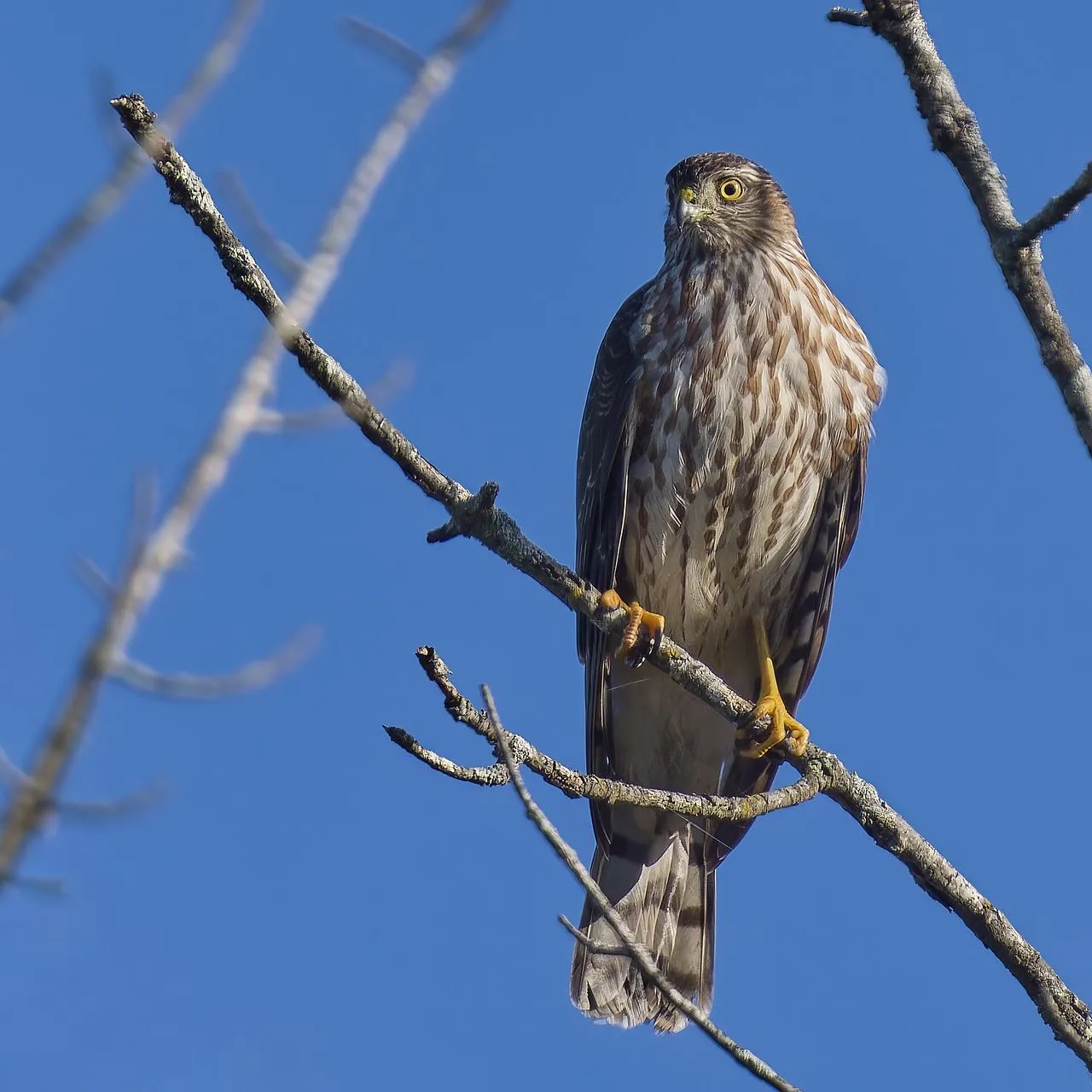
Accipiter striatus Vieillot, 1808, the Sharp-shinned Hawk, is the smallest widespread North American accipiter, with males sometimes weighing little more than 85 grams and hunting birds nearly their own mass.
Part of the Complete Raptors Guide.
Identification
| Character | Sharp-shinned Hawk (A. striatus) | Cooper's Hawk (A. cooperii) |
|---|---|---|
| Size impression | Robin- to jay-sized; males can be very small | Crow-sized; females substantially larger |
| Head | Small, rounded, little projection | Larger head, thicker neck |
| Tail tip | Squared or slightly notched | Usually rounded |
| Flight | Quick, fluttering flap-glide | Slower, more deliberate flap-flap-glide |
Visual
Sharp-shinned Hawk is compact, short-winged, long-tailed, and built for acceleration inside cover. In flight it often looks like a small body pulled forward by fast wings, with a head that barely projects beyond the wrists. Adults are slate-grey above and barred rufous below. Juveniles are brown above and vertically streaked below. The legs are thin, giving the species its common name, though this character is rarely useful except at close range on perched birds.
The field problem is Cooper's Hawk. Sharp-shinned is smaller on average, but size alone fails when a large female Sharp-shinned is compared with a small male Cooper's. Structural characters matter more. Sharp-shinned has a smaller head, less projecting neck, squarer tail tip, and quicker, more fluttering wingbeat. In glide, the wrists can appear pushed forward but the whole bird remains compact. A perched Sharp-shinned often looks small-headed and barrel-chested, with the eye set centrally in the head rather than forward beneath a pronounced cap.
At migration watchpoints, the species can pass high and fast. The flight rhythm is the classic accipiter pattern but sharper: several quick beats followed by a short glide. When kettling or rising in lift, it may look briefly buteo-like, but the long tail and small head resolve the problem.
Audio
Sharp-shinned Hawks are largely silent away from breeding territories. At the nest they give high, rapid ki-ki-ki calls, thinner than Cooper's Hawk. Vocal evidence is seldom available for routine field identification outside the breeding season.
Distribution
The species breeds across boreal and montane forests of North America, extending south through higher elevations in the western United States, the Appalachians, Mexico, Central America, and parts of South America in closely related forms sometimes treated within a complex. Northern birds are migratory. Autumn movements are conspicuous at ridgeline hawkwatches from September through November, where Sharp-shinned Hawks may constitute a large fraction of daily accipiter counts.
Winter distribution shifts southward but remains broad across the United States. Birds appear in suburbs and gardens, especially where feeder birds are abundant. In much of the eastern United States, winter Sharp-shinned records are strongly associated with residential bird concentrations, though the species remains less urban-tolerant than Cooper's Hawk in many regions.
Habitat
Breeding habitat is usually dense coniferous or mixed woodland, including spruce-fir, young second-growth, and montane forest. The nest is concealed within cover rather than exposed near open edges. During migration and winter, the species uses woodland edge, hedgerows, orchards, shelterbelts, and suburban plantings. It is less tied to extensive mature forest outside the breeding season than its nesting habits suggest.
The essential habitat feature is close-interval cover. Sharp-shinned Hawks are not open-country pursuit specialists. They require the ability to approach unseen, explode through a gap, and force a flock into disorganised flight. A garden with dense shrubs, feeders, and adjacent trees can supply that geometry as effectively as a woodland edge.
Diet and Hunting
Small birds dominate the diet. Typical prey includes sparrows, warblers, finches, chickadees, titmice, kinglets, and small thrushes. Females, being larger, take somewhat larger birds, including robins and doves on occasion. Insects, bats, and small mammals appear in the diet but are secondary.
The attack is a short ambush, not a long chase. A Sharp-shinned Hawk uses cover to approach within striking distance, then accelerates into the flock. The long tail permits abrupt course corrections around branches; the short wings reduce the risk of collision in tight spaces and produce rapid acceleration over a few metres. Captured prey is usually plucked before consumption, often on a concealed perch. At feeders, the hawk may make repeated passes over several days if prey remains predictable.
In migration, Sharp-shinned Hawks hunt opportunistically but travel efficiently along ridges and coastlines. They are among the raptors most strongly affected by wind direction at watchpoints because their small size makes headwinds costly and tailwinds productive. A cold front with northwest winds in the eastern United States can move large numbers along Appalachian ridges within hours.
Breeding Biology
The nest is a stick platform placed in dense trees, usually well concealed against the trunk or in a crotch. Clutch size is commonly four to five eggs. The female performs most incubation while the male hunts. Nestlings are fed plucked prey delivered to the nest, and fledglings remain near the nesting area after leaving the platform.
Because nests are inconspicuous and often in dense forest, breeding Sharp-shinned Hawks are under-detected compared with open-nesting buteos. Local abundance is therefore difficult to assess from casual observation. Migration counts provide useful trend information but mix birds from broad breeding origins, which complicates interpretation.
Notes
The Cooper's versus Sharp-shinned problem is not a beginner's embarrassment; it is an intrinsically difficult field problem. The most reliable identifications are built from multiple characters observed together: head projection, tail shape, wingbeat tempo, apparent size, and behaviour. A single tail-tip impression on a distant bird should not carry the weight of a confident record.
See Also
- Cooper's Hawk
- American Kestrel
- Merlin
- Barn Owl
- The Complete Raptors Guide
- Why Is a Hawk at My Bird Feeder?: the symptom-angle reader guide; covers Sharp-shinned vs Cooper's ID and the legal framework.
- Cooper's Hawk vs Sharp-shinned Hawk: the accipiter side-by-side; head, tail, and wingbeat as the diagnostic triad.
- Northern Goshawk: the third accipiter, much larger than both Cooper's and Sharp-shinned; forest-interior breeding.
Frequently Asked Questions
How do I separate Sharp-shinned Hawk from Cooper's Hawk?
Sharp-shinned has a smaller head, less projecting neck, squarer tail tip, and quicker more fluttering wingbeat. Cooper's has a larger head, thicker neck, more deliberate wingbeat, and a rounded tail tip. Size alone is unreliable because a large female Sharp-shinned approaches a small male Cooper's. The most reliable identifications combine multiple characters: head projection, wingbeat tempo, tail shape, and behaviour observed together.
Why are Sharp-shinned Hawks at bird feeders?
Sharp-shinned Hawks are not attracted to seed. They exploit the vigilance failure created when many small birds feed at close quarters in a predictable location. A garden with dense shrubs, feeders, and adjacent trees provides the geometry an accipiter needs: approach cover, a gap to accelerate through, and a flock of birds that flush unpredictably. Repeated passes over several days indicate a hunting routine established around a predictable prey concentration.
How do I identify Sharp-shinned Hawk in flight?
The flight is classic accipiter: several quick wingbeats followed by a short glide, with a long tail and small head that barely projects beyond the wings. In glide the wrists can appear pushed forward but the whole bird remains compact and short-winged. At migration watchpoints the species can pass high and fast; the small size, long tail, and quick flight rhythm are the best characters. When kettling it may briefly look buteo-like.
What do Sharp-shinned Hawks eat?
Small birds dominate the diet: sparrows, warblers, finches, chickadees, titmice, kinglets, and small thrushes. Females, being larger, take somewhat larger birds including robins and doves on occasion. Insects, bats, and small mammals appear secondary. The attack is a short ambush from cover; the long tail permits abrupt course corrections around branches in tight spaces. Captured prey is usually plucked on a concealed perch.
Sources & References
- Cornell Lab of Ornithology. (2024). All About Birds: Sharp-shinned Hawk. birds.cornell.edu
- Sibley, D.A. (2014). The Sibley Guide to Birds (2nd ed.). Knopf.
- Palmer, R.S. (Ed.) (1988). Handbook of North American Birds, Vol. 5. Smithsonian.
- Ferguson-Lees, J. & Christie, D.A. (2001). Raptors of the World. Helm Identification Guides.