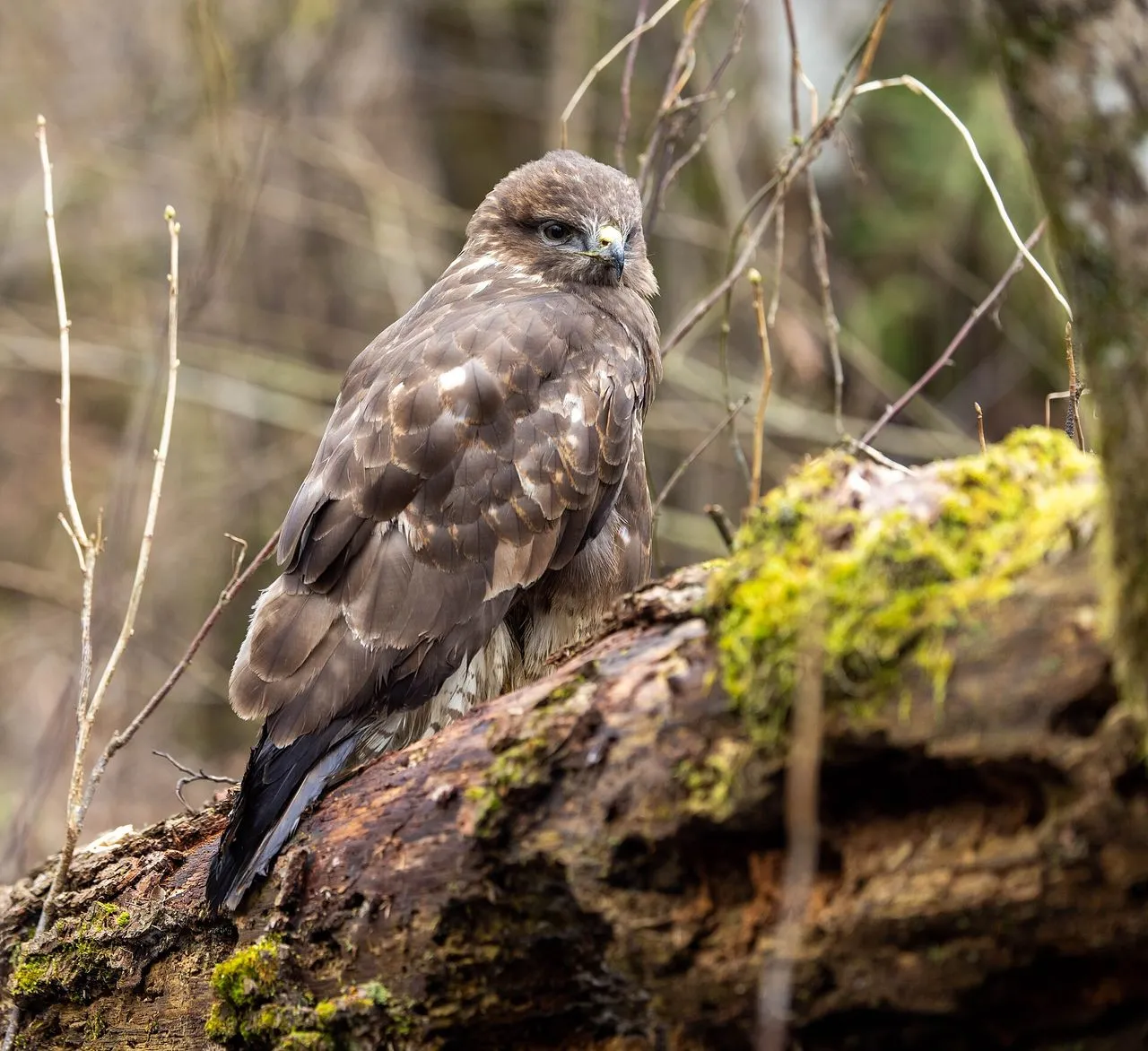
No single field mark is absolute. Cooper's typically shows a larger head projecting beyond the wrists, a thicker neck, a rounded tail tip with white terminal band, and a deliberate flap-flap-glide. Sharp-shinned shows a smaller head barely projecting, a squared or notched tail tip, and a quicker, more fluttering wingbeat. Size overlap is real: a large female Sharp-shinned can match a small male Cooper's. Combine head projection, tail shape, and cadence rather than relying on size or any single feature.
Accipiter cooperii versus Accipiter striatus is arguably the hardest routine raptor identification in North America. Both are accipiters: short rounded wings, long tail, and that characteristic flap-glide flight pattern. They share the same habitats, appear at the same feeders in the same seasons, and in the field can be separated only by differences that are real but consistently subtle. Unlike many identification problems that dissolve with a steady view in good light, the Cooper's versus Sharp-shinned problem remains genuinely difficult even for experienced birders who know exactly what to look for. Birders who know the Eurasian Sparrowhawk will recognise the same framework: the diagnostic challenge exists across the Atlantic with a different species pair and the same structural logic.
Part of the Complete Raptors Guide.
Quick answer: No single field mark reliably separates the two species. Cooper's Hawk typically shows a larger head projecting well beyond the wrists in flight, a thick neck, a rounded tail tip with a white terminal band, and a deliberate flap-flap-glide cadence. Sharp-shinned Hawk shows a small head that barely clears the wrists, a thinner neck, a squared or notched tail tip, and a quicker, more fluttering wingbeat. Use all three main characters together.
Best first step: Watch the wingbeat cadence before fixing on individual structural marks. A Cooper's Hawk flaps deliberately, with a measured rhythm and built-in glide phases. A Sharp-shinned flaps faster and more continuously, with a quicker, stiffer quality and shorter glide intervals. Cadence is readable at distances where tail shape and head projection are not yet resolved.
Avoid: Judging by size alone. A large female Sharp-shinned Hawk can approach a small male Cooper's in overall body length. Without a direct comparison bird in the same view, size impression misleads more often than it helps.
The Big Comparison Table
The characters below represent consistent tendencies across each species, not absolutes. No single row should carry the weight of a confident identification on its own.
| Character | Cooper's Hawk (A. cooperii) | Sharp-shinned Hawk (A. striatus) |
|---|---|---|
| Scientific name | Accipiter cooperii Bonaparte, 1828 | Accipiter striatus Vieillot, 1808 |
| Body length | 37-47 cm (14.6-18.5 in) | 24-34 cm (9.4-13.4 in) |
| Body mass, male | 280-330 g (9.9-11.6 oz) | 85-115 g (3.0-4.1 oz) |
| Body mass, female | 440-570 g (15.5-20.1 oz) | 150-220 g (5.3-7.8 oz) |
| Head size | Large, prominent | Small, rounded |
| Head projection in flight | Projects clearly beyond wrists; cross-like silhouette | Barely clears wrists; compact, rounded silhouette |
| Neck thickness | Thick; large-headed look on perched birds | Thin; small-headed look; eye appears centred in head |
| Tail tip (folded) | Rounded, with a narrow white terminal band | Squared or slightly notched |
| Tail bands | Broad dark bands across a long tail | Narrower bands; shorter tail overall |
| Wingbeat cadence | Deliberate flap-flap-glide; slower tempo | Quicker, more fluttering; shorter glide intervals |
| Hunting style | Short-range ambush; approaches low along cover | Short-range ambush; lighter build enables fast acceleration in tight spaces |
| Habitat | Woodland, suburban parks, gardens; highly urban-tolerant | Boreal and montane forest (breeding); woodland edge and gardens in winter |
| Feeder presence | Regular at suburban feeders across most of range | Present but less frequent; less urban-tolerant than Cooper's |
| Juvenile streak pattern | Vertical brown streaks below; breast markings broader, often blotchy or diffuse | Vertical brown streaks below; markings typically narrower and crisper |
Why Size Fails
Accipiters show reversed sexual dimorphism: females are substantially larger than males. In Cooper's Hawk, a large female may weigh over 570 grams while a small male can weigh less than 300. In Sharp-shinned Hawk, females reach 150-220 grams against males as light as 85 grams.
The overlap zone sits between a large female Sharp-shinned and a small male Cooper's. These two birds occupy adjacent mass ranges. A large female Sharp-shinned at 200-220 grams and a small male Cooper's at 280-310 grams are genuinely close in total body size, and without a direct comparison bird in the same view the gap may not be readable in the field at all.
Size impression is also affected by factors that have nothing to do with the bird itself. A perched bird that is fluffed in cold weather looks larger than the same bird in alert posture. Distance compresses perceived size. An observer who expects a small species will unconsciously underestimate; one expecting a large species will overestimate. These perceptual pressures operate even in careful, experienced observers.
The practical response is to set size aside as soon as it becomes ambiguous and work the structural marks instead. If the hawk is visiting a feeder repeatedly, see predator-proofing your feeders for guidance on managing repeat accipiter visits, which often provide extended observation time that a single alarm-flush encounter does not.
The Three Reliable Marks Together
No single mark is sufficient. The diagnostic framework rests on three characters that should be assessed simultaneously rather than in sequence.
Head projection. In flight, watch how far the head extends beyond the wrists. Cooper's Hawk projects its head clearly forward of the wing bend, producing a cross-shaped or flying-cross silhouette. The wings appear to attach behind a distinct neck, and the overall impression is of a bird with a head in front of rather than between its wings. Sharp-shinned Hawk barely clears the wrists; the wings appear to attach almost at the head, giving the whole bird a compact, rounded front end. On a perched Cooper's, the large head and thick neck create a noticeably bullish impression. A perched Sharp-shinned looks small-headed and almost barrel-chested by comparison, with the eye set centrally in the head rather than beneath a pronounced dark cap.
Tail tip. Cooper's Hawk typically shows a rounded tail tip with a narrow white terminal band. Sharp-shinned typically shows a squared or slightly notched tip. Both characters vary with wear and moult: a bird replacing outer tail feathers may show an apparently squared or rounded tip that does not reflect its true species-typical shape. Tail tip is useful supporting evidence, particularly on a well-seen, recently moulted bird, but it should not be the primary deciding mark. When the tail is fully spread in a soaring or braking bird, the rounded versus square distinction becomes more apparent than on a loosely folded tail.
Wingbeat cadence. This is often the most immediately readable character at a feeder or in open flight. Cooper's flaps with a deliberate, measured rhythm: several beats, a glide, several beats, with each stroke appearing unhurried. Sharp-shinned flaps more continuously, with a quicker, stiffer quality and shorter time between flap series, producing an impression of more effort for less distance. This is an accumulated impression from watching the whole bird move, not a counted beats-per-second measurement. At migration watchpoints, cadence often produces a working identification before the bird is close enough for structural detail to be assessed.
When all three characters point the same way, the identification is solid. When they conflict, record which characters were seen and under what conditions, and treat the bird as unidentified rather than forcing a conclusion on partial evidence.
Juvenile Considerations
Both species in their first year are brown above and show vertical brown streaking on pale underparts. This is the opposite of the adult's horizontal rufous barring and means the juvenile field problem lacks the adult's strongest plumage cue.
Juvenile Cooper's Hawk tends to have broader, more diffuse streaking on the breast, with marks that are sometimes blotchy or drop-shaped rather than clean vertical lines. A pale eyebrow stripe is usually present above the eye, relatively clean and distinct against the brown head. On many juvenile Cooper's this pale supercilium creates a crisply patterned facial impression.
Juvenile Sharp-shinned Hawk typically shows narrower, crisper streaking on the underparts. The face is plainer, with the eye set more centrally and the overall facial impression blander and less patterned than juvenile Cooper's. Some individuals show a faint supercilium, but it rarely has the clean definition seen on juvenile Cooper's.
Neither juvenile plumage pattern is absolute. Individual variation overlaps, and feather wear through the autumn and winter softens markings on both species. The structural framework applies as fully to juveniles as to adults: head projection, tail shape, and wingbeat cadence remain the primary diagnostic tool. Plumage in juveniles supports the identification rather than drives it.
A Note on Northern Goshawk
North America has three accipiters, and any accipiter identification should at minimum rule out the third. Northern Goshawk (Accipiter gentilis) is substantially larger: a female Northern Goshawk can weigh over 1,100 grams, more than double a large female Cooper's. In flight, Goshawk shows broader, more tapered wings, a proportionally shorter tail, and a powerful rowing wingbeat with deeper strokes than either smaller accipiter. Adults are grey above with finely barred pale underparts and a bold white eyebrow stripe. Juveniles are brown above and heavily marked below with irregular triangular streaking rather than the cleaner vertical lines of juvenile Cooper's or Sharp-shinned.
At a garden feeder, Goshawk is uncommon and the size difference from Cooper's is usually immediately apparent. In boreal habitat during breeding season, a large accipiter flushing from a dense nest tree is more likely a Goshawk than a Cooper's, particularly in northern Canada. A small, pointed-winged falcon at the same feeder is more likely a Merlin, which is often mistaken for a small accipiter but has structurally different, pointed falcon wings with a very different flight action. The full three-accipiter framework, including range maps and flight silhouettes, is covered in the Complete Raptors Guide.
See Also
- Cooper's Hawk: full species account covering feeder predation, hunting method, and the complete accipiter silhouette.
- Sharp-shinned Hawk: full species account covering migration watchpoint identification, boreal breeding biology, and winter feeder behaviour.
- Eurasian Sparrowhawk: the Old World ecological equivalent; a useful comparison for understanding what the accipiter body plan is optimised for.
- Merlin: another small, fast raptor that can appear at feeders; structurally very different, with pointed falcon wings and a direct, powerful flight.
- The Complete Raptors Guide: full reference for all raptor species on this site, including buteos, falcons, and owls.
- Predator-proofing Your Feeders: practical steps for reducing accipiter predation at garden feeders without removing them.
Frequently Asked Questions
What is the single most reliable field mark?
Head projection in flight is the most consistent single character. Cooper's Hawk projects its head well beyond the wrists, producing a cross-like silhouette; Sharp-shinned barely clears the wrists, keeping the bird compact. No single mark is truly sufficient on its own. A complete identification combines head projection, tail tip shape, and wingbeat cadence; any one of them alone leaves real room for error.
Why is size unreliable?
Both species show reversed sexual dimorphism, with females substantially larger than males. A large female Sharp-shinned Hawk can reach 150-220 grams, approaching a small male Cooper's Hawk at around 280 grams. Without a direct comparison bird in the same view, size impression in the field is unreliable: posture, distance, and perceptual anchoring all affect how large a hawk appears.
Which is more likely at my feeder?
In most suburban gardens, Cooper's Hawk is more likely year-round. It has adapted well to urban and suburban environments and actively exploits feeder-bird concentrations. Sharp-shinned Hawk does appear at winter feeders but tends to be less urban-tolerant in most of its range. If the hawk visits the same garden repeatedly over many weeks, Cooper's is the stronger candidate.
Can plumage alone separate them?
Rarely with confidence. Adults of both species are blue-grey above and barred rufous below. Adult Cooper's tends to show a dark cap contrasting more strongly with a paler nape; Sharp-shinned shows a less contrasting, more uniformly coloured head. Juvenile Cooper's often has a cleaner pale eyebrow stripe. These plumage differences are subtle and are affected by light angle and feather wear. Structural characters are more reliable than plumage for routine identification.