Buteo swainsoni Bonaparte, 1838, the Swainson's Hawk, is a long-winged grassland buteo that migrates from western North American breeding grounds to the Argentine Pampas, a round trip exceeding 20,000 kilometres for many birds.
Part of the Complete Raptors Guide.
Identification
| Character | Swainson's Hawk (B. swainsoni) | Red-tailed Hawk (B. jamaicensis) | Broad-winged Hawk (B. platypterus) |
|---|---|---|---|
| Structure | Slim, long-winged buteo | Heavy-chested, broad-winged buteo | Compact, short-tailed buteo |
| Adult underparts | Dark breast bib, pale belly in light morph | Belly band on many light morphs | Barred underparts |
| Underwing | Pale linings, dark flight feathers | Patagial marks; variable morphs | Broad pale and dark bands, compact outline |
| Migration | Long-distance to South America, often flocking | Shorter-distance or resident | Dense autumn kettles to Neotropics |
Visual
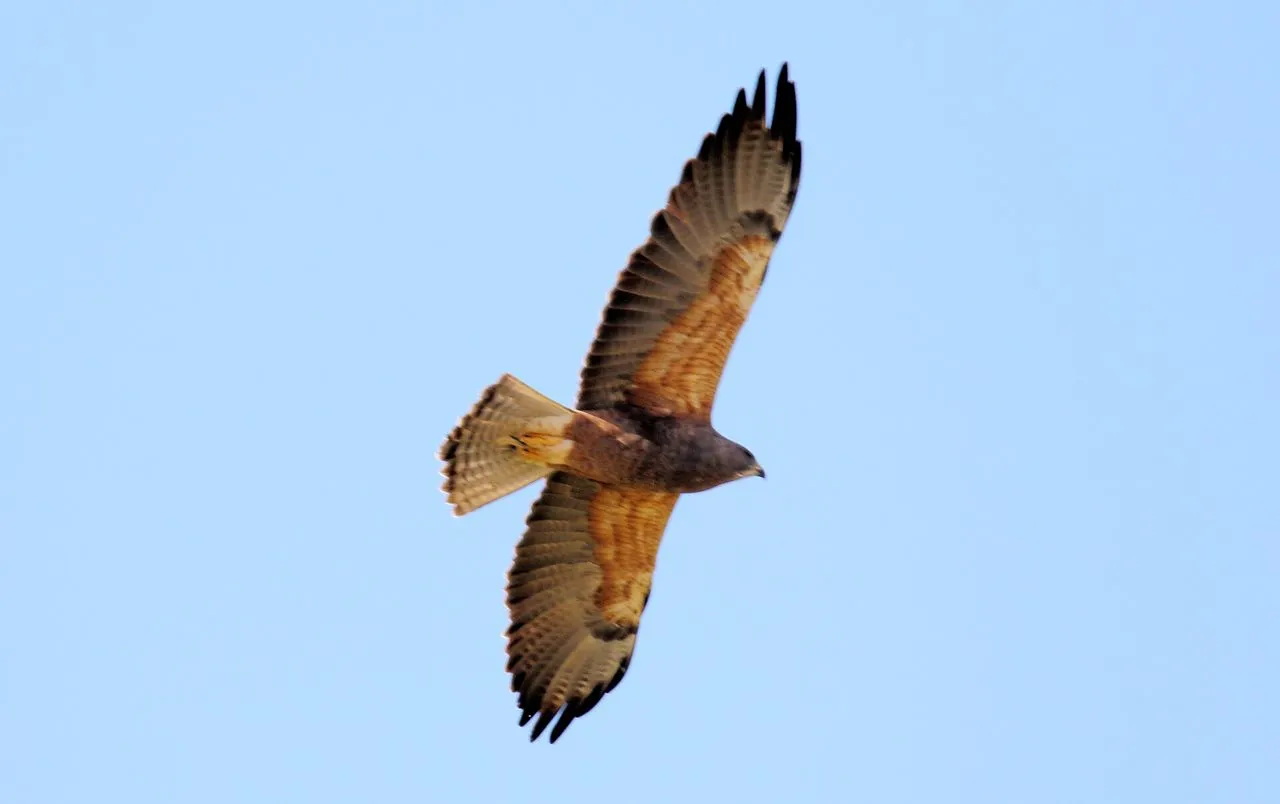
Swainson's Hawk is slimmer and longer-winged than Red-tailed Hawk, with pointed-looking wingtips and a relatively small bill. The classic light morph adult shows a dark brown breast bib contrasting with pale belly and underwings. The underwing pattern is important: pale wing linings contrast with dark flight feathers, the reverse emphasis of many other buteos. Dark morphs are chocolate-brown overall and can be difficult, but the long narrow wings and buoyant flight remain useful.
Juveniles are variable, often pale below with streaking and a less distinct bib. In flight, the species often holds the wings in a slight dihedral and rocks more than Red-tailed Hawk. It soars readily but also spends time walking on the ground after insects, a behaviour that surprises observers expecting all buteos to hunt from perches.
Audio
Swainson's Hawks call around nests with a thin, descending scream, weaker than the Red-tailed Hawk's rasping cry. Away from breeding territories they are often silent, particularly during migration kettles.
Distribution
The breeding range covers western North America: prairie Canada, the Great Plains, intermountain basins, agricultural valleys, and open ranchland from the Dakotas and Canadian Prairies west to the interior Pacific states and south into the Southwest. Nearly the entire population migrates to South America, with major wintering concentrations in Argentina, Uruguay, Paraguay, and southern Brazil.
This migration is narrow compared with the breadth of the breeding range. Birds from widely separated nesting areas converge through Mexico and Central America, then continue south along routes that minimise water crossings and maximise thermal availability. The result is a species that can be locally common in breeding season, nearly absent in winter, and briefly abundant in migration corridors.
Migration is highly gregarious. Large flocks move through Central America and northern South America, often with Turkey Vultures and Broad-winged Hawks. The species is therefore both a local breeding bird of open western landscapes and a hemispheric migrant dependent on conditions across two continents.
Habitat
Breeding habitat is open country with scattered nest sites: native prairie, sagebrush steppe, pasture, alfalfa, wheat, hayfields, and ranchland with trees, shelterbelts, riparian strips, or utility structures. Complete treelessness limits nesting unless artificial structures are available. Dense forest is unsuitable.
Modern agricultural landscapes can be productive where prey remains abundant and pesticide exposure is low. Irrigated fields may concentrate grasshoppers and small mammals; ploughing and hay cutting can expose prey. But the same agricultural dependence creates vulnerability to chemical use and rapid land-use change.
Tree availability is often the limiting breeding feature in otherwise suitable grassland. Isolated cottonwoods, shelterbelts, farm groves, and riparian strips can determine where pairs settle. Removal of those structures simplifies the landscape into hunting habitat without nest sites.
Fire and grazing history also shape suitability. Short vegetation can improve prey visibility, while complete conversion to intensive row crop reduces both nesting options and vertebrate prey. The best territories are often working landscapes that retain rough margins, burrowing mammal colonies, and a few durable nest trees.
Diet and Hunting
Swainson's Hawk has a seasonal diet split. During breeding it takes vertebrates for nestlings: ground squirrels, voles, mice, young rabbits, snakes, lizards, and birds. During migration and winter it becomes heavily insectivorous, feeding on grasshoppers, crickets, dragonflies, and other large insects. Flocks may follow tractors, fires, or insect outbreaks, walking and hopping on the ground to seize prey.
The species is therefore a raptor whose winter ecology can resemble that of an insectivorous flocking bird. Hundreds may spread across a field taking orthopterans, rising together when disturbed and settling again a short distance away. This behaviour is normal, not evidence of starvation or abnormal tameness.
This insect dependence is unusual for a large buteo and central to its conservation history. A bird that winters by feeding in agricultural insect concentrations is exposed directly to insecticide regimes. It also benefits from outbreaks that would be irrelevant to a strictly mammal-hunting hawk.
Breeding Biology
Nests are stick platforms in trees, shrubs, shelterbelts, riparian cottonwoods, or artificial structures. Clutch size is usually two or three eggs. Incubation lasts about a month, and young fledge after five to six weeks. Adults defend nests vigorously against corvids, mammals, and humans approaching too closely.
Breeding success tracks prey availability. In years with abundant ground squirrels or grasshoppers, pairs may raise multiple young; in poor years productivity drops. Because the species is migratory, adult survival during migration and winter may dominate population trends even when breeding habitat appears intact.
Notes
In the mid-1990s, tens of thousands of Swainson's Hawks died in Argentina after feeding on grasshoppers treated with organophosphate insecticides, especially monocrotophos. The mortality was not subtle: carcasses accumulated in fields. International pressure and restrictions on the chemical reduced the immediate crisis. The episode remains a model case for why migratory raptor conservation cannot stop at the breeding range boundary.
It also shows why diet matters to regulation. A pesticide applied to insects became a raptor mortality event because this buteo's non-breeding diet is insect-heavy. Risk assessment that treats all hawks as mammal predators would miss the pathway entirely.
See Also
Frequently Asked Questions
How do I identify a Swainson's Hawk in flight?
Swainson's Hawk is slimmer and longer-winged than Red-tailed Hawk, with pointed wingtips and a relatively small bill. The classic light morph adult shows a dark brown breast bib contrasting with pale belly and underwings. The underwing pattern is distinctive: pale wing linings contrast with dark flight feathers, the reverse of many buteos. Dark morphs are chocolate-brown overall. Wings are often held in a slight dihedral and the bird rocks more than Red-tailed Hawk.
What makes Swainson's Hawk migration unusual?
Nearly the entire population migrates to South America, with wintering concentrations in Argentina, Uruguay, Paraguay, and southern Brazil. The migration is highly gregarious, with large flocks moving through Central America often with Turkey Vultures and Broad-winged Hawks. In the mid-1990s, tens of thousands died in Argentina after feeding on grasshoppers treated with organophosphate insecticides, demonstrating that the species' insect winter diet creates direct exposure to agricultural chemicals.
How does the Swainson's Hawk diet shift seasonally?
During breeding the diet includes vertebrates for nestlings: ground squirrels, voles, mice, young rabbits, snakes, lizards, and birds. During migration and winter the species becomes heavily insectivorous, feeding on grasshoppers, crickets, dragonflies, and other large orthopterans. Hundreds of birds may walk and hop across fields taking orthopterans, rising when disturbed and settling nearby. This insect-heavy non-breeding diet is unusual for a large buteo.
What conservation lessons does Swainson's Hawk teach?
The 1990s mortality event in Argentina showed why diet matters to pesticide regulation. A chemical applied to crops became a raptor mortality event because this buteo winters by feeding in agricultural insect concentrations. Risk assessment that treats all hawks as mammal predators would miss this exposure pathway entirely. Migratory raptor conservation also cannot stop at the breeding range boundary, conditions on wintering grounds directly affect population health.
Sources & References
- Cornell Lab of Ornithology. (2024). All About Birds: Swainson's Hawk. birds.cornell.edu
- Wheeler, B.K. (2003). Raptors of Western North America. Princeton University Press.
- Bildstein, K.L. (2006). Migrating Raptors of the World: Their Ecology and Conservation. Cornell University Press.
- Ferguson-Lees, J. & Christie, D.A. (2001). Raptors of the World. Helm Identification Guides.