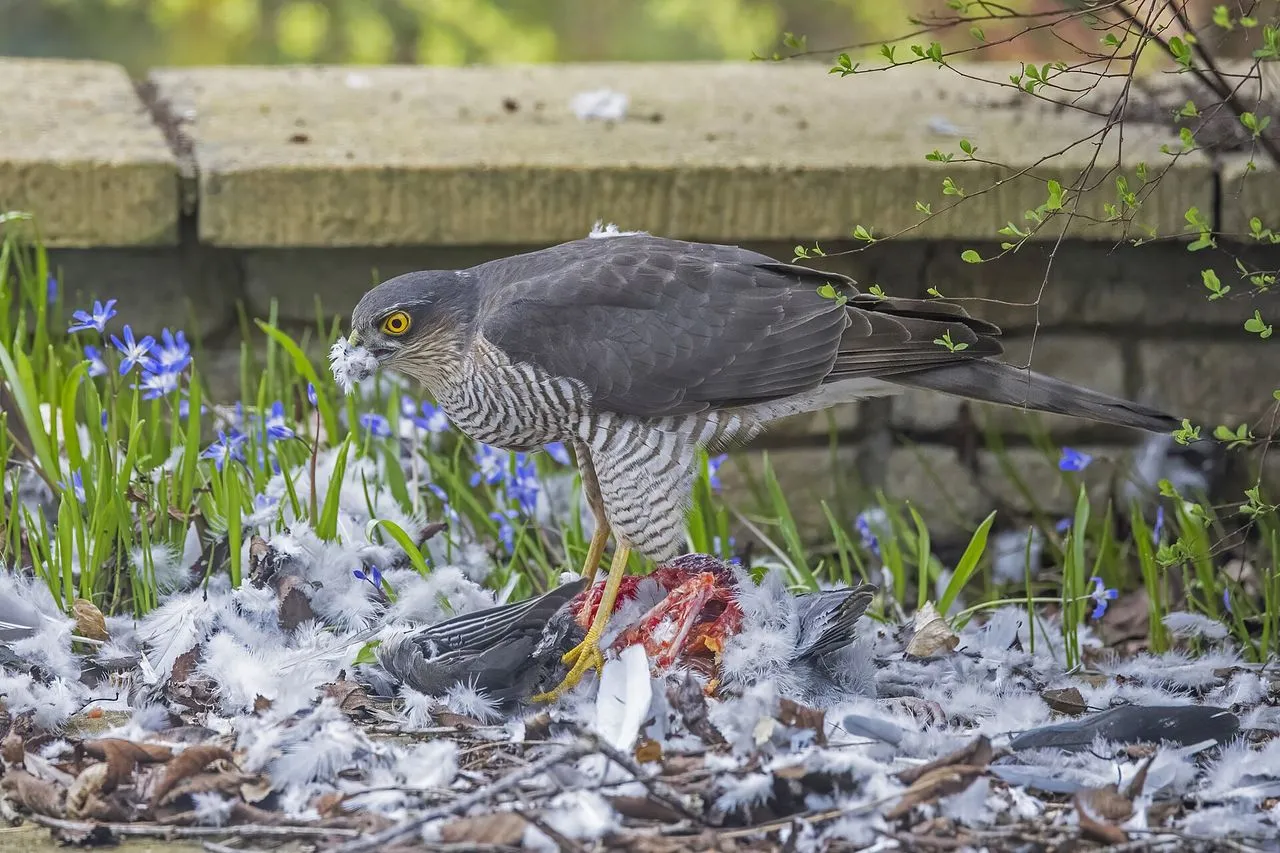
Accipiter nisus Linnaeus, 1758, the Eurasian Sparrowhawk, is a small woodland accipiter with extreme reversed size dimorphism: females may be nearly twice the mass of males and take substantially larger prey.
Part of the Complete Raptors Guide.
Identification
| Character | Eurasian Sparrowhawk (A. nisus) | Northern Goshawk (A. gentilis) |
|---|---|---|
| Build | Slim, narrow-hipped accipiter | Heavy-bodied, deep-chested accipiter |
| Size impression | Male thrush-like; female crow-sized | Much larger and more powerful |
| Wingbeat | Quick, light, rapid | Slower and stronger |
| Garden likelihood | Common predator at British feeders | Unlikely without strong supporting evidence |
Visual
Eurasian Sparrowhawk has the standard accipiter architecture: short rounded wings, long tail, and a flap-glide flight adapted to woodland pursuit. Adult males are blue-grey above with orange-rufous barring below and orange cheeks. Females are larger, brownish-grey above, and barred grey-brown below. Juveniles are browner and more coarsely marked.
In Britain and much of Europe, the main confusion is with Northern Goshawk, especially large female Sparrowhawks glimpsed briefly. Sparrowhawk is much smaller, slimmer, and more delicate, with narrower hips and quicker wingbeats. Goshawk is heavy-bodied, deep-chested, and slower-winged, with a more powerful presence even when distant. In gardens, the bird flashing through at hedge height after tits or finches is overwhelmingly likely to be Sparrowhawk.
Sex matters in field impression. A male can look barely larger than a thrush when accelerating through a garden; a female may appear crow-sized and capable of taking pigeons. Many reported "large hawks" at feeders are female Sparrowhawks rather than Goshawks.
Audio
Away from nests, Eurasian Sparrowhawks are usually silent. Around breeding sites they give rapid chattering calls, especially during food delivery and alarm. Garden visits in winter are typically silent and sudden.
Distribution
The species occurs across Europe and much of temperate and boreal Asia, extending into North Africa and wintering farther south in parts of Africa and Asia. In Britain it is widespread and familiar after recovering from twentieth-century pesticide declines. Northern and eastern populations are migratory; many western European and British birds are resident or partially migratory.
Continental migration is visible at watchpoints around the Baltic, North Sea, and Mediterranean bottlenecks, where birds moving from Scandinavia and eastern Europe are channelled by coastlines and water crossings. British garden observations therefore represent only one expression of a much broader Eurasian species.
The Sparrowhawk's return to British gardens after organochlorine restrictions is one of the more visible raptor recoveries. It is now a routine predator of suburban bird assemblages, though still unevenly distributed according to woodland cover and prey abundance.
Habitat
Breeding habitat is woodland, including conifer plantations, mixed woods, shelterbelts, and mature scrub. The nest is usually concealed in trees, often in younger dense stands rather than open old woodland. Foraging habitat extends into hedgerows, parks, orchards, villages, and gardens. The species requires approach cover and prey density, not remote forest.
British garden feeding has created dense winter concentrations of Blue Tits, Great Tits, House Sparrows, finches, and Starlings. Sparrowhawks exploit those concentrations by using fences, sheds, hedges, and shrubs as approach screens. The bird is part of the garden food web, not an intruder into it.
Diet and Hunting
Small birds dominate the diet. Male Sparrowhawks take tits, finches, sparrows, warblers, and other small passerines. Females take larger prey, including Blackbirds, Starlings, thrushes, Collared Doves, and pigeons. Mammals are rare in comparison. The sex difference in prey size is strong enough that male and female hunting niches overlap only partly.
Prey remains reflect this split. A plucking of small contour feathers from a Blue Tit-sized bird may indicate a male's kill, while a Woodpigeon or Collared Dove carcass is within the capacity of a female. Exact assignment is unsafe without seeing the hawk, but the size dimorphism is large enough to shape what each sex can profitably attack.
The attack is a close-range ambush. The hawk flies low along a hedge, wall, ditch, or row of shrubs, then bursts into a flock at high speed. If the initial strike fails, pursuit may continue briefly through branches or around buildings, but extended open chases are inefficient. Captured birds are plucked on a perch or on the ground. Plucking sites with small feathers under cover are often the only evidence of regular hunting.
Breeding Biology
Pairs build a stick nest in trees, often selecting conifers or dense young woodland. Clutch size is commonly four or five eggs. The female incubates while the male supplies prey. Because the female is much larger, the male's provisioning performance is critical early in the season; food shortage can reduce laying or chick survival.
Young fledge after about four to five weeks and remain dependent nearby. Breeding success varies with prey abundance, weather, and adult experience. Sparrowhawks are sensitive to persistent disturbance near the nest but can breed close to human activity when the nest itself is concealed.
Notes
Garden Sparrowhawk predation is often blamed for songbird declines, but the evidence does not support a simple causal claim at national scale. Sparrowhawks remove individual birds, visibly and sometimes dramatically. Broad declines in British farmland and woodland birds are more strongly tied to habitat change, food availability, agricultural intensification, disease, and climate effects. Predation is real; it is not automatically the population driver.
The emotional asymmetry is understandable: a Sparrowhawk kill is immediate and visible, while invertebrate decline or winter seed shortage is diffuse. Field interpretation has to resist that bias. The event in front of the kitchen window is evidence of predation; it is not, by itself, evidence of population regulation.
See Also
Frequently Asked Questions
How do I identify an Eurasian Sparrowhawk in a garden?
In a British garden the bird flashing through at hedge height after small passerines is overwhelmingly likely to be Sparrowhawk. Adult males show blue-grey upperparts and orange-rufous barring below. Females are crow-sized and can take pigeons. The accipiter structure, short rounded wings, long tail, quick wingbeats, is more reliable than any single plumage mark.
How do I separate Eurasian Sparrowhawk from Northern Goshawk?
Sparrowhawk is much smaller, slimmer, and more delicate, with narrower hips and quicker wingbeats. Goshawk is heavy-bodied, deep-chested, and slower-winged, with a more powerful presence even at distance. A reported 'large hawk' at a garden feeder is usually a female Sparrowhawk rather than a Goshawk; the size difference is substantial enough to make confusion unlikely with good views.
Do Sparrowhawks cause garden bird declines?
Predation by Sparrowhawks is real but not automatically the population driver of broad songbird declines. Farmland and woodland bird declines are more strongly tied to habitat change, food availability, agricultural intensification, and climate effects. The emotional visibility of a hawk kill at a feeder does not, by itself, constitute evidence of population regulation by the predator.
What do Eurasian Sparrowhawks eat?
Small birds dominate. Male Sparrowhawks take Blue Tits, Great Tits, finches, sparrows, and warblers. Females take larger prey including Blackbirds, Starlings, thrushes, Collared Doves, and pigeons. The sex difference in prey size is strong enough that male and female hunting niches overlap only partly. Plucking remains with small feathers indicate male kills; pigeon-sized carcasses are within a female's capacity.
Sources & References
- Cramp, S. & Simmons, K.E.M. (Eds.) (1980). The Birds of the Western Palearctic, Vol. 2. Oxford University Press.
- Ferguson-Lees, J. & Christie, D.A. (2001). Raptors of the World. Helm Identification Guides.
- Snow, D. & Perrins, C.M. (1998). The Birds of the Western Palearctic: Concise Edition. Oxford University Press.
- Ehrlich, P.R., Dobkin, D.S. & Wheye, D. (1988). The Birders Handbook. Simon & Schuster.