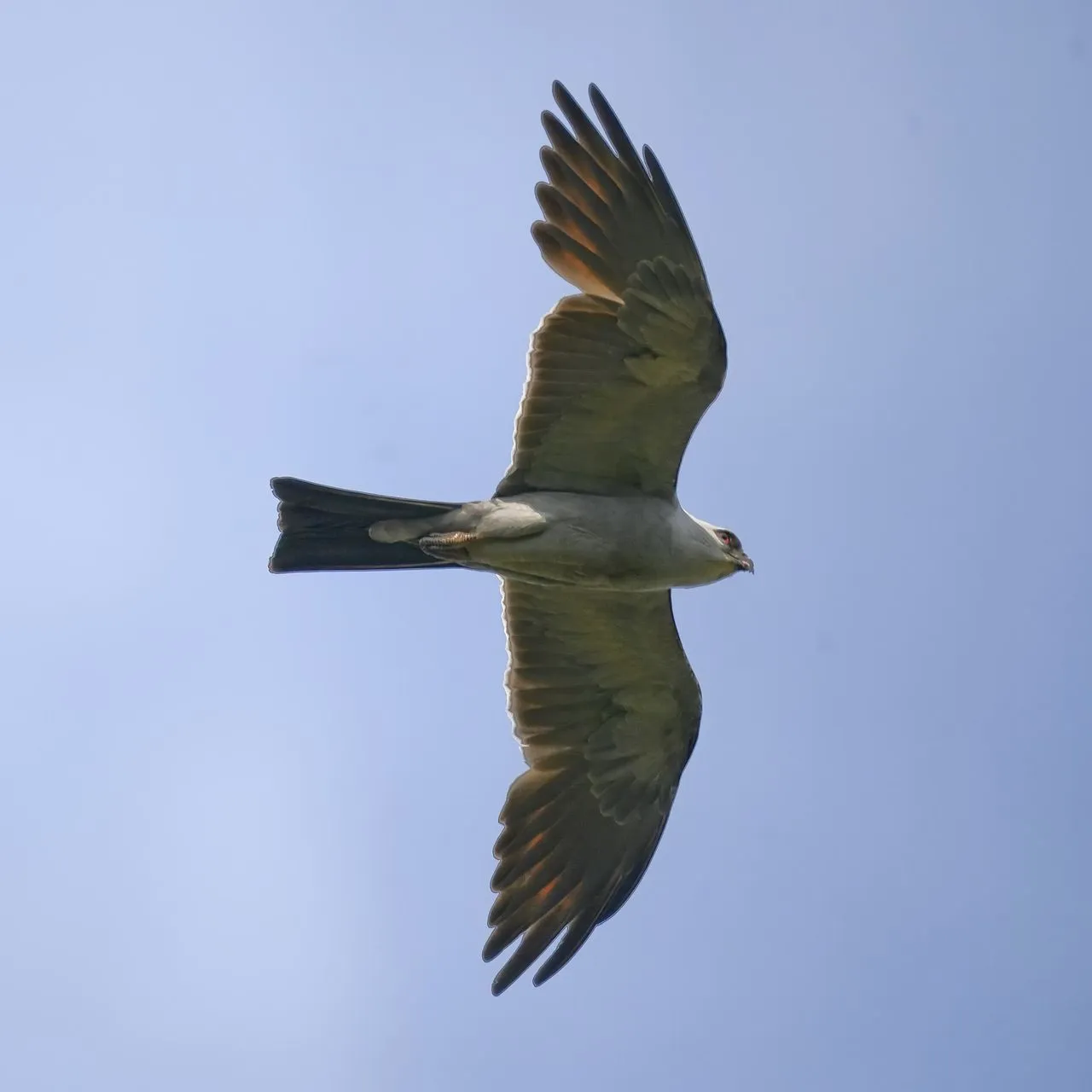
Northern Goshawk (Accipiter gentilis) is the largest of the three North American accipiters, 49-66 cm long with a wingspan of 89-127 cm. Adults are blue-grey above with finely barred grey underparts and a prominent white supercilium contrasting with a dark crown and cheek. Juveniles are brown and streaked. The species breeds in mature coniferous and mixed forest interior across boreal North America and Eurasia. Recent taxonomic work has split the American populations as Accipiter atricapillus (American Goshawk).
Accipiter gentilis Linnaeus, 1758, the Northern Goshawk, is the largest of the three North American accipiters and the only one regularly built to take grouse, hares, and squirrels as primary prey rather than occasional opportunism.
Part of the Complete Raptors Guide.
Identification
| Character | Northern Goshawk (A. gentilis) | Cooper's Hawk (A. cooperii) | Sharp-shinned Hawk (A. striatus) |
|---|---|---|---|
| Size impression | Large; females approach raven-sized | Crow-sized; females substantially larger than males | Robin- to jay-sized |
| Supercilium | Bold white, contrasts with dark crown and cheek | Absent or faint | Absent or faint |
| Adult underparts | Finely barred pale grey | Warm rufous barring | Rufous barring |
| Tail | Long, rounded to square, white undertail coverts | Long, rounded tip, narrow white terminal edge | Long, squared or slightly notched |
| Body mass | 600-1,300+ g | 280-600 g | 85-340 g |
Visual
The Northern Goshawk is substantially larger than a Cooper's Hawk, with a body mass more than double that of an average female Cooper's and a wingspan extending to 127 cm in large females. Adult birds are blue-grey above and covered below with fine grey barring that produces a pale, silvery appearance from a distance. The most reliable adult field mark is the bold white supercilium: a clean, long stripe above the eye that contrasts sharply with the dark crown and dark cheek patch, giving the bird an intense, helmeted expression. The eye is deep red to orange-red in fully mature adults. The undertail coverts are white and often fluffed, visible from below in flight.
Juveniles are brown above with pale feather fringes on the upperparts, and buff to cream below with coarse dark streaking. The supercilium is present in juveniles, typically wider and buffer than the adult's clean white stripe, and conspicuous enough to separate juvenile Goshawks from juvenile Sharp-shinned Hawks, which lack a comparable mark.
In flight, the Goshawk is longer-winged relative to body length than the smaller accipiters and carries more mass. It can soar more readily and may briefly suggest a small buteo on a thermal, but the flap-glide cadence and long tail resolve the ambiguity quickly. Size overlap with a large female Cooper's Hawk does not exist: even a small male Goshawk outweighs the largest female Cooper's by a wide margin.
Audio
The alarm call near the nest is loud, rapid, and persistent: a repeated kek-kek-kek or cak-cak-cak at close intervals, clearly louder and more forceful than the equivalent calls of Cooper's Hawk. A Goshawk defending a nest will call continuously while circling overhead and escalate to direct stooping passes toward an intruder. The intensity and persistence of the call indicate proximity to the nest: a single brief call is awareness; a sustained rapid series means the nest is very close.
Outside the breeding season, Northern Goshawks are largely silent. Forest interior habitat and secretive behaviour outside nesting make audio evidence uncommon in autumn and winter.
Distribution
The Northern Goshawk has a Holarctic distribution, breeding across northern and montane forests from western Alaska and Canada through the boreal zone, south along the Rocky Mountains, Sierra Nevada, and Cascade Range, and with scattered populations in the Appalachians and the Great Lakes forest region. In Eurasia the species breeds from the British Isles and Scandinavia east across Russia to the Pacific, with additional populations in Central Asia, China, and Japan.
In North America, core breeding populations are concentrated in the boreal forest and the major western mountain ranges. Eastern populations in the Appalachians and around the Great Lakes are patchier and more sensitive to forest disturbance, locally declining where large forest blocks have been reduced by harvesting or development.
Winter movements are driven by prey availability. When grouse and snowshoe hare populations crash in northern forests, Goshawks move south in irruptions that bring birds well into the central and southern United States, far below the normal winter range. These irruptions are irregular and tied to the cyclic population dynamics of key prey species rather than temperature or calendar date.
Habitat
The Northern Goshawk is one of the most forest-dependent raptors in North America. Breeding habitat is mature coniferous or mixed forest with large unfragmented blocks, a closed or semi-closed canopy, and enough open understory for approach flight below the canopy layer. Old-growth and late-successional forest are preferred: large trees provide the nest-tree diameter required, and undisturbed blocks provide the hunting range needed to support a breeding pair.
Unlike the Cooper's Hawk, which has adapted broadly to suburban and urban environments, the Northern Goshawk largely avoids edges and open habitats during breeding. Territory boundaries follow forest interior, and pairs in fragmented landscapes require substantially larger home ranges to compensate for reduced prey density and hunting efficiency in degraded habitat. Sensitivity to forest fragmentation makes the species a widely used management indicator in forest planning.
Outside the breeding season, Goshawks use a wider range of wooded habitats, including forest edge, large parks, and wooded river corridors. Even in winter the species rarely appears at suburban feeders: the prey profile (grouse, hares, squirrels) is simply absent from typical residential yards.
Diet and Hunting
The diet is dominated by medium-sized birds and mammals. Regular avian prey includes ruffed grouse, blue grouse, spruce grouse, gray jay, Steller's jay, various woodpeckers, and American crow. Mammalian prey includes red squirrel, northern flying squirrel, snowshoe hare, and various ground squirrels. The relative importance of birds versus mammals varies by region and season; in the boreal zone, snowshoe hare can be the dominant prey when populations are at a cyclical peak.
The hunting technique is essentially an enlarged version of the forest-pursuit approach used by its smaller relatives, but scaled to prey that can weigh 1 kg or more. The Goshawk uses forest cover for a concealed low approach, then commits to a direct high-speed pursuit through dense cover. The long tail provides directional correction through the canopy in the same way it functions in Cooper's Hawk, but the body mass and leg strength allow restraint of prey far larger than anything a Cooper's Hawk routinely handles. A Goshawk can pursue ruffed grouse through closed boreal canopy at full speed and carry the carcass to a plucking post.
This prey profile is why the Northern Goshawk is not a feeder visitor. Where the Peregrine Falcon hunts the open sky above cliffs and cities, and where Cooper's and Sharp-shinned Hawks exploit the prey concentrations created by garden feeders, the Goshawk hunts a prey community tied to mature forest interior at body sizes that make suburban environments irrelevant.
Breeding Biology
Nests are large stick platforms, substantially larger than those of Cooper's Hawk, placed high in the main fork or against the trunk of a large canopy tree. Pairs typically reuse the same nest or alternate between nearby nests within a territory across multiple years, adding material annually. Fresh green sprigs are often incorporated into the nest lining during the active breeding period.
Clutch size is commonly two to four eggs, with three being typical. Incubation is primarily by the female and lasts approximately five weeks. The male hunts and delivers prey to the female during incubation and the early nestling period. Chicks fledge at roughly five to six weeks but remain in the territory for several further weeks, provisioned by the adults as they develop flight and hunting skills.
Northern Goshawks are among the most aggressively territorial raptors in North American forests. Adults, particularly females, will stoop at and physically strike humans, dogs, bears, and other raptors entering the nest area during late incubation and the nestling period. Nest monitors conducting population surveys wear helmets as standard practice in many active territories. The attacks follow a clear escalation: sustained alarm calling, then aerial stooping, then contact strikes if the intruder does not withdraw.
Conservation and the American Goshawk Split
In 2023, the American Ornithological Society recognized North American Goshawk populations as a distinct species under the name American Goshawk (Accipiter atricapillus). The split was based on accumulated morphological and genetic evidence showing consistent differences from Eurasian populations in measurements, plumage details, and genomic data, at a level comparable to other recognized accipiter species pairs. Under this taxonomy, the name Northern Goshawk and the binomial Accipiter gentilis apply to Eurasian birds only. Field guides published before 2023 use the combined treatment, and older records in databases are typically listed under Accipiter gentilis regardless of provenance.
Conservation status in North America is primarily a function of forest management. The species is not globally threatened, but populations in the Appalachians and in fragmented eastern forest regions are locally declining where mature forest blocks are reduced by timber harvest or development. The species is included as a management indicator in several US national forest plans, where territory occupancy rates are used as a proxy for old-growth and late-successional forest quality. Broad stable populations in the boreal zone and western mountains mask localized pressures in the east.
See Also
- Cooper's Hawk: the medium-sized accipiter; structure, suburban adaptation, and feeder predation
- Sharp-shinned Hawk: the smallest North American accipiter; migration watchpoints and feeder visits
- Cooper's Hawk vs Sharp-shinned Hawk: the accipiter identification problem in detail; head, tail, and wingbeat as the diagnostic triad
- Eurasian Sparrowhawk: the Old World parallel to Sharp-shinned in woodland hunting ecology
- Peregrine Falcon: open-country and cliff-nesting raptor; contrast with goshawk's closed-forest niche
- The Complete Raptors Guide: silhouette, flight style, taxonomy, and how to read a raptor against the sky
Frequently Asked Questions
How big is a Northern Goshawk?
Body length runs 49-66 cm and wingspan 89-127 cm, with females substantially larger than males. Body mass ranges from roughly 600 g in small males to over 1,300 g in large females, well above the 280-600 g range of Cooper's Hawk. In the field the size difference from Cooper's is immediately apparent: even a small male Goshawk is longer-winged and heavier-bodied than the largest female Cooper's.
What does it eat?
The Northern Goshawk takes medium-sized birds and mammals. Regular avian prey includes ruffed grouse, spruce grouse, blue grouse, gray jay, Steller's jay, and American crow. Mammalian prey includes red squirrel, northern flying squirrel, snowshoe hare, and ground squirrels. The relative importance of birds versus mammals varies by region and season; in the boreal zone, snowshoe hare can dominate the diet when hare populations are at a cyclical peak.
Is it common at backyard feeders?
No. Unlike its smaller relatives, the Northern Goshawk is a forest interior specialist whose regular prey (grouse, hares, squirrels) is not available at suburban feeders. A bird approaching 1 kg in body mass has no use for a platform feeder. Occasional winter records near wooded suburban edges occur during irruption years, when prey crashes in the northern boreal zone push birds south, but a Goshawk at a garden feeder is genuinely unusual.
What is the American Goshawk split?
In 2023 the American Ornithological Society recognized North American Goshawk populations as a distinct species, Accipiter atricapillus (American Goshawk), separate from the Eurasian Accipiter gentilis. The split was supported by consistent morphological and genetic differences between the two populations. Under the new taxonomy, the name Northern Goshawk and the binomial Accipiter gentilis apply to Eurasian birds only. Field guides and checklists published before 2023 still use the combined treatment.