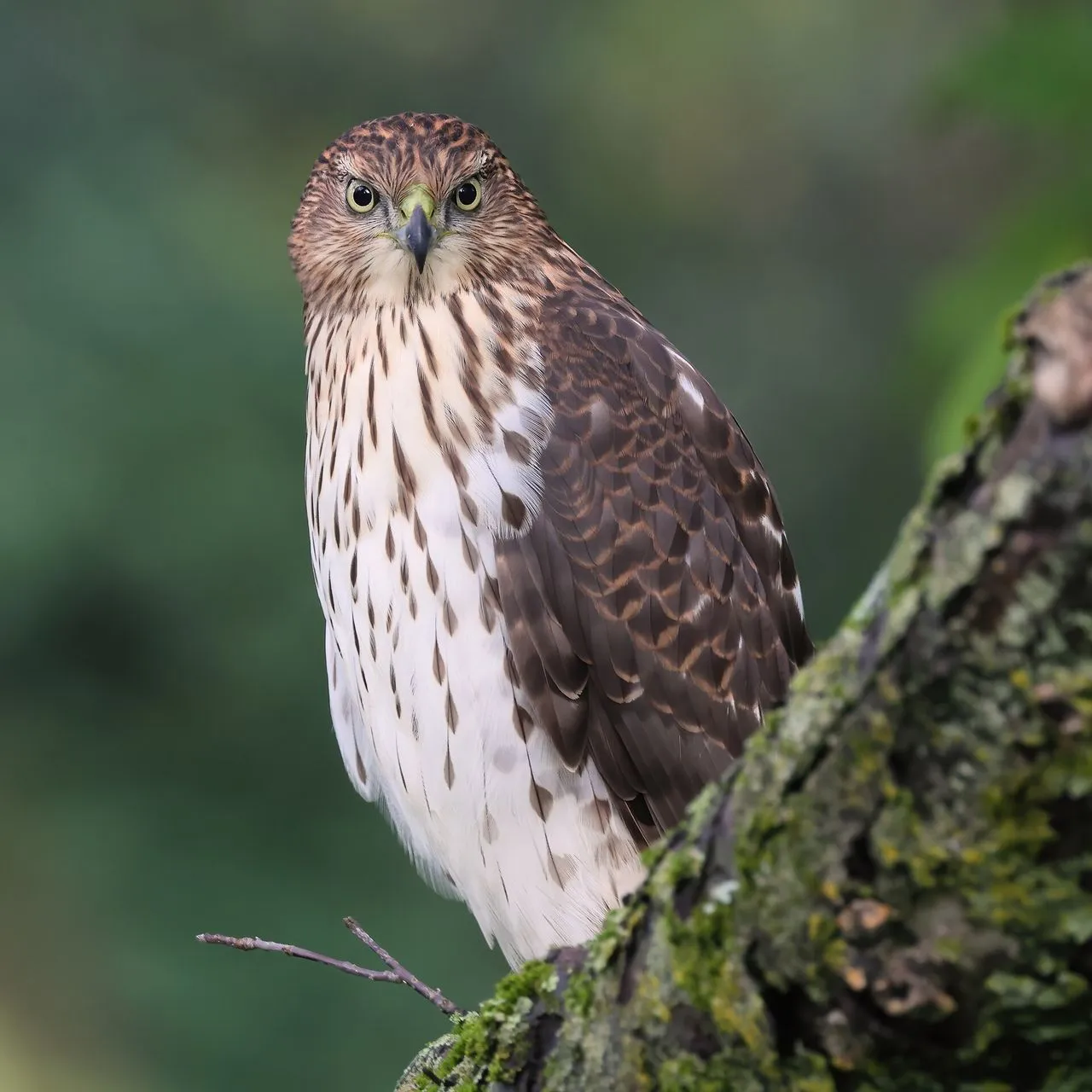
Accipiter cooperii Bonaparte, 1828, the Cooper's Hawk, is a medium-sized accipiter in which females commonly outweigh males by more than one-third, a degree of reversed size dimorphism that affects both prey choice and field impression.
Part of the Complete Raptors Guide.
Identification
| Character | Cooper's Hawk (A. cooperii) | Sharp-shinned Hawk (A. striatus) |
|---|---|---|
| Size impression | Crow-sized; females larger | Robin- to jay-sized; females approach small Cooper's |
| Head | Large, projects beyond wrists | Small, barely projects beyond wrists |
| Tail tip | Usually rounded with narrow white edge | Usually square or slightly notched |
| Flight | Deliberate flap-flap-glide | Quicker, more fluttering flap-glide |
Visual
Cooper's Hawk is the crow-sized North American accipiter: short rounded wings, long tail, small head projecting beyond the wrists in flight, and a repeated flap-flap-glide cadence when travelling. Adults are blue-grey above with warm rufous barring across the underparts and a dark cap that contrasts with a paler nape. The tail is long, usually rounded at the tip when folded, with broad dark bands and a narrow white terminal edge. Juveniles are brown above and streaked below, with vertical brown marks on a pale breast rather than the adult's horizontal rufous barring.
Separation from Sharp-shinned Hawk is never based on one character. Cooper's typically shows a larger head, thicker neck, and more deliberate wingbeat. In flight the leading edge of the wing often appears pushed forward, producing a cross-like shape rather than the compact flying mallet impression of Sharp-shinned. The tail tip is useful but not absolute: Cooper's tends to be rounded, Sharp-shinned squared or slightly notched. Tail spread, feather wear, and moult can erase the distinction.
Audio
Away from the nest, Cooper's Hawks are usually silent. Around breeding territories they give a harsh, repeated cak-cak-cak, often from within the canopy. Begging juveniles produce thin, persistent calls after fledging, which can reveal a breeding site before an adult is seen.
Distribution
The breeding range covers southern Canada, most of the United States, and much of Mexico. Northern populations migrate south in autumn; many urban and southern birds are resident. Since the late twentieth century, the species has increased conspicuously in suburbs and cities, reversing earlier declines associated with shooting and organochlorine pesticides. In winter it is now routine at garden feeding stations across much of the United States, particularly where House Sparrows, European Starlings, Mourning Doves, and feeder-associated finches are concentrated.
Habitat
Historically this was a woodland and woodland-edge hawk, nesting in mature deciduous, mixed, or coniferous stands with enough canopy cover for concealed approach flight. Modern Cooper's Hawks use suburban parks, cemeteries, wooded residential blocks, shelterbelts, riparian strips, and campuses. The key habitat elements are not wilderness but structure: trees for nesting and ambush routes, open gaps for pursuit, and reliable prey concentrations.
Backyard feeders alter local habitat by aggregating birds in predictable positions. A Cooper's Hawk does not hunt the feeder because seed is present; it hunts the vigilance failure created when many small birds feed at close quarters in the same place every day. Dense shrubs near feeders can protect songbirds, but they also provide approach cover for an accipiter. The same planting can be refuge and ambush corridor depending on angle and distance.
Diet and Hunting
Cooper's Hawks are bird specialists, though not bird exclusives. Common prey includes Mourning Dove, Rock Pigeon, European Starling, American Robin, Northern Cardinal, House Sparrow, Blue Jay, and medium-sized woodpeckers. Mammals such as Eastern Chipmunk and young squirrels are taken, especially by large females. Prey size differs by sex because females are substantially larger; a female can handle pigeons and doves more consistently than a male.
The hunting method is short-range surprise. The bird approaches low and fast, using trunks, hedges, fences, buildings, or shrubbery to obscure its line. The final attack is often explosive, with rapid wingbeats and tail-flick corrections through clutter. Cooper's Hawks will continue a chase on foot into shrubs or under garden furniture if a bird has crashed into cover but remains visible. They also learn the geometry of productive yards. A feeder visited once successfully may be checked again within hours.
Collision risk is part of this hunting ecology. Accipiters pursuing birds near houses strike windows, walls, and fences at speed. Some apparent "window kills" attributed to panic may involve an unseen Cooper's Hawk initiating the flush. The hawk is not evidence of a damaged backyard ecosystem; it is evidence that a prey concentration has become large and predictable enough to be worth patrolling.
Breeding Biology
Pairs usually nest in trees, often conifers or dense deciduous trees, placing a stick nest against the trunk or in a substantial fork. Many pairs build a new nest each year within the same territory. Clutch size is typically three to five eggs. Incubation is mainly by the female and lasts about five weeks; the male provides most prey during incubation and early nestling stages. Young fledge at roughly four to five weeks but remain dependent for several more weeks, during which their begging calls are conspicuous.
Breeding territories in cities can be surprisingly close together where prey density is high. Nest success depends heavily on food delivery and disturbance near the nest tree. Adults can be aggressive toward humans, dogs, corvids, and other raptors near active nests, especially during the late nestling and early fledgling period.
Notes
Cooper's Hawk predation at feeders is often misread as an imbalance created by the hawk. The stronger ecological point is the opposite: feeder stations create unnaturally stable prey patches. A competent accipiter will find them. Removing feeders for one to two weeks after repeated kills disperses prey and usually breaks the hunting routine without requiring any action against the hawk.
See Also
- Sharp-shinned Hawk
- Merlin
- Barn Owl
- Red-tailed Hawk
- The Complete Raptors Guide
- Why Are Birds Flying Into My Windows?: hawk-flush-into-glass is one of the eight strike mechanisms covered here.
- Why Is a Hawk at My Bird Feeder?: the symptom-angle reader guide for the species profiled above.
- Cooper's Hawk vs Sharp-shinned Hawk: head projection, tail shape, and wingbeat cadence as the three reliable marks; why size alone fails.
- Northern Goshawk: the largest of the three North American accipiters; forest interior specialist with the recent American Goshawk taxonomic split.
Frequently Asked Questions
How do I separate Cooper's Hawk from Sharp-shinned Hawk?
No single character is absolute. Cooper's typically shows a larger head, thicker neck, and more deliberate wingbeat; the leading edge of the wing often appears pushed forward producing a cross-like shape. The tail tip tends to be rounded while Sharp-shinned is squared or notched. Size is unreliable because a large female Sharp-shinned may approach a small male Cooper's. Combine head projection, wingbeat tempo, and tail shape for the best result.
Why do Cooper's Hawks hunt at bird feeders?
Cooper's Hawks do not hunt seed or feeders directly. They hunt the vigilance failure created when many small birds feed at close quarters in the same location every day. Dense shrubs near feeders can protect songbirds, but they also provide approach cover for the accipiter. The same planting serves both functions, and removing feeders for one to two weeks disperses prey and breaks the hunting routine.
What do Cooper's Hawks eat?
Birds dominate the diet: Mourning Dove, Rock Pigeon, European Starling, American Robin, Northern Cardinal, House Sparrow, Blue Jay, and medium-sized woodpeckers. Mammals including Eastern Chipmunk and young squirrels are also taken, especially by large females. Prey size differs by sex because females are substantially larger; a female can handle pigeons more consistently than a male.
What does the Cooper's Hawk flight silhouette look like?
The flap-flap-glide cadence is classic. In sustained flight the wings appear pushed forward at the leading edge, producing a cross-like silhouette rather than the compact flying mallet impression of Sharp-shinned. The head projects beyond the wrists, and the tail is long with a rounded tip and broad dark bands with a narrow white terminal edge.
Sources & References
- Cornell Lab of Ornithology. (2024). All About Birds: Cooper's Hawk. birds.cornell.edu
- Sibley, D.A. (2014). The Sibley Guide to Birds (2nd ed.). Knopf.
- Palmer, R.S. (Ed.) (1988). Handbook of North American Birds, Vol. 5. Smithsonian.
- Ferguson-Lees, J. & Christie, D.A. (2001). Raptors of the World. Helm Identification Guides.