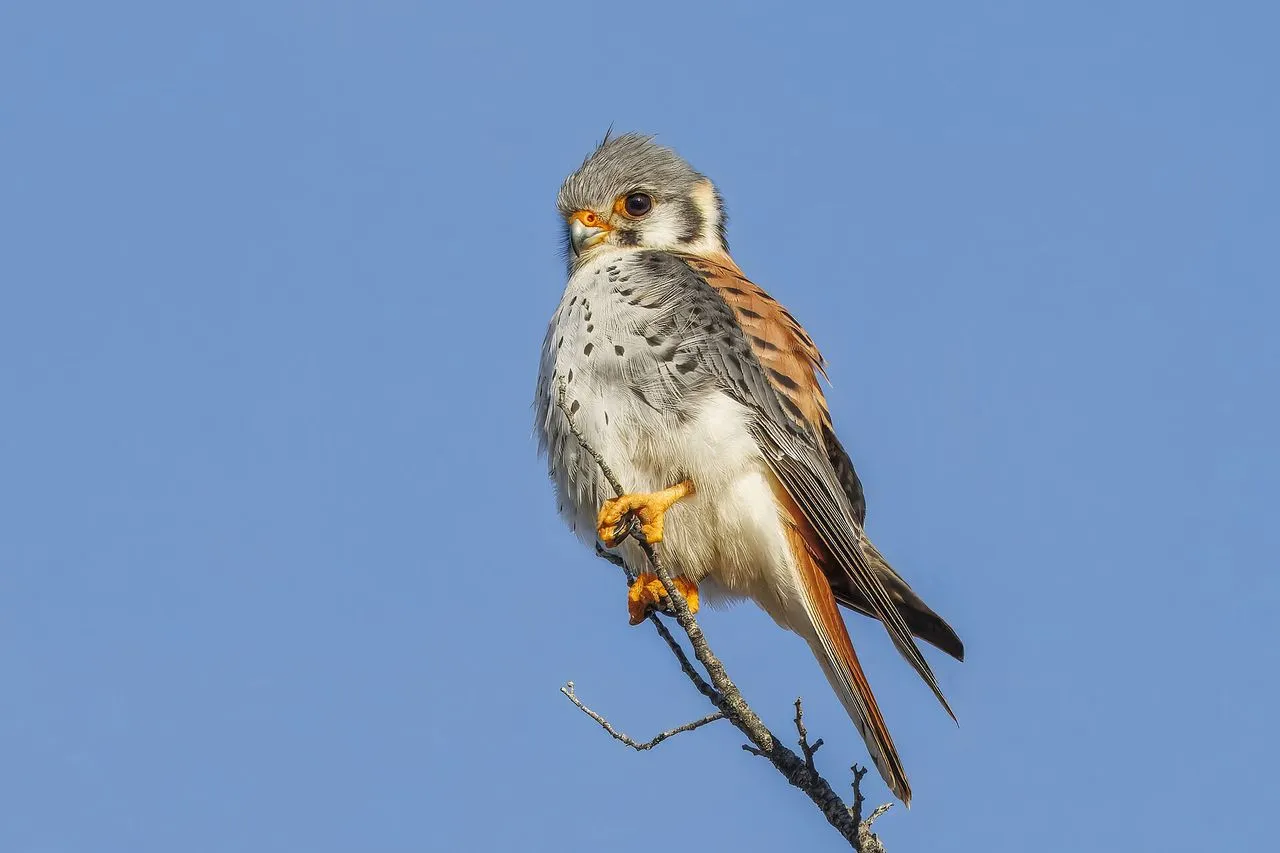
Falco sparverius, the American Kestrel, is the smallest falcon in North America and one of the most carefully monitored, because its population trajectory over the past fifty years has been consistently downward and the cause remains incompletely understood.
The bird is conspicuous, easy to observe from roadsides, and has been counted at hawkwatching stations since the mid-twentieth century. The data are unusually good. The decline is unambiguous. Part of the Complete Raptors Guide.
Identification
| Character | American Kestrel (F. sparverius) | Merlin (F. columbarius) |
|---|---|---|
| Length | 22–31 cm (8.7–12.2 in) | 24–33 cm (9.4–13.0 in) |
| Tail | Rufous in both sexes; often bobbed | Darker, shorter; held still when perched |
| Face | Two black moustache marks | Weak single moustachial mark |
| Hunting flight | Sustained hover, then stepped drop | Fast, low, direct pursuit; no hover |
The American Kestrel is the small, compact falcon on the wire above the roadside field. Total length runs 22 to 31 cm; wingspan 51 to 61 cm. The species is strongly sexually dimorphic in plumage, though not markedly in size.
Male. Blue-grey wings contrast with a rufous back and tail. Underparts are pale with black spotting on the breast. The head pattern is diagnostic at close range: two vertical black moustache marks on a white face, with a rufous crown patch. In flight, the blue-grey wing panel against the rufous back is readable even at modest range in good light.
Female. Entirely rufous-brown above, with heavy dark barring across the back, wings, and tail. Underparts pale with brown streaking. The same double moustache marks as the male, though typically less bold. At a glance, females suggest a small Merlin (Falco columbarius), and the two are regularly confused in the field.
Separation from Merlin
Both species are small falcons using open-country habitat. The reliable separators: the kestrel shows a rufous tail in both sexes and frequently hovers; the Merlin carries a single moustache stripe in most plumages, has a shorter and squarer-headed profile, and does not hover. Posture on a perch is also useful. Kestrels pump and bob their tail repeatedly and continuously; Merlins hold the tail still. A small falcon on a wire that is actively working its tail is a kestrel until the field marks say otherwise.
Hover-Hunting
The American Kestrel is the only North American falcon that routinely employs sustained hover as a primary hunting strategy. The bird faces into the wind, makes continuous fine adjustments to wing angle and tail spread to maintain a fixed point relative to the ground below, and scans for prey. This is kinematically demanding. Maintaining position against variable wind requires active continuous correction, and the tail functions as the primary control surface throughout.
Once prey is located, the kestrel does not immediately stoop. It drops in stages: a partial descent, a brief re-hover to reconfirm the target's position, another drop, and then the final strike. This stepped descent appears to function as repeated target assessment before commitment, reducing the cost of missed strikes.
Prey taken varies by season. In summer, large insects, particularly grasshoppers and dragonflies, make up a substantial portion of the diet in most populations. In winter, small mammals, primarily voles, and small birds become proportionally more important as insect prey disappears. The kestrel is a generalist across prey types, which has not insulated it from population pressure.
There is experimental evidence that Falco species can detect vole runways by UV reflectance. Fresh vole urine reflects in the near-ultraviolet range, and kestrels tested in laboratory conditions responded behaviourally to UV-reflective surfaces in ways consistent with using this cue to identify productive foraging areas. Whether this mechanism explains the precision of the hover-and-drop sequence in field conditions remains an active research question.
Range and Habitat
Falco sparverius breeds from Alaska to Tierra del Fuego, the most extensive breeding range of any falcon in the Western Hemisphere. In North America, breeding habitat is open and semi-open country with scattered elevated perch sites: farmland, meadows, roadsides, and forest edges where open foraging ground is accessible.
The species is a cavity nester. It cannot excavate its own holes and requires pre-existing cavities in trees, banks, or structures adjacent to open foraging habitat. Old woodpecker excavations are the primary natural nest site. In landscapes where snags and old trees have been removed, nest-site availability becomes a genuine limiting factor.
Winter range covers the entire continental USA and extends into Central America. Northern populations are migratory; southern populations are often resident year-round. In winter the birds move readily along roadsides and are among the most consistently findable raptors in open agricultural landscapes.
Population Decline
The Breeding Bird Survey (BBS), which has run standardised roadside counts across North America since 1966, shows a mean annual decline of roughly 1.4% per year across the continent from the 1970s onwards. In parts of the eastern USA the cumulative loss over fifty years is estimated above 50% of the breeding population. Hawkwatch count data from sites including Cape May in New Jersey and Hawk Mountain in Pennsylvania corroborate the BBS trend independently.
What makes the decline scientifically difficult is that no single factor explains it cleanly across the range.
Nest-site availability. The removal of old trees and snags from agricultural landscapes reduces cavity availability in some areas, and nest box programs have demonstrated genuine local population responses where cavity supply was the limiting factor. This explains part of the decline in some landscapes but does not account for declines in areas where nest sites remain abundant.
Prey base changes. Declines in invertebrate biomass across intensively farmed landscapes, documented across multiple European long-term studies and increasingly corroborated in North America, would reduce the summer prey base for a species that relies heavily on large insects. A bird that depends on grasshoppers in summer and voles in winter is exposed to stressors in both seasons simultaneously.
Contaminants. Organochlorine pesticides drove the Peregrine to near-extinction before being banned; secondary poisoning from rodenticides used on farmland is now an established source of mortality for small raptors, including kestrels, that hunt in agricultural landscapes.
West Nile virus. American Kestrels are susceptible, and seroprevalence studies in some populations have found non-trivial infection rates. The contribution to overall population decline is not quantified with confidence.
Predation pressure from Cooper's Hawks. Accipiter cooperii populations have increased substantially in the same period that kestrel numbers have declined, and Cooper's Hawks take kestrels. Whether the predation rate is high enough to drive population-level effects is contested.
The American Kestrel Partnership, a collaborative monitoring programme involving Cornell Lab of Ornithology and multiple state agencies, maintains a network of monitored nest boxes and publishes its count data publicly. It represents one of the most detailed ongoing datasets for any declining North American raptor and is the best current source for range-wide population information.
Where to Find
Kestrels are conspicuous birds in appropriate habitat and straightforward to locate once the search image is clear.
In summer, look for pairs in open farmland and along road margins with utility wires. Males are often visible from distance on account of the blue-grey wing panel. Listen for the kik-kik-kik call, which is loud enough to locate a bird before you see it.
In winter, slow roadside driving through open agricultural landscape in the eastern and central USA remains the most reliable method. A kestrel on a wire typically allows a vehicle to stop within 20 to 30 metres before flushing, which is close enough for clear observation of the head pattern and plumage.
At hawkwatch sites in autumn, kestrels are consistently among the commonest counted species at most eastern sites in September and October. The trend in those counts, visible as a declining slope across the multi-decade datasets available at HMANA, is one of the clearest illustrations of the population trajectory.
See Also
Frequently Asked Questions
How do I identify an American Kestrel?
Look for a small compact falcon on wires or hovering over fields. Males show blue-grey wings contrasting with a rufous back and tail, plus two vertical black moustache marks on a white face. Females are brown above with barred wings and tail. Kestrels tail-bob while perched and hover with their heads into the wind, scanning for prey below.
What makes American Kestrel identification from Merlin reliable?
The kestrel shows a rufous tail in both sexes and frequently hovers; Merlin carries a single moustache stripe, has a squarer head, and never hovers. A small falcon actively working its tail on a wire is a kestrel until the field marks say otherwise. Merlins hold their tails still when perched.
Why is the American Kestrel population declining?
No single factor explains it cleanly across the range. Contributing causes include nest-site loss from snag removal in agricultural landscapes, reduced invertebrate prey in intensively farmed areas, secondary poisoning from rodenticides, West Nile virus susceptibility, and increased predation pressure from recovering Cooper's Hawk populations.
Where can I see American Kestrels most reliably?
In summer, scan utility wires along farmland and road margins, males' blue-grey wing panels are visible at distance. In winter, slow roadside driving through open agricultural landscape in the eastern and central USA is most productive. Autumn hawkwatch counts at ridge sites also produce the species consistently in September and October.
Sources & References
- BirdLife International. (2024). Falco sparverius. IUCN Red List of Threatened Species.
- Cornell Lab of Ornithology. (2024). All About Birds: American Kestrel. birds.cornell.edu
- Sibley, D.A. (2014). The Sibley Guide to Birds (2nd ed.). Knopf.
- Ferguson-Lees, J. & Christie, D.A. (2001). Raptors of the World. Helm Identification Guides.