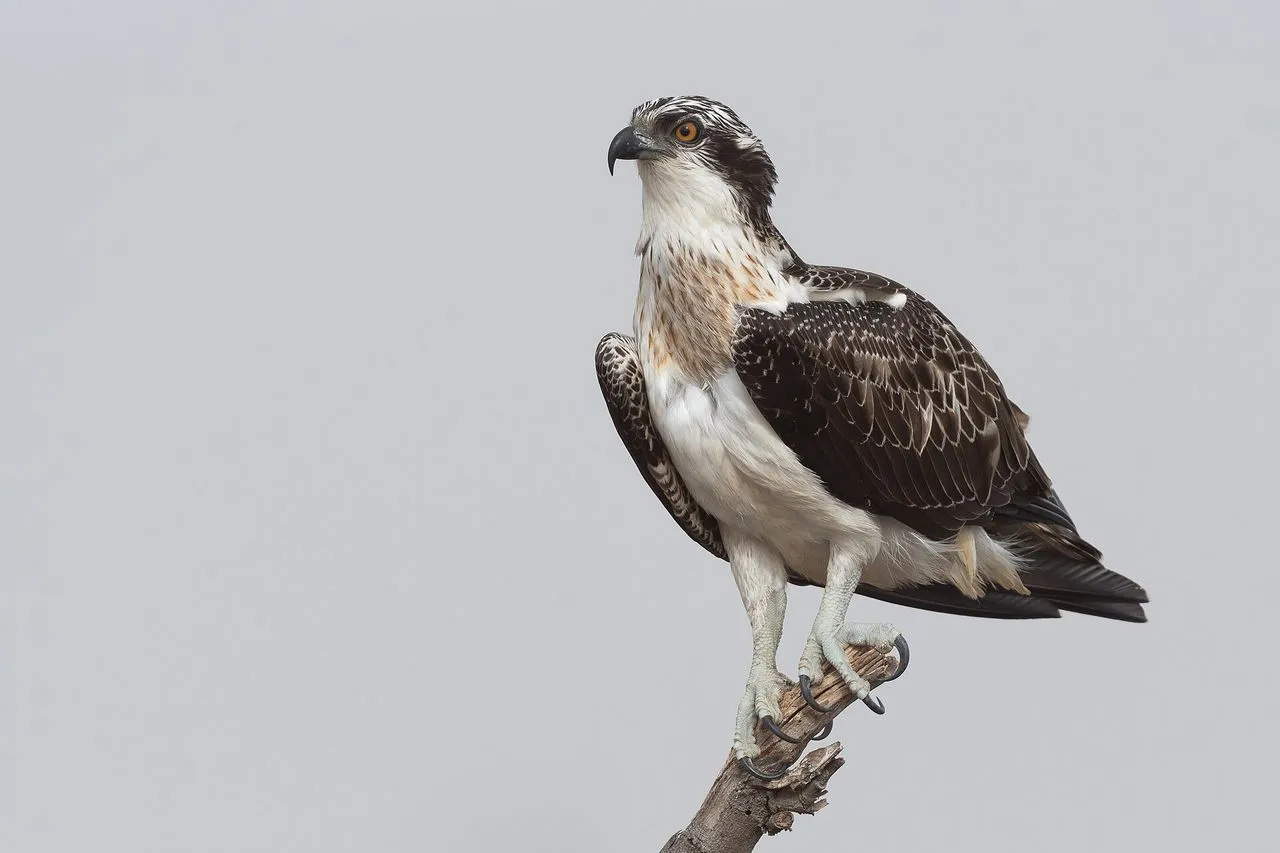
Pandion haliaetus Linnaeus, 1758, the Osprey, is the sole living species in Pandionidae and is so specialised for fish capture that reversible outer toes and spiny foot pads are central field biology, not trivia.
Part of the Complete Raptors Guide.
Identification
| Character | Osprey (P. haliaetus) | Bald Eagle (H. leucocephalus) | Red-tailed Hawk (B. jamaicensis) |
|---|---|---|---|
| Wings | Long, kinked at wrist; M-shaped head-on | Broad, flat, plank-like | Broad, rounded buteo wings |
| Underparts | White with dark carpal patches | Dark body in immatures; white head only in adults | Pale or dark morphs; patagial marks common |
| Hunting | Feet-first plunge into water | Snatches fish or scavenges; no plunge-dive | Perch-hunts mammals on open ground |
| Carrying prey | Fish held head-forward | Carries fish or carrion without fixed posture | Prey carried in feet, usually not fish-specialist |
Visual
Osprey is a large, long-winged raptor with white underparts, dark carpal patches, a dark eye stripe, and a distinctive kinked-wing profile. In flight the wings are held with a gull-like bend at the wrist, producing an M-shaped silhouette from head-on. The upperparts are dark brown; the head is mostly white with a bold brown mask through the eye. Females often show a darker necklace of breast streaking than males, though sexing in the field is not always secure.
No other common raptor combines this size, pale body, dark wrist patches, and association with open water. Juveniles show pale scaling on the upperwing coverts and can look fresher and more patterned than adults. At distance, an Osprey circling over a reservoir may be mistaken for a pale buteo, but the long narrow wings and kinked wrists resolve the identification.
Audio
Ospreys are vocal at nests and during territorial interactions, giving high whistled chirps and alarm calls. Away from nest platforms they are often silent. Calling birds near water in spring and summer should prompt a search of poles, dead trees, navigation markers, or artificial platforms.
Distribution
Ospreys are nearly cosmopolitan, breeding on every continent except Antarctica where suitable fish-bearing water and nest sites exist. North American birds breed from Alaska and Canada south through much of the United States and into the Caribbean. Many migrate to Central and South America for winter. European birds breed from Scotland and Scandinavia eastward across Eurasia, with many wintering in West Africa.
Migration can be individually consistent. Satellite-tracked birds often use similar routes across years, crossing seas and deserts on schedules shaped by wind, stopover water bodies, and fishing opportunities. Juveniles migrate without parental guidance, which makes the precision of their first southbound journey particularly notable.
The species recovered strongly in regions where DDT had caused eggshell thinning and reproductive failure. Artificial nest platforms accelerated recovery in many lowland and coastal landscapes by supplying secure nest sites near productive water.
Habitat
The habitat requirement is simple and strict: fish-bearing water within commuting distance of a secure nest site. Lakes, reservoirs, rivers, estuaries, coastal lagoons, fish farms, and large ponds all qualify. Water clarity and fish availability matter more than scenic quality. Turbid water, deep fish distribution, or heavy disturbance can reduce hunting success.
Nests are built in exposed positions: dead trees, snags, utility poles, channel markers, communication towers, cliffs, and nest platforms. Ospreys tolerate human activity better than many raptors if the nest itself is not directly disturbed, which is why working harbours and reservoirs can support breeding pairs.
Diet and Hunting
Fish make up the overwhelming majority of the diet. Common prey includes mullet, menhaden, herring, perch, pike, trout, flounder, carp, and locally abundant schooling fish. Ospreys generally take fish near the surface and within a manageable size range, often 15 to 35 cm long. Very large fish are energetically risky and may force the bird to drag or abandon the catch.
The hunting sequence is distinctive. The bird circles or hovers above water, folds its wings partially, and plunges feet-first. The legs extend forward before impact; the talons close on the fish under the surface. On emergence the Osprey shakes water from its plumage and rotates the fish head-first using its reversible outer toes, reducing drag during flight. This head-forward carrying posture is one of the best behavioural field marks.
The plunge is shallower than many observers imagine. Ospreys are not pursuit-divers like cormorants; they enter the upper layer of water, usually where a fish is visible near the surface. Wind chop, glare, suspended sediment, and low sun all reduce capture efficiency because the attack begins with visual detection. Productive Osprey water is therefore often clear, shallow, or filled with schooling fish near the surface.
Ospreys are frequent victims of kleptoparasitism by Bald Eagles, gulls, and occasionally other large birds. An eagle chasing an Osprey with a fish is not a rare spectacle in productive coastal and reservoir systems; it is a predictable interaction between a specialist fisher and a larger opportunist.
Breeding Biology
Pairs build large stick nests, often reused for years and enlarged each season. Clutch size is usually two or three eggs. Incubation lasts about five weeks, and young fledge after seven to eight weeks. The male supplies most fish during incubation and early nestling stages; the female broods and feeds young until they can tear prey themselves.
Nest platforms have become important conservation tools. They reduce conflict with utility infrastructure, provide stable sites where natural snags are scarce, and concentrate monitoring effort. However, platforms do not replace the need for clean water and adequate fish populations.
Notes
The Osprey's taxonomic isolation matters. It is not merely a fish-eating hawk; it is a separate accipitriform lineage with anatomical specialisations for a narrow prey base. That specialisation makes the bird easy to identify and also exposes it to waterborne contaminants. The twentieth-century crash and recovery of many populations followed the same broad contaminant pattern as eagles and Peregrines: organochlorine exposure reduced reproduction, regulation allowed recovery, and nest-site management helped the rebound become visible.
See Also
Frequently Asked Questions
How do I identify an Osprey in flight?
Look for a large long-winged raptor with white underparts, dark carpal patches, a dark eye stripe, and a distinctive kinked-wing profile. Wings are held with a gull-like bend at the wrist, producing an M-shaped silhouette from head-on. The head is mostly white with a brown mask through the eye. The combination of size, pale body, dark wrist patches, and association with open water is distinctive.
How does the Osprey's foot specialisation work?
Ospreys have reversible outer toes allowing azygos grasp, all four toes can face forward or backward, and spiny foot pads with sharp scales that help grip slippery fish. After a plunge, the bird rotates the fish head-forward using the reversible toes, reducing drag during flight. This carrying posture is one of the best behavioural field marks and helps confirm identification at distance.
Where do Ospreys nest?
Nests are built in exposed positions: dead trees, snags, utility poles, channel markers, communication towers, cliffs, and nest platforms. Ospreys tolerate human activity better than many raptors if the nest itself is not directly disturbed, which is why working harbours and reservoirs can support breeding pairs. Artificial nest platforms have been important conservation tools providing secure sites near productive water.
What is the Osprey's conservation history?
Ospreys suffered severe population decline from organochlorine pesticides, particularly DDT, which caused eggshell thinning and reproductive failure. Restrictions on DDT allowed recovery in many regions, and nest platforms accelerated rebound by supplying secure sites. The species was removed from the U.S. Endangered Species List in 1999. Ongoing threats include contamination of fish prey and disturbance at nest sites.
Sources & References
- Cornell Lab of Ornithology. (2024). All About Birds: Osprey. birds.cornell.edu
- Poole, A.F. (1989). Ospreys: A Natural and Unnatural History. Cambridge University Press.
- Ehrlich, P.R., Dobkin, D.S. & Wheye, D. (1988). The Birders Handbook. Simon & Schuster.
- Ferguson-Lees, J. & Christie, D.A. (2001). Raptors of the World. Helm Identification Guides.