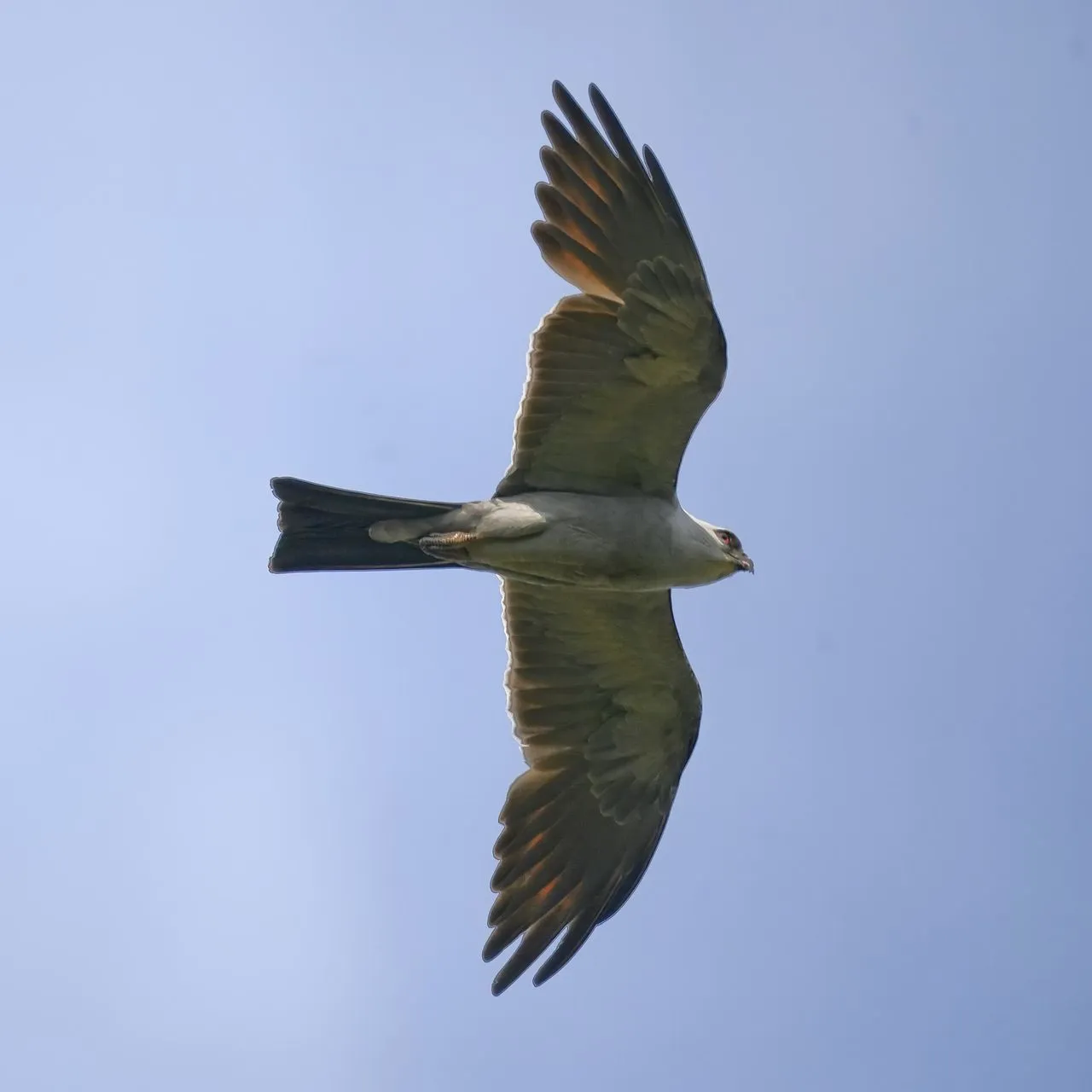
Ictinia mississippiensis Wilson, 1811, the Mississippi Kite, is a slim North American kite of about 240 to 390 grams that feeds heavily on large flying insects captured and eaten in the air.
Part of the Complete Raptors Guide.
Identification
| Character | Mississippi Kite (I. mississippiensis) | Merlin (F. columbarius) | Swainson's Hawk (B. swainsoni) |
|---|---|---|---|
| Build | Slim kite, long wings and tail | Compact falcon, blunt head | Long-winged buteo, broader body |
| Flight | Buoyant turns with shallow wingbeats | Fast, low, purposeful pursuit | Thermal soaring and rocking glide |
| Adult plumage | Pale grey head, darker grey body | Blue-grey or brown, streaked below | Light morph has dark breast bib |
| Main prey | Large flying insects | Small to medium-sized birds | Vertebrates in breeding season; insects in winter |
Visual
Mississippi Kite is a small, elegant raptor with long pointed wings, a long dark tail, pale grey head, darker grey body, and blackish flight feathers. Adults show a red eye at close range. The flight is buoyant and controlled, with shallow wingbeats, glides, and effortless turns after insects. At distance, the bird can suggest a falcon, but the wing action is softer and the tail longer.
Juveniles are streaked below and browner overall, with banded tails. They can be confused with small falcons or accipiters, but the long-winged kite shape and social behaviour help. Mississippi Kites often forage in loose groups, circling over fields, treelines, and towns where insects are rising.
Audio
The call is a thin, high whistle, often given near nests or during interactions with other kites. Away from breeding areas, birds may be quiet while feeding in the air. Nesting pairs in urban neighbourhoods are usually detected by repeated whistles and defensive flights before the nest itself is found.
Distribution
The breeding range is centred in the south-central and southeastern United States, including the Great Plains edge, Texas, Oklahoma, Kansas, Arkansas, Louisiana, Mississippi, Alabama, Georgia, and parts of the Carolinas. The species has expanded or become more conspicuous in some urban and suburban areas with mature trees. It winters in South America, especially in the Chaco and surrounding regions, migrating in flocks through Central America.
Arrival on breeding grounds is relatively late compared with many raptors, matching the seasonal rise in aerial insect abundance. Departure can be conspicuous where post-breeding flocks form and drift south on warm late-summer days. The migration is easy to overlook because birds may travel high and in loose groups rather than as a tight stream along ridges.
Northern vagrants occur regularly enough to be expected at migration watchpoints and during late spring overshoots, but sustained breeding remains tied to warm-region prey and nesting conditions.
Habitat
Breeding habitat includes open woodland, shelterbelts, riparian groves, towns with mature street trees, parks, golf courses, and agricultural edges. The species needs tall trees for nesting and open airspace for aerial insect capture. It is notably tolerant of human settlement where nest trees remain.
Water is not required in the manner of an Osprey or eagle, but riparian corridors often hold high kite densities because they combine tall trees, edge structure, and insect production. In dry prairie towns, irrigated lawns and mature planted trees can create a comparable nesting matrix.
Historically associated with bottomland and prairie-edge woodland, Mississippi Kites now nest in residential neighbourhoods in parts of the southern Great Plains. Lawns, playing fields, and roads do not provide natural habitat in a strict sense, but they create open flight corridors around mature trees and support insect concentrations under some conditions.
Diet and Hunting
Large insects dominate the diet: cicadas, grasshoppers, dragonflies, beetles, and moths. Kites capture insects in flight with the feet, transfer them to the bill, and often eat while still airborne. Small vertebrates are also taken, including lizards, frogs, small snakes, bats, and nestling birds, especially for feeding young.
Prey delivery to nestlings often includes more vertebrates than the adult's casual aerial feeding would suggest. A lizard or small snake provides a larger package for a growing chick than a single beetle. Adults therefore shift between fine-scale aerial feeding for themselves and more substantial prey collection for the nest.
The hunting style is aerial gleaning and pursuit rather than stooping predation. Birds patrol above treetops, fields, and streets, turning with minimal wingbeats to intercept insects. During cicada emergences, kites can concentrate locally and deliver heavy prey loads to nests. Their flight economy is exceptional; they can remain airborne for long periods with little visible effort.
Breeding Biology
The nest is a small stick platform placed high in a tree, often more lightly built than the nests of buteos. Clutch size is usually one or two eggs. Incubation lasts about a month, and young fledge after roughly five to six weeks. Pairs may nest semi-colonially where suitable trees and prey are abundant.
Nest defence is conspicuous. Adults dive at crows, hawks, dogs, and people passing near the nest. In urban areas this behaviour leads to conflict because a sidewalk or front garden can fall within the defended zone. The behaviour peaks around late nestling and fledgling stages and declines after young disperse.
Notes
Mississippi Kite is a useful corrective to the popular equation of raptors with taloned mammal-killers. It is a raptor, but its daily energy budget in summer may be built largely from insects taken on the wing. The ecological comparison is sometimes closer to a large swift or bee-eater than to a Red-tailed Hawk, despite the hooked bill and talons.
Urban nesting brings the species into contact with people who may never have noticed a kite before it defended a nest. The dives are usually warnings rather than attempts to injure, but the behaviour is real and predictable. Temporary avoidance of the nest tree during the fledging window is more effective than treating the bird as aggressive in any general sense.
See Also
Frequently Asked Questions
How do I identify a Mississippi Kite in flight?
Look for a small elegant raptor with long pointed wings, a long dark tail, pale grey head, and darker grey body with blackish flight feathers. The flight is buoyant and controlled, with shallow wingbeats, glides, and effortless turns after insects. At distance it can suggest a small falcon, but the wing action is softer and the tail longer. Juveniles are streaked below and browner with banded tails.
What do Mississippi Kites eat?
Large flying insects dominate: cicadas, grasshoppers, dragonflies, beetles, and moths captured and eaten in the air. Small vertebrates are also taken, lizards, frogs, small snakes, bats, and nestling birds, especially for feeding young. Nestling prey loads often include more vertebrates than the adult's casual aerial insect foraging would suggest, since a lizard provides a larger package for a growing chick.
Where do Mississippi Kites breed?
Breeding occurs in the south-central and southeastern United States, including the Great Plains edge, Texas, Oklahoma, Arkansas, Louisiana, Mississippi, Alabama, Georgia, and parts of the Carolinas. Habitat includes open woodland, shelterbelts, riparian groves, towns with mature street trees, parks, golf courses, and agricultural edges. The species has expanded into suburban neighbourhoods with mature trees, showing notable tolerance of human settlement.
Why are Mississippi Kite nest defence displays notable?
Adults dive at crows, hawks, dogs, and people passing near the nest, a behaviour that creates conflict in urban neighbourhoods where sidewalks or front gardens fall within the defended zone. The dives are usually warnings rather than attempts to injure. The behaviour peaks around late nestling and fledgling stages and declines after young disperse. Temporary avoidance of the nest tree during the fledging window is more effective than treating the bird as generally aggressive.
Sources & References
- Cornell Lab of Ornithology. (2024). All About Birds: Mississippi Kite. birds.cornell.edu
- Sibley, D.A. (2014). The Sibley Guide to Birds (2nd ed.). Knopf.
- Bildstein, K.L. (2006). Migrating Raptors of the World: Their Ecology and Conservation. Cornell University Press.
- Ferguson-Lees, J. & Christie, D.A. (2001). Raptors of the World. Helm Identification Guides.