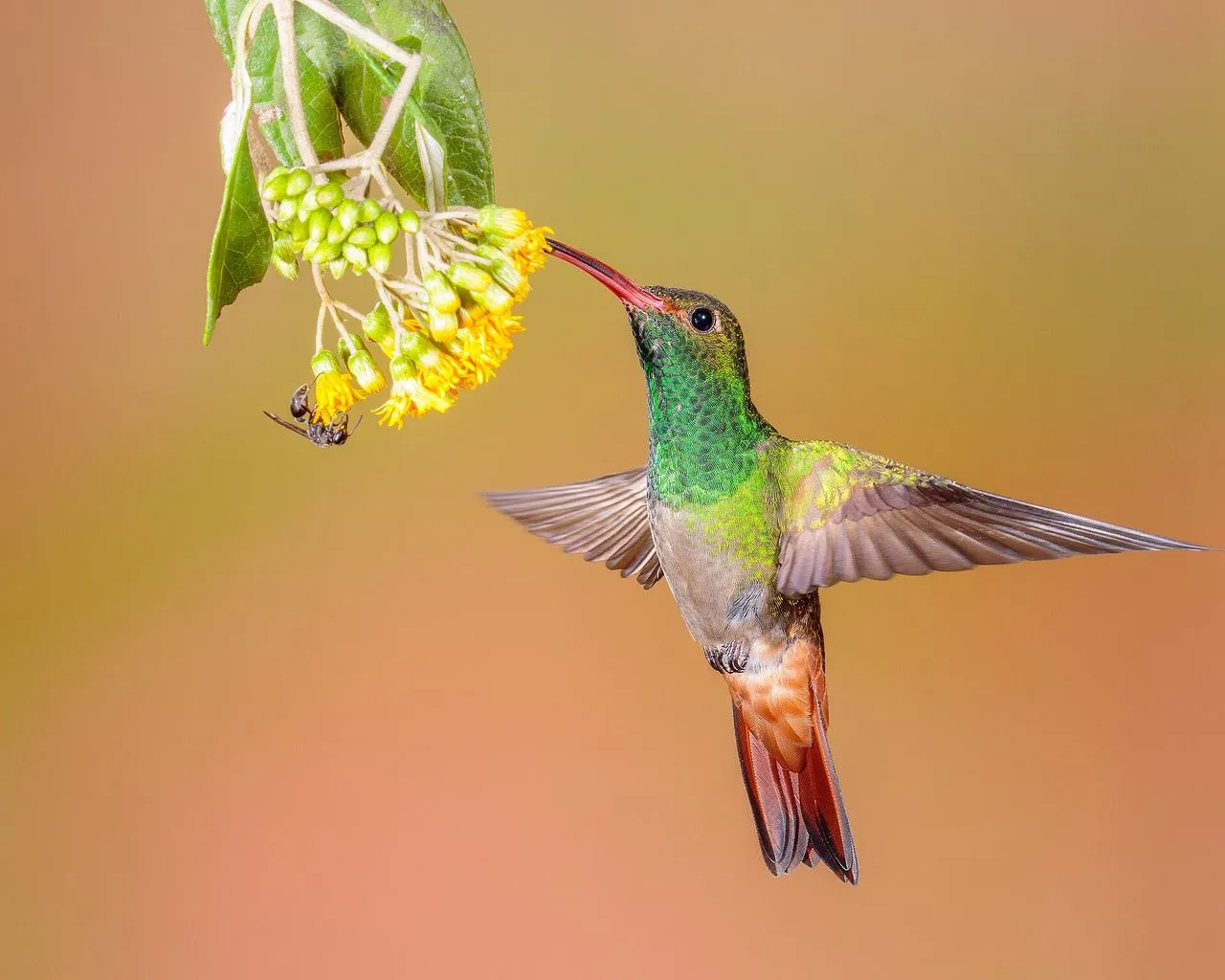
Trochilidae (360 species) are the only birds that can hover sustained and fly backwards. Their metabolism is the highest of any vertebrate, a Ruby-throated Hummingbird beats wings 53 times per second. The correct feeder formula is 1:4 (sugar:water), never use honey or red dye. Anna's Hummingbird is the only North American species with iridescent crown and throat.
The Trochilidae is a family of approximately 360 New World species, representing the most species-rich bird family in the Western Hemisphere after the tyrant-flycatchers, and the only family in which all members are capable of sustained hovering flight.
I'm Dr. James Whitfield, an ornithologist trained at Oxford and a former research associate with the British Trust for Ornithology, with more than 12,000 hours of field observation across North American and European garden habitats. The questions that reach me most consistently from garden birders concern two things: what to put in a hummingbird feeder, and why birds keep dying at one that appears to be well-used. Both questions have precise answers, and most of what follows comes directly from what I have seen work and fail in the field.
Taxonomy and Phylogeny
Trochilidae sits within the order Apodiformes as the sister family to the swifts (Apodidae). The two families share a highly reduced hindlimb adapted for perching but not walking, a disproportionately elongated hand skeleton relative to the arm bones, and a flight musculature that constitutes an unusually large proportion of body mass. Molecular divergence estimates place the Trochilidae-Apodidae split at approximately 50-55 million years ago in the early Eocene. The shared anatomical characters that unite them were identified long before molecular work confirmed the relationship.
The radiation of the Trochilidae is wholly confined to the Americas. No species has ever established a breeding population outside the New World. Species diversity peaks in the montane Neotropics, particularly in Ecuador and Colombia, and declines sharply with latitude; most of North America north of Mexico is served by a small number of species per region.
Within the family, the broad working division is between the hermits (subfamily Phaethornithinae, confined to the Neotropics, characterised by curved bills and cryptic brown plumage) and the typical hummingbirds (subfamily Trochilinae), which includes all regularly occurring North American species. The genera most relevant to backyard observers in the United States and Canada are Archilochus, Calypte, Selasphorus, Stellula, Amazilia, and Eugenes.
Hovering Biomechanics
The ability to hold a fixed position in mid-air while foraging, and to fly with equal facility in any horizontal direction including backwards, is the family's defining character and its most energetically expensive one. The mechanism differs from that of every other bird. In standard avian flapping flight, lift is generated primarily on the downstroke and the upstroke serves largely as a recovery phase. In hummingbirds, the wing traces a figure-of-eight in the roughly horizontal plane, supinating on the back-stroke so that lift is generated on both the forward and return phases. Aerodynamically, this is closer to the asynchronous muscle-driven flight of a hawk-moth than to any other vertebrate flight yet described.
Wing-beat frequency in Archilochus colubris averages approximately 53 Hz in level hovering flight. Calypte anna beats at roughly 40 Hz at rest. At these frequencies the wing is invisible to the unaided eye and produces the audible hum from which the family takes its English name. In steep dive displays, wing-beat frequency increases and additional acoustic output arises from tail feathers vibrating in the airstream at the base of the dive.
Hovering imposes a near-maximal aerobic demand. A hummingbird extracting nectar from a flower is working close to its physiological ceiling, which is why minimising the ratio of flight distance to caloric yield is the central economic problem of a hummingbird's foraging day.
Metabolism and Thermoregulation
Hummingbirds hold the record for the highest mass-specific metabolic rate of any vertebrate yet studied. A Calypte anna weighing approximately 4.5 g sustains, during active flight, an oxygen consumption rate per gram of body mass that exceeds that of any comparably sized mammal. The daily caloric requirement is met through continuous foraging: hundreds of flower visits supplemented by small arthropods, principally insects and spiders, which supply the amino acids and lipids that nectar alone cannot provide.
The overnight problem is more acute. Without continuous feeding, a bird must survive 8-12 hours on stored reserves. The solution is torpor: a regulated depression of core body temperature from the active range of 38-41 degrees C to near ambient, sometimes as low as 4 degrees C in a cold roosting environment. Heart rate drops from an active 500-1,200 bpm to 50-180 bpm. The bird is cold to the touch and largely unresponsive to auditory stimuli.
Arousal from torpor requires 20-40 minutes of shivering thermogenesis and burns a meaningful fraction of the bird's stored fat. A hummingbird that enters torpor at critically low body mass will not arouse by morning. This is the physiological mechanism behind one observation that surprises many observers: a hummingbird that has been using a feeder regularly may die overnight in a cold snap if the feeder has frozen or been removed. The feeder is a caloric supplement; in marginal conditions, it can be the deciding margin.
The Correct Sugar-Water Recipe
The standard formula is 1 part white refined granulated sugar to 4 parts water, by volume. This produces a solution of approximately 20% sucrose by mass, which falls within the sucrose concentration range of the flowers North American hummingbirds preferentially visit: typically 18-26%. Boiling the water is optional but accelerates dissolution and slightly extends the fermentation-free window of the solution. Mix until the sugar is fully dissolved before filling the feeder.
Several commonly used alternatives are wrong, each for a different reason.
Honey ferments rapidly at the ambient temperatures typical of a feeder in North American summers. The fermentation products include ethanol and support growth of Candida and other yeast species at concentrations sufficient to cause gut pathology within 24-48 hours. Honey also contains fructose oligosaccharides that hummingbirds do not digest efficiently, reducing caloric return per visit.
Brown sugar, turbinado, raw sugar, or demerara contain residual molasses. Molasses is iron-rich. Hummingbirds have a documented low tolerance for dietary iron; haemosiderosis has been recorded in captive birds fed above approximately 100 ppm iron. White refined sugar is the correct choice precisely because the refining process removes the molasses and with it the iron load. The purity that makes refined sugar nutritionally uninteresting in a human diet is exactly the property required here.
Artificial sweeteners contain no usable calories. A hummingbird visiting a sweetener solution at normal rates will starve.
Red dye serves no function at the feeder. Hummingbirds locate flowers using colour vision that extends into the near-UV and learn feeder locations after a single visit. The visual attractant is the feeder's red housing, port rings, or perches; the colour of the liquid inside is irrelevant to the bird's decision to approach. Studies using commercial dyes, including FD&C Red 40, have produced intestinal lesions in experimental passerine subjects. There is no documented attractant benefit from dyed solution and there is evidence of harm. The feeder's shape and colour do the attracting; the sugar does the feeding.
Feeder Hygiene
Sugar solution in a feeder begins fermenting within 24-72 hours at temperatures above 20 degrees C. The practical maintenance standard is to clean and refill every 2-3 days in warm weather and every 1-2 days when temperatures consistently exceed 27 degrees C. Cloudy conditions do not meaningfully slow fermentation; ambient temperature, not solar radiation, is the primary driver of microbial growth rate.
Cleaning protocol: disassemble the feeder completely. Hot water and a bottle brush for all interior surfaces and ports. A 10-minute soak in dilute white vinegar (1 part vinegar to 4 parts water) removes yeast biofilm that hot water alone does not clear. Rinse thoroughly with clean water before refilling. Avoid dish soap: surfactant residue is difficult to fully remove from porous plastic port assemblies and taints subsequent solution.
Fermented feeder solution is not simply unappealing. Proliferating yeasts produce mycotoxins at concentrations sufficient to cause proventricular dilation in hummingbirds, a deterioration of muscular function in the glandular stomach that impairs the mechanical processing of food. Birds with proventricular dilation continue visiting feeders at normal rates but cannot properly digest the arthropods that supply most of their protein and lipid. The condition has been documented in wild hummingbirds and the dietary mycotoxin pathway is the established causative mechanism. Feeder hygiene is a clinical matter, not a cosmetic one.
Identification: Reading the Gorget
| Confusion pair | Safer adult-male mark | Practical caution |
|---|---|---|
| Ruby-throated (A. colubris) vs Black-chinned (A. alexandri) | Full ruby gorget vs black throat with violet lower band | Females are nearly inseparable; use range |
| Anna's (C. anna) vs Costa's (C. costae) | Full crown-gorget vs violet side plumes | Costa's is smaller and drier-country |
| Rufous (S. rufus) vs Allen's (S. sasin) | Rufous back vs green back with rufous rump | Female-types often require restraint |
| Broad-tailed (S. platycercus) vs Calliope (S. calliope) | Wing-trill and shield gorget vs magenta rays | Size alone misleads |
The gorget, the iridescent throat patch of adult males, is the family's most recognisable character and the most consistently misread one. Gorget colour is structural rather than pigmentary: it arises from thin-film interference in the flattened melanin-containing platelets of the feather barbules, and the colour perceived depends entirely on the angle between light source, feather surface, and the observer's eye. An Archilochus colubris male with the sun behind it and the gorget angled away from the observer shows flat, opaque black. The same bird, gorget rotated toward the light source, shows saturated ruby-crimson. Both observations are accurate descriptions of the same feather.
The field implication: never assign a gorget-absent identification on a single look. Change your position relative to the bird, wait for it to turn, or note the structural colour visible at the gorget margins even in suboptimal light conditions.
In females and immatures, the gorget is absent or vestigial. Most North American species share greenish-bronze upperparts, pale whitish underparts, and a white post-ocular streak. Separating females of closely related species, such as A. colubris from A. alexandri or Selasphorus rufus from S. sasin, requires attention to primary-tip spacing, undertail covert patterning, and in most cases, geographic range.
Common Confusions
- Ruby-throated vs Black-chinned (Archilochus alexandri). In adult males: Black-chinned shows a narrow violet band at the lower gorget edge, visible when the gorget catches favourable light. The chin above this band is flat non-iridescent black, not ruby. Females of the two species are nearly inseparable in the field; range is the most practical separator.
- Anna's vs Costa's (Calypte costae). In adult males: Costa's gorget extends in dramatically elongated lateral plumes beyond the cheek line; Anna's gorget is full but does not project sideways. Costa's is a shorter-billed bird of dry scrub; Anna's favours chaparral and suburban environments.
- Rufous vs Allen's (Selasphorus rufus vs S. sasin). In adult males: Rufous has an all-rufous back; Allen's has a green back with rufous rump. Females and immatures of the two species are safely separable only in hand.
Migration Windows
Archilochus colubris appears at Gulf Coast sites from mid-March, reaches its northern breeding limit in southern Canada by mid-May, and departs the northern range through August and September. Most individuals have cleared the eastern seaboard by early October, with the full southbound route requiring a non-stop trans-Gulf crossing of approximately 950 km.
Calypte anna is largely sedentary along the Pacific Coast but withdraws from interior high-elevation breeding sites in autumn. Some individuals now winter as far north as southern British Columbia, a range extension documented since the early 20th century and linked to introduced ornamental plants and the proliferation of year-round feeders in suburban gardens.
Selasphorus rufus breeds farther north than any other hummingbird, reaching coastal Alaska, and undertakes the longest migration in the family relative to body size. Its southbound passage through Rocky Mountain meadows occurs in July and August.
Notable Species by Region
- Eastern North America. Ruby-throated Hummingbird (Archilochus colubris), the only regularly breeding species east of the Mississippi, and the source of nearly all eastern feeder observations.
- Pacific Coast. Anna's Hummingbird (Calypte anna), year-round resident from Baja California to British Columbia, the most cold-tolerant hummingbird in the continental United States.
- Intermountain West (breeding season). Broad-tailed Hummingbird (Selasphorus platycercus), adult males produce a diagnostic mechanical wing-trill from a notched outer primary, audible at 50 m.
- Pacific states and Rockies (summer-autumn migration). Rufous Hummingbird (Selasphorus rufus), the longest-distance migrant in the family relative to body size.
- Texas coast. Buff-bellied Hummingbird (Amazilia yucatanensis), buff belly and rufous tail are diagnostic; the only resident lowland Texas hummingbird.
- Southeast Arizona sky islands. The highest hummingbird species richness north of Mexico: Rivoli's (Eugenes fulgens), Blue-throated Mountain-gem (Lampornis clemenciae), Broad-billed (Cynanthus latirostris), and Violet-crowned (Leucolia violiceps) are all regular in canyon feeders above Tucson from May through September.
See Also
- Ruby-throated Hummingbird
- Anna's Hummingbird
- Rufous Hummingbird
- Blue-throated Mountaingem
- The Complete Hummingbirds Guide
- Allen's vs Rufous Hummingbird: arguably the hardest common North American hummingbird ID; the in-hand tail-feather diagnostic.
Frequently Asked Questions
What is the correct hummingbird sugar ratio?
1 part white refined sugar to 4 parts water (by volume), approximately 20% sucrose, the concentration in natural hummingbird flowers. Boil briefly to dissolve, then cool. Never use honey (ferments), brown sugar (toxic iron), or red dye (harmful, unnecessary, the red feeder is the attractant).
How often should I clean my hummingbird feeder?
Every 2–3 days in warm weather (above 20°C), daily when above 27°C. Cloudy syrup means fermentation has started, immediately empty and clean. Use hot water and a bottle brush; a 10-minute soak in 1:4 vinegar-water removes yeast biofilm. Rinse thoroughly.
Why do some hummingbirds stay in winter?
Anna's Hummingbird has expanded northward using introduced ornamental plants (Eucalyptus) and winter feeders. In freezing climates, a heated feeder can be the difference between survival and death, a feeder that freezes overnight removes a hummingbird's primary early-morning energy source.
What is the difference between Ruby-throated and Black-chinned Hummingbird?
Male Ruby-throated has a full gorget of iridescent red; male Black-chinned shows a narrow violet band at the lower gorget edge, with black above. Females are nearly inseparable in the field, range is the most practical clue. Ruby-throated is eastern; Black-chinned is western.