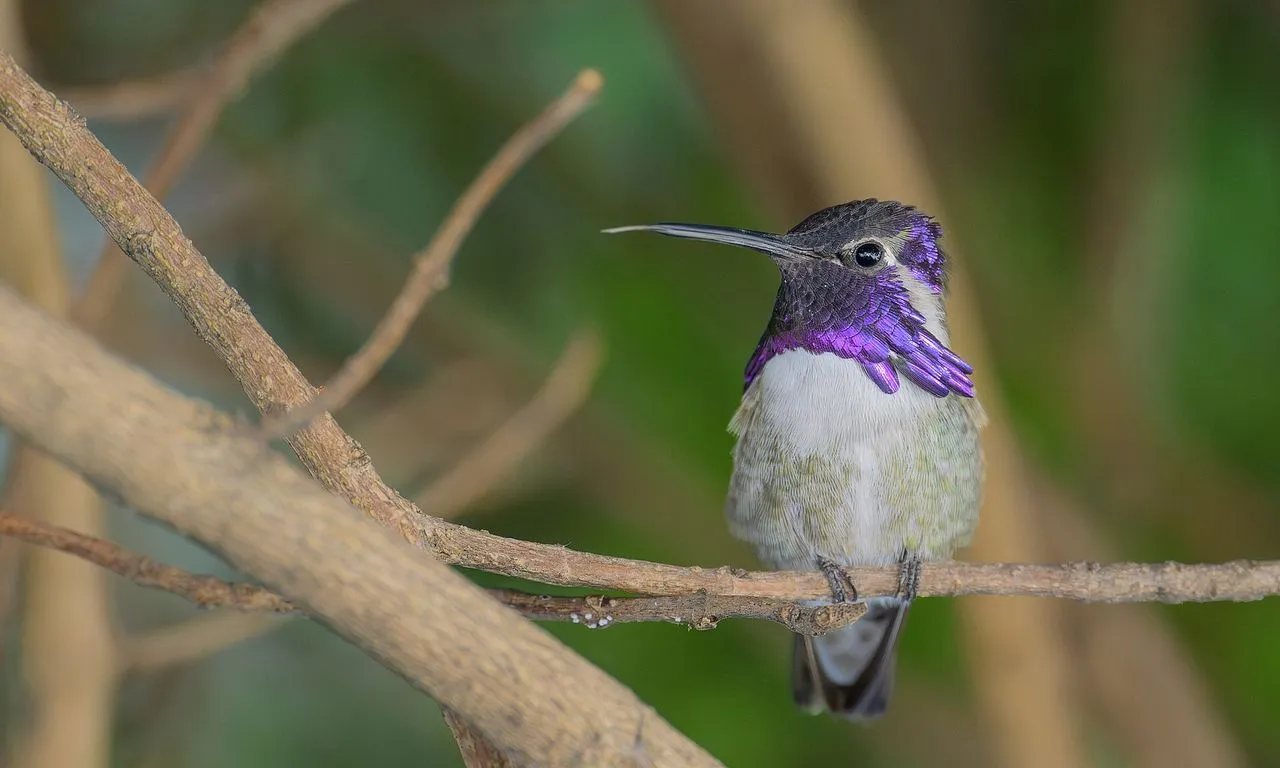
Costa's Hummingbird (Calypte costae) is a desert species weighing 2.5–3.2g. Males have distinctive elongated violet gorget plumes projecting beyond the head, unlike Anna's. Found in arid scrub, chaparral, and urban gardens in the Southwest. Breeds in response to desert flowering.
Calypte costae, Costa's Hummingbird, was described by Bourcier in 1839 and weighs about 2.5-3.2 g, a desert and dry-scrub hummingbird whose adult male carries elongated violet gorget plumes that project beyond the sides of the head.
The species is best understood as a bird of arid timing. It breeds when winter and spring moisture produce flowering in deserts, then may shift upslope or toward irrigated habitats when lowland heat suppresses nectar availability.
Part of the Complete Hummingbirds Guide.
Identification
| Character | Costa's (C. costae) | Anna's (C. anna) |
|---|---|---|
| Body mass | 2.5-3.2 g | 3.5-5.2 g |
| Male gorget shape | Violet plumes project beyond head sides | Full rose-red gorget and crown, no plumes |
| Bill | Short, slightly decurved | Medium, straight |
| Female cue | Small, short-billed, arid habitat | Larger, often with central throat iridescence |
| Habitat cue | Desert scrub and dry canyons | Pacific chaparral, gardens, suburbs |
Visual
Adult male Costa's Hummingbird is compact, short-tailed, and short-billed. The gorget and crown are iridescent violet to purple, with the throat feathers extending laterally into long pointed plumes. When fully lit from the front, the head appears hooded in saturated violet. When the angle is wrong, the same feathers turn blackish.
The lateral gorget plumes distinguish male Costa's from Anna's Hummingbird. Anna's has a rose-magenta throat and crown but lacks the long side projections. Costa's is also smaller, shorter-billed, and more tightly associated with desert scrub.
Females are green above and pale below with a modest white post-ocular mark and a short, slightly decurved bill. The underparts can look clean whitish, with limited flank wash. Female Costa's may be difficult, but the combination of small size, short bill, arid habitat, and range is useful.
Audio
Male song is a thin, high, wiry whistle, often delivered from an exposed perch. Display flights include a close pass to the female, during which the male angles the head to expose the violet plumes. The voice is less scratchy and complex than Anna's song, and the species lacks Broad-tailed's wing-trill.
Distribution
Costa's Hummingbird breeds in the deserts and dry scrublands of the southwestern United States and northwestern Mexico, including the Sonoran and Mojave deserts, Baja California, southern California, southern Nevada, western Arizona, and nearby regions.
Its movements are seasonal and opportunistic. Birds may breed in low desert during late winter and spring, then move toward coastal scrub, foothills, or higher elevations as summer heat intensifies. In irrigated suburbs, some remain where ornamental flowers and feeders provide continuity.
Habitat
Typical habitat includes desert wash, creosote-bursage flats, palo verde and ironwood associations, ocotillo slopes, coastal sage scrub, chaparral edge, and dry gardens planted with nectar-bearing shrubs. It is often most visible where flowering is patchy and males can defend productive clumps.
Shade is not incidental. Desert hummingbirds must manage heat load as carefully as caloric intake. Perches often sit within sparse cover that allows surveillance without prolonged exposure.
Diet and Feeder Behaviour
Costa's uses nectar from chuparosa, ocotillo, desert lavender, penstemon, salvia, and flowering shrubs, along with small insects and spiders. Arthropods are especially important for females producing eggs and feeding young.
At feeders the species may be displaced by larger Anna's or aggressive Rufous migrants, but males defend small territories when competitor pressure allows. In hot desert weather, feeders require strict maintenance. A 1:4 white sugar solution is correct, but it can ferment rapidly in high temperatures. Small volumes changed often are safer than large reservoirs left in sun.
Place feeders where birds can approach from cover and where the solution is shaded during the hottest part of the day. Shade does not eliminate cleaning requirements; it only slows heating.
Breeding Biology
Breeding often begins early, tied to winter rain and spring bloom rather than to the temperate calendar. Males display with pendulum flights and head-oriented gorget flashes. The violet side plumes are signal surfaces; their effect depends on precise angle.
Females build the nest alone in shrubs, small trees, cacti, or desert vegetation, using plant down, fibres, and spider silk. Two eggs are usual. Incubation and nestling care are entirely female tasks. Nest placement may be low compared with woodland species, but concealment among desert branches can be excellent.
Heat, wind, and food pulses shape success. A nest initiated after good bloom can fail if flowers dry abruptly and arthropods decline. Conversely, irrigated gardens can support nesting outside what would have been the historical local window.
Notes
Costa's Hummingbird is often misread because its most obvious character disappears without the right light. A male perched in shade may look like a small dark-throated hummingbird; a slight head turn produces violet plumes that leave no serious alternative.
The species also illustrates why desert birding should follow bloom, not just maps. Where flowers are active, Costa's may be conspicuous. Where the desert has dried and no ornamental subsidy exists, the same site may appear empty.
See Also
Frequently Asked Questions
How do I identify a male Costa's Hummingbird?
Male Costa's has elongated violet gorget plumes that project dramatically beyond the sides of the head, visible in good light. The gorget appears dark from most angles and flashes purple-violet from favourable angles. Compare to Anna's, Anna's has a full gorget but no elongated plumes.
Where does Costa's Hummingbird range overlap with Anna's?
Both occur in California, but Costa's prefers drier habitats, desert scrub, chaparral, arid canyons. Anna's favours suburban gardens, chaparral, and riparian areas. In coastal California, Anna's is more common; inland and desert-edge areas host Costa's.
What does Costa's Hummingbird eat in the desert?
Desert native flowers (desert honeysuckle, ocotillo, fairy duster), plus insects and spiders. In gardens, they readily take sugar water. They shift to higher elevations and irrigated habitats when lowland temperatures suppress native flowering.
When does Costa's Hummingbird breed?
Timing follows desert rainfall and subsequent flowering, typically February–May in lowland deserts, later at higher elevations. They time breeding with peak nectar availability rather than following a fixed calendar.