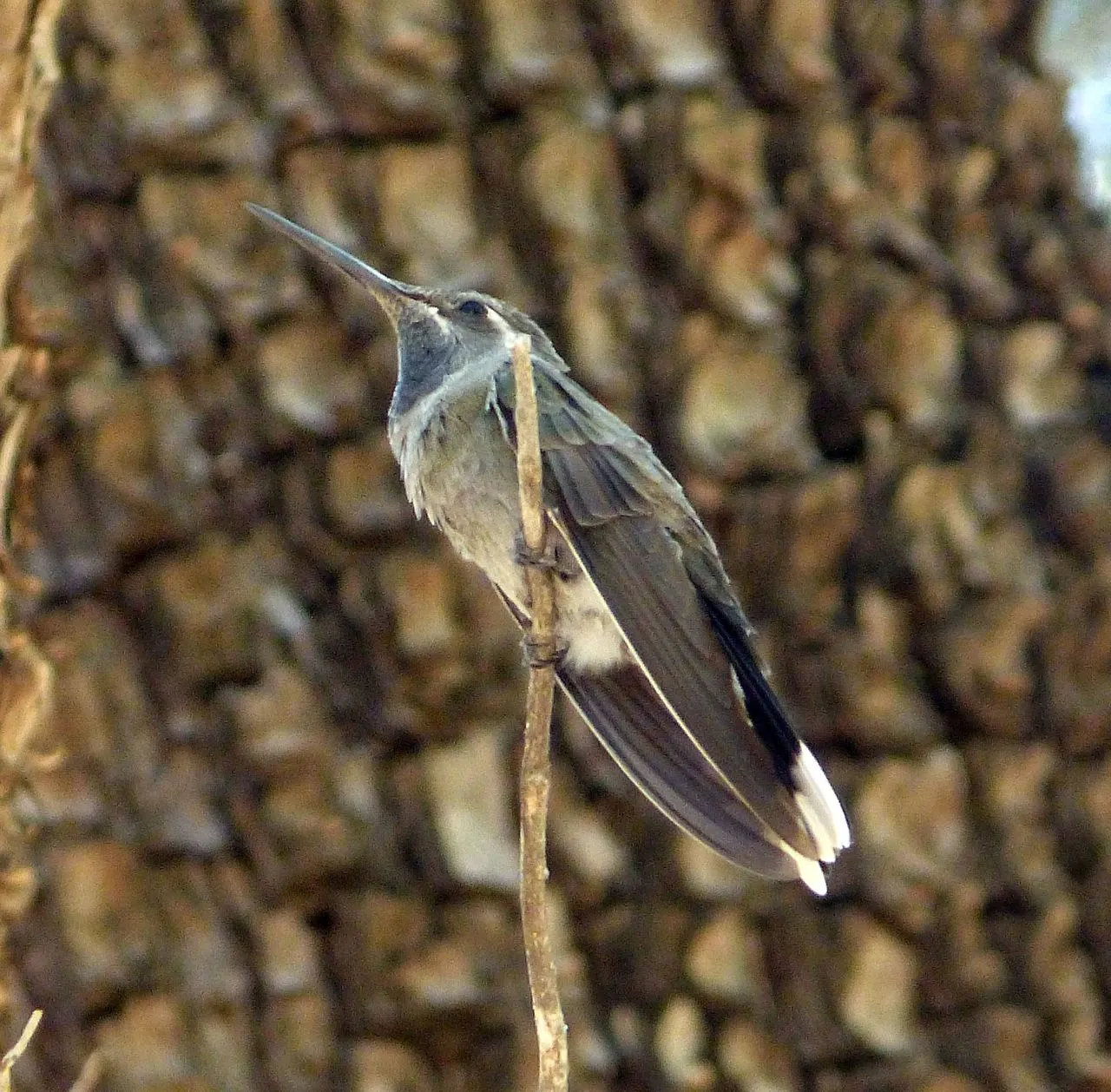
Blue-throated Mountaingem (Lampornis clemenciae) is the largest US hummingbird at 7.5–10.5g. Males have a blue throat that shifts from black to saturated blue with light angle. Both sexes show distinctive white tail corners. Found in Arizona/New Mexico mountain canyons.
Lampornis clemenciae, the Blue-throated Mountaingem, was described by Lesson in 1829 and weighs roughly 7.5-10.5 g, making it the largest hummingbird regularly recorded in the United States.
The species is not merely a large feeder visitor. It is a montane canyon bird with a slow, heavy wing impression, broad white tail corners, and a male throat that can shift from black to saturated blue when the light angle changes by a few degrees.
Part of the Complete Hummingbirds Guide.
Identification
| Character | Blue-throated Mountaingem (L. clemenciae) | Rivoli's (E. fulgens) |
|---|---|---|
| Body mass | 7.5-10.5 g | 7-10 g |
| Adult male throat | Deep blue, often black in shade | Green to emerald gorget |
| Crown | Green, not contrasting violet | Iridescent violet to blue-violet |
| Tail | Dark with conspicuous white corners | Broad, dark tail |
| U.S. habitat cue | Sky-island canyon riparian woodland | Montane pine-oak and canyon forest |
Visual
Adult male Blue-throated Mountaingem is large, green above, grey below, and marked by bold white stripes above and below the eye. The gorget is deep blue when lit directly, but because the colour is structural rather than pigmentary, it often appears black in shade. The tail is dark with conspicuous white tips or corners, visible in flight and when the bird fans during manoeuvres.
Females lack the blue throat but retain the large size, facial stripes, grey underparts, and white tail corners. That combination is distinctive in the U.S. range. Rivoli's Hummingbird is also large, but female Rivoli's lacks the same broad white tail-corner pattern and has a different facial expression.
The bill is long and straight to slightly decurved. The bird often looks proportionally heavier than smaller hummingbirds at the same feeder, with a lower wingbeat frequency and a more deliberate approach.
Audio
Calls include sharp chips and repeated notes, but the species is also known for a complex male song in parts of its range, delivered from perches in breeding habitat. It does not produce the Broad-tailed type of continuous wing-trill. At close range, the wing hum is lower in pitch than that of smaller species because of body and wing size.
Distribution
The main distribution extends through the mountains of Mexico into parts of Central America. In the United States, it occurs chiefly in southeastern Arizona and southwestern New Mexico, especially in wooded canyons of the sky-island ranges.
Its U.S. status is local but regular. Birds appear at canyon feeders from spring through autumn, and some may linger where conditions allow. Records outside the core region are unusual and should be documented carefully.
Habitat
Blue-throated Mountaingems use pine-oak woodland, sycamore-lined canyons, humid ravines, and highland forest edges. They are strongly associated with mountain drainages where shade, water, nesting structure, and nectar plants occur together.
In Arizona, a typical site may include sycamore, oak, pine, seep-fed vegetation, and flowering understory. Feeders placed in such habitat attract birds, but the canyon system supplies insects, nest sites, and cover.
Diet and Feeder Behaviour
Nectar is taken from tubular flowers and feeders; arthropods are captured by hawking and gleaning. A large hummingbird has a large daily energy requirement, and feeder use can be heavy. Individuals may perch between feeding bouts rather than hover continuously.
At feeders this species can displace smaller hummingbirds by size alone. It may not chase as constantly as a Rufous, but a bird of 9 g landing at a port changes the behaviour of Black-chinned and Broad-billed hummingbirds nearby.
Use the standard 1:4 white sugar solution. In warm canyon climates, clean frequently. Larger birds place more bill contact on ports and can empty reservoirs quickly; neither factor removes the need to scrub the feeder.
Breeding Biology
Breeding in the U.S. range occurs in mountain canyons where suitable vegetation and food align. Males sing and display, but parental care is female-only. The female constructs a substantial cup compared with smaller hummingbirds, using plant fibres, moss, and spider silk.
The nest is often placed on a branch, ledge, or protected structure in shaded canyon habitat. Two eggs are typical. Nestling provisioning includes arthropods as well as nectar, and the female must maintain high foraging rates across a larger body and brood demand than smaller species face.
Some nests are reused or built upon in successive attempts, producing stacked structures. Reuse should not be assumed for every nest, but the behaviour is documented often enough to be a notable feature of the species.
Notes
The recent English name Mountaingem reflects taxonomic and nomenclatural revisions; many observers still know the bird as Blue-throated Hummingbird. The scientific name, Lampornis clemenciae, is the stable anchor when common names shift.
For field identification, look first for size and tail corners, then for the male's blue throat if present. The throat may be invisible as colour, but the white facial stripes and white tail pattern remain visible when iridescence fails.
See Also
Frequently Asked Questions
How do I identify Blue-throated Mountaingem?
Large size (largest US hummingbird), white tail corners visible in flight, and male's blue throat that shifts colour with angle. The blue is most visible from below in good light. Compare to Magnificent (which has green crown).
Where is Blue-throated Mountaingem found?
Southeastern Arizona and southwestern New Mexico mountain canyons, primarily the Madrean Sky Islands and adjacent ranges. They occur in pine-oak woodland and canyon riparian areas, often at higher elevations.
Does Blue-throated Mountaingem use feeders?
Yes, they readily come to sugar water feeders, especially in sky island canyons. They can be dominant at feeders due to their size. They coexist with Rivoli's and other large hummingbirds.
What makes Blue-throated different from other large hummers?
White tail corners are distinctive and visible in flight. The blue throat (not green crown like Magnificent) and large size help identify. They have a slower, heavier wingbeat than smaller species.