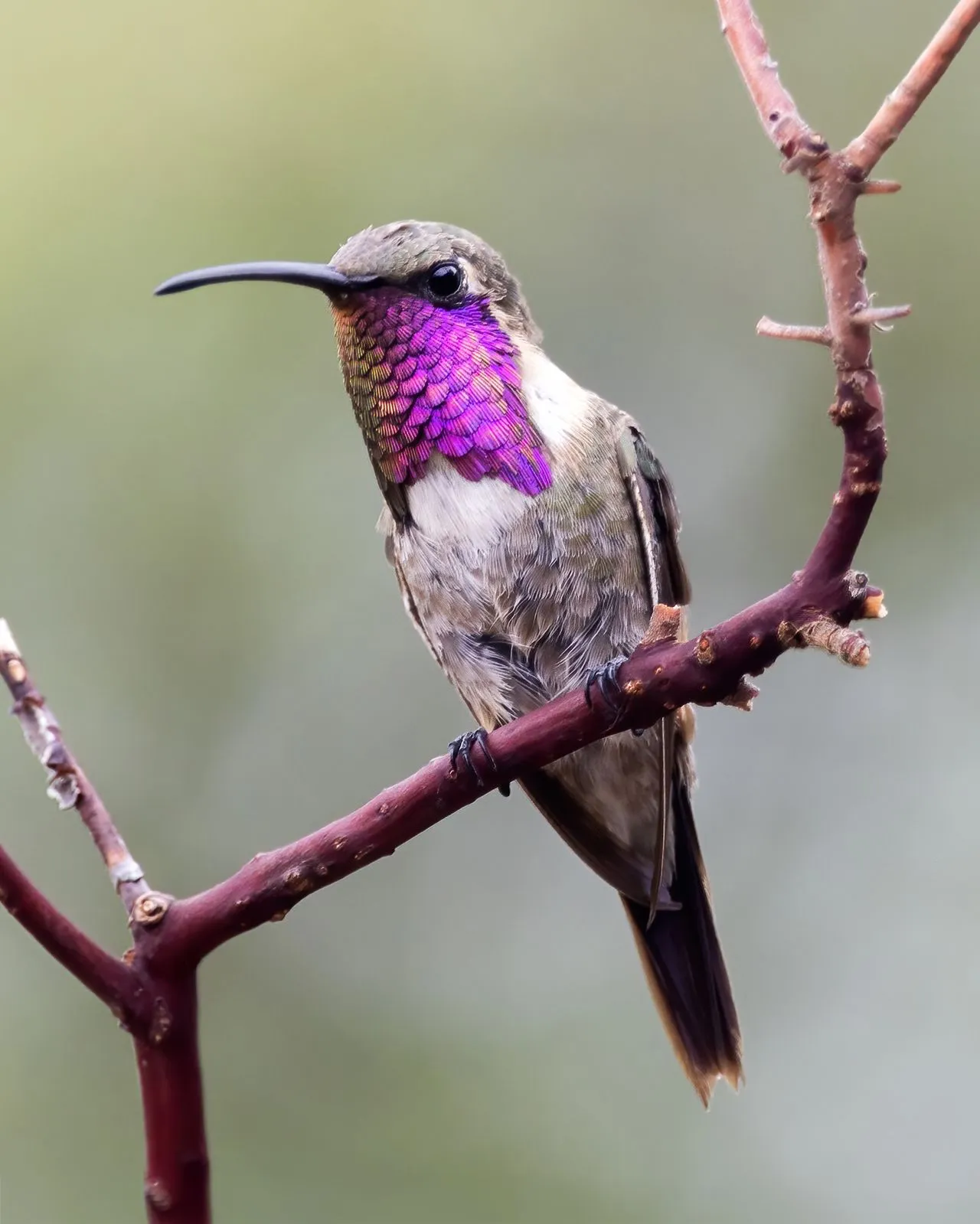
Lucifer Hummingbird (Calothorax lucifer, 2.7–3.6g) has a distinctly decurved bill, unique among North American hummingbirds. Males have a purple gorget. Found in desert canyons of west Texas, southern New Mexico, and Arizona sky islands.
Calothorax lucifer, the Lucifer Hummingbird, was described by Swainson in 1827 and weighs about 2.7-3.6 g, with a distinctly decurved bill that separates it from most small North American hummingbirds.
The name attracts attention, but the bill and habitat are the useful facts. This is a bird of arid slopes, desert canyons, agave country, and the northern edge of a primarily Mexican distribution, reaching the United States mainly in west Texas, southern New Mexico, and southeastern Arizona.
Part of the Complete Hummingbirds Guide.
Identification
| Character | Lucifer (C. lucifer) | Costa's (C. costae) |
|---|---|---|
| Body mass | 2.7-3.6 g | 2.5-3.2 g |
| Bill | Distinctly decurved | Short, slightly decurved |
| Adult male gorget | Long, flaring purple-magenta | Violet plumes beyond head sides |
| Tail | Relatively long, forked in male | Shorter, compact |
| Habitat cue | Desert canyons, agave slopes, sky islands | Desert scrub, arid canyons, dry gardens |
Visual
Adult male Lucifer Hummingbird is green above with a forked dark tail, buffy or whitish underparts, and a long, flaring purple gorget. The throat feathers extend down and outward, but the shape differs from Costa's: Lucifer is longer-tailed and shows the decurved bill. The gorget is structural; when the angle is poor it may look black or dull, then turn vivid purple-magenta when aligned with light.
Females are green above and buffy below, with the same decurved bill and a rounded to slightly notched tail with pale tips. The bill is often the first reliable field mark. A small desert hummingbird with a clearly down-curved bill should not be forced into Black-chinned or Costa's.
The body is slight but the tail looks relatively long. Males in display may appear angular, with the tail fork and gorget shape visible during turns.
Audio
Vocalisations are high chips and thin notes. Display includes rapid flights and close passes, but the species lacks Broad-tailed's sustained wing-trill. In arid canyons, detection is often visual: a bird moving between agave flowers, ocotillo, or a feeder, then perching on a bare twig.
Distribution
The core range is in Mexico. North of the border, Lucifer Hummingbird is local and irregularly distributed in the Big Bend region of Texas, parts of southern New Mexico, and southeastern Arizona. Its occurrence follows arid mountain and canyon habitat rather than broad desert flats.
Movements are not as familiar to casual observers as those of Ruby-throated or Rufous. Birds may appear where flowering agaves, desert shrubs, and canyon resources align, and feeders in appropriate habitat can reveal presence that would otherwise be missed.
Habitat
Lucifer Hummingbird uses desert canyons, rocky slopes, agave-studded hillsides, thorn scrub, arid washes, and sky-island foothills. It is particularly associated with places where nectar flowers occur in broken terrain rather than uniform lowland desert.
Agaves are important in many areas, but the bird is not restricted to a single plant. It uses a seasonal sequence of flowers and supplements them with arthropods gathered from vegetation and air.
Diet and Feeder Behaviour
The decurved bill suits curved or angled flowers, though hummingbird bills are not rigid one-plant tools. Lucifer feeds from agave, ocotillo, salvias, penstemons, and desert shrubs, and captures insects and spiders for protein.
At feeders it may be shy around larger or more aggressive hummingbirds. Black-chinned, Broad-billed, and Rufous can dominate busy stations. A smaller feeder placed near cover and away from the main cluster can give Lucifer access with lower competition.
Use 1 part white refined sugar to 4 parts water. In desert heat, replace solution often and clean ports thoroughly. Stronger syrup is not a substitute for maintenance and may be less appropriate physiologically.
Breeding Biology
Males display with gorget presentation and aerial movements, but do not assist after mating. Female-only nesting is typical. The female builds a small cup using plant fibres, down, and spider silk, usually in shrubs, small trees, or protected canyon vegetation.
The clutch is normally two eggs. Nesting depends on the overlap of nectar and arthropod availability, which in arid landscapes may follow rainfall patterns closely. A dry year can reduce flowering and insect emergence simultaneously.
Nest sites are often difficult to find because the female is quiet and the vegetation is structurally complex. Feeder presence during breeding season should not be treated as proof of local nesting unless accompanied by nest material carrying, repeated female routes, or dependent young.
Notes
Lucifer Hummingbird is a good example of why bill shape matters. Gorget colour can vanish with angle, size can be misjudged, and desert light can distort tones, but a decurved bill seen well is a durable character.
The species also illustrates the biological continuity between northern Mexico and the U.S. borderlands. Its U.S. appearances are not anomalies; they are the northern edge of a desert-mountain system that extends across the political line.
See Also
Frequently Asked Questions
How do I identify Lucifer Hummingbird?
The decurved bill is distinctive, curved downward noticeably. Male has a purple gorget (visible in good light), pale chest, and green back. Female has pale underparts and a slightly curved bill. The bill shape is the key identification feature.
Where does Lucifer Hummingbird range?
Primarily Mexican distribution reaching US in west Texas (Big Bend), southern New Mexico, and southeastern Arizona sky islands. Found in desert canyons, arid slopes, and agave-rich habitats.
Does Lucifer Hummingbird use feeders?
Yes, will visit feeders in its US range, especially in desert canyon communities. They may be outcompeted by larger hummingbirds like Costa's at shared feeders.
What makes Lucifer Hummingbird unique?
The decurved bill is unique among regularly occurring North American hummingbirds. It's adapted for feeding on desert flowers, especially those with curved corollas. The species name 'lucifer' means 'light-bringer'.