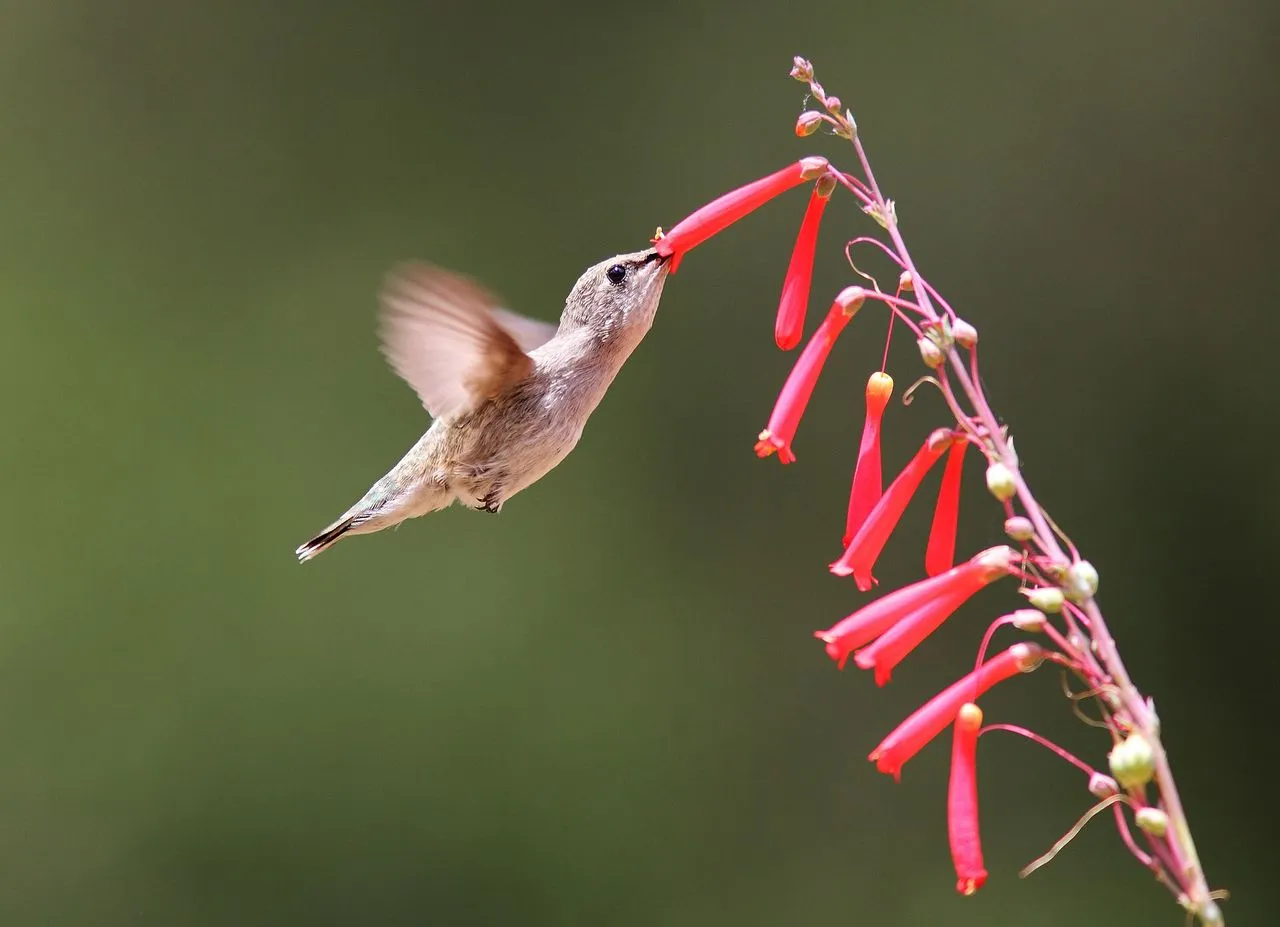
Black-chinned Hummingbird (Archilochus alexandri) is the western counterpart to Ruby-throated (2.7–4.2g). Males have a black chin with a narrow violet band at the lower gorget edge, the key identification feature. Found in riparian corridors, desert washes, and western gardens.
Archilochus alexandri, the Black-chinned Hummingbird, was described by Bourcier and Mulsant in 1846 and weighs roughly 2.7-4.2 g, occupying much of the western ecological role held by Ruby-throated Hummingbird in the East.
The comparison is useful but incomplete. Black-chinned is not a western copy. It is a bird of riparian corridors, desert washes, oak edges, gardens, and canyon feeders, with a male gorget whose decisive field mark is a narrow violet band rather than a red throat.
Part of the Complete Hummingbirds Guide.
Identification
| Character | Black-chinned (A. alexandri) | Ruby-throated (A. colubris) |
|---|---|---|
| Body mass | 2.7-4.2 g | 2.8-3.8 g |
| Adult male gorget | Black throat with narrow violet lower band | Full ruby-red throat when lit |
| Female-type birds | Nearly inseparable; use range and date | Nearly inseparable; use range and date |
| Range cue | Western U.S., Texas to Pacific states | Eastern breeding hummingbird |
| Sound cue | Thin chips; no wing-trill | Thin chips; no wing-trill |
Visual
Adult male Black-chinned Hummingbird is green above and pale below, with a dark chin and throat. In poor light the entire gorget appears black. When the bird turns into favourable light, a narrow iridescent violet band appears along the lower edge of the gorget. The upper chin remains black, not violet.
That violet line is structural colour, produced by feather microstructure rather than pigment. It may appear only for a fraction of a second. Observers who expect the whole throat to glow will miss it. The Ruby-throated male shows red across the gorget when lit; Black-chinned shows black above and violet below.
Females and immatures are green above, pale below, and white-tipped in the outer tail. Female Black-chinned and female Ruby-throated are among the hardest North American hummingbird pairs to separate visually. Range, date, and behaviour are often more honest than plumage claims.
Audio
The species gives high, thin chips and squeaky notes, especially during chases. It lacks the loud male wing-trill of Broad-tailed Hummingbird and the elaborate song of Anna's. At feeders, wing noise during rapid pursuits can be more conspicuous than vocal output.
Distribution
Black-chinned Hummingbird breeds broadly across the western United States, from Texas and Oklahoma through the Southwest, Great Basin, California interior, Pacific Northwest, and parts of the northern Rockies. It winters mainly in Mexico, with some individuals remaining along the Gulf Coast or in mild southwestern localities.
It is one of the characteristic breeding hummingbirds of Texas Hill Country, Arizona riparian corridors, New Mexico canyons, Utah valleys, and irrigated western towns. East of the Great Plains it is rare, and claimed records should be documented carefully because female Archilochus are difficult.
Habitat
The species is flexible but not random. It favours open woodland, riparian trees, desert washes with flowering shrubs, oak-juniper edges, orchards, gardens, and suburban areas with continuous bloom. In arid regions, water-shaped vegetation often determines local abundance.
Shade and perch structure are important. Males use exposed twigs to monitor territories, while females nest in trees or shrubs where overhanging cover reduces heat and predation.
Diet and Feeder Behaviour
Nectar sources include penstemon, ocotillo, desert willow, chuparosa, salvias, honeysuckles, and many garden flowers. Arthropods are taken by hawking and gleaning; spider webs are both food source and nest-material source.
At feeders Black-chinned can be territorial but is often less absolute in defence than Rufous. In high-density western yards, several may feed in rotation when ports are numerous and sightlines are broken. Use the standard 1:4 white sugar solution and clean frequently in heat. Desert and interior summer temperatures can make a feeder unsafe faster than its appearance suggests.
Do not use red dye or honey. The species finds the feeder by location and colour contrast; it does not need coloured liquid, and it cannot use non-caloric sweeteners.
Breeding Biology
Males perform U-shaped and shuttle displays, orienting the gorget so the violet band flashes toward the female. The display is brief and angular, not a prolonged song performance. After mating, the male provides no parental care.
The female builds a small cup of plant down, fibres, and spider silk, often saddled on a horizontal branch. Sycamore, cottonwood, oak, mesquite, and ornamental trees may all be used. Two eggs are typical. The nest expands as young grow because spider silk allows controlled stretch.
In hot regions, nest placement balances concealment and thermal load. A fully exposed cup can overheat; a deeply shaded cup may be harder to access and may carry different predator risks. Females solve this locally, which is why nest height and plant choice vary widely.
Notes
The Black-chinned Hummingbird is a useful corrective to overreliance on colour names. The chin is black only from most angles; the identifying colour is the narrow violet lower border that appears only when light and posture align.
For eastern observers travelling west, the best rule is to treat any female Archilochus with restraint. For western feeder hosts, the practical rule is hygiene: a Black-chinned using a feeder in 35 degrees C heat is visiting a microbial culture if the solution is not changed on schedule.
See Also
Frequently Asked Questions
How do I identify a male Black-chinned Hummingbird?
Male shows a black chin with a narrow violet or purple band at the lower edge of the gorget. The throat above the band is flat black, not ruby-red. From most angles the gorget appears black; the violet band is only visible from specific angles.
How do I separate Black-chinned from Ruby-throated?
Males: Black-chinned has a black throat with violet band; Ruby-throated has a full ruby-red gorget. Females are nearly indistinguishable, range is the best clue: Black-chinned is western, Ruby-throated is eastern.
Where does Black-chinned Hummingbird nest?
Western US and Mexico, riparian corridors, desert washes, oak woodland, canyon habitats, and suburban gardens. They nest in trees and shrubs, typically 1–3m above ground. Nest construction takes 7–10 days.
Do Black-chinned Hummingbirds use feeders?
Yes, they readily come to sugar water feeders, especially in desert and riparian habitats. They often coexist with Anna's Hummingbirds at western feeders. They're less aggressive than Rufous at feeders.