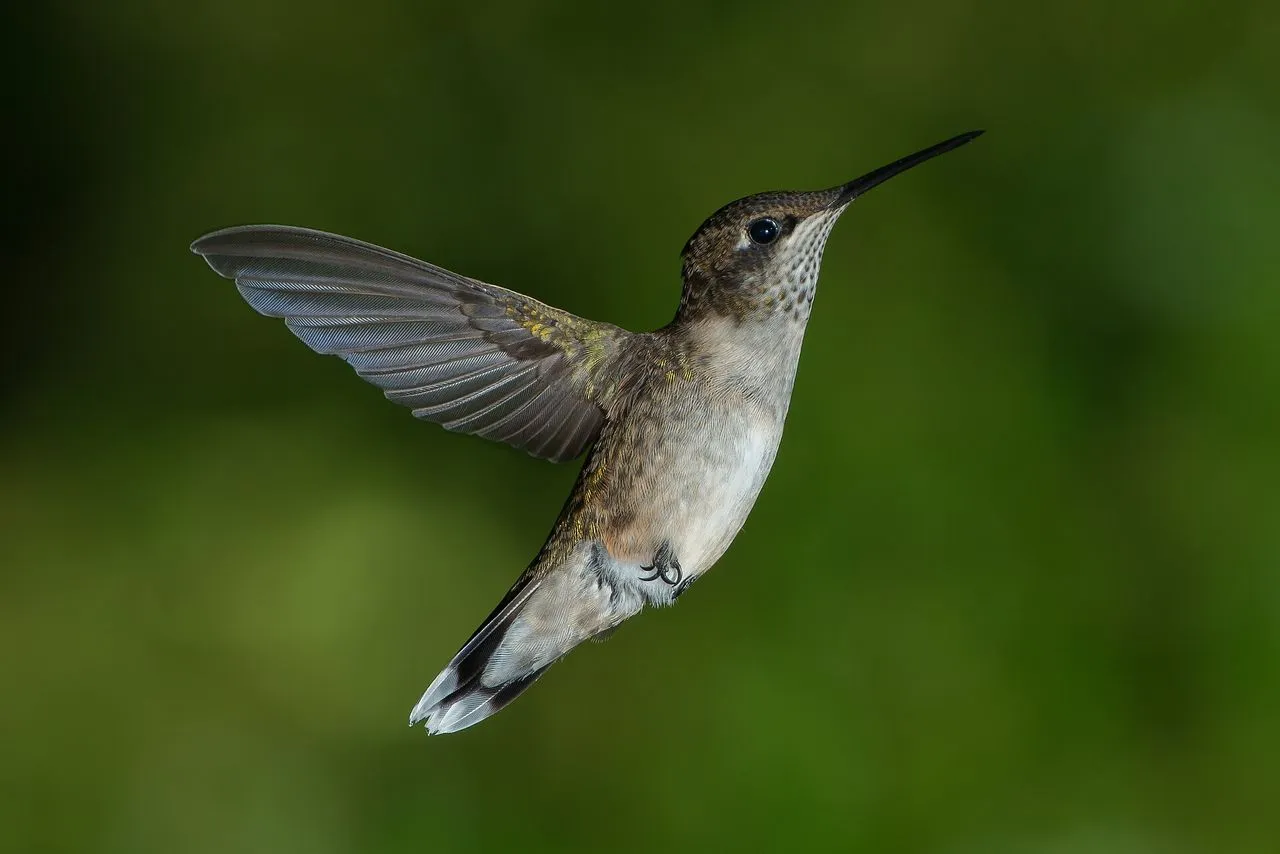
Ruby-throated Hummingbird (Archilochus colubris) is the ONLY hummingbird breeding east of the Mississippi. Males have iridescent ruby-red gorget; females have white throat with fine streaking. They cross the Gulf of Mexico (950km non-stop) in spring, doubling body fat to do so.
Archilochus colubris, the Ruby-throated Hummingbird, is the only member of the family Trochilidae that breeds regularly east of the Mississippi River, occupying a breeding range that extends from the Gulf Coast north to the boreal fringe of southern Canada and west across the Great Plains to Nebraska and the eastern Dakotas.
The species was described by Linnaeus in 1758 from a specimen of unknown provenance and has been in continuous scientific study since then, making it among the most thoroughly documented hummingbirds in North America. Its singular position as the only eastern breeding hummingbird means that any hummingbird encountered at a garden feeder from Florida to Maine is almost certainly this species.
Part of the Complete Hummingbirds Guide.
Identification
| Character | Ruby-throated (A. colubris) | Black-chinned (A. alexandri) |
|---|---|---|
| Body mass | 2.8-3.8 g | 2.7-4.2 g |
| Adult male gorget | Full ruby-red throat when lit | Black throat with narrow violet lower band |
| Female-type birds | Nearly inseparable where ranges meet | Nearly inseparable where ranges meet |
| Range cue | Only regular eastern breeder | Western U.S. and western Texas |
| Best field rule | East in breeding season strongly favours Ruby-throated | Use western range, date, and male gorget band |
Adult Male
The adult male is a compact bird of 2.8-3.5 g. Upperparts are iridescent green throughout, including the crown. The bill is straight to very slightly decurved, medium-length relative to head size. The tail is slightly forked and visible as such when the bird spreads it during hovering turns.
The definitive character is the gorget: the throat patch of iridescent ruby-red to crimson feathers that covers the chin and full throat but does not reach the crown. A narrow white band separates the lower gorget from the green breast. The gorget's colour is structural rather than pigmentary, produced by thin-film interference in the feather barbule platelets, and the hue perceived depends entirely on the angle between light source, feather, and observer. In shade, or with the bird facing away from the light, the gorget reads flat opaque black. Under direct frontal light it shows saturated crimson. This is the most frequent cause of field misidentification: a male dismissed as gorget-absent or logged as a possible Black-chinned because it was backlit at the moment of observation.
The Black-chinned Hummingbird (A. alexandri), the nearest relative and the species most likely to cause confusion in the western part of the range, shows a narrow violet band at the lower gorget edge and a flat non-iridescent black chin above it. In A. colubris the entire gorget is ruby when correctly lit; there is no violet component.
Female and Immature
Females are slightly larger than males, averaging 3.2-3.8 g. The upperparts are the same metallic green; underparts are white to buff-white, with light streaking on the flanks in some individuals. The gorget is absent. The outer three to four tail feathers are tipped white, a useful character visible when the tail fans during landing or hovering. A clean white post-ocular stripe runs from behind the eye and is consistent across ages and sexes.
Immature males resemble females through their first autumn and winter. A few scattered iridescent gorget feathers may appear by September or October of the first year; full gorget development is complete by the following spring before the first northward migration.
Female A. colubris and female A. alexandri are nearly inseparable in the field over most of the range. Where the two species overlap in Texas and the southern Great Plains, range and date are more reliable than plumage. In hand, primary spacing and bill curvature can be measured, but this requires a mist-netted bird.
Range: The Sole Eastern Breeding Hummingbird
East of the Mississippi, A. colubris is the only regularly breeding hummingbird. Vagrant records of other species occur annually in the East in small numbers, particularly Rufous Hummingbird (Selasphorus rufus) in autumn along the Gulf and Atlantic coasts, but no other species has established a breeding presence.
Breeding habitat is broad: open deciduous and mixed woodland, woodland edge, suburban gardens with flowering trees and shrubs, and any site that offers reliable nectar sources within reasonable foraging distance of a suitable nest location. The nest is a walnut-sized cup of plant down and spider silk, camouflaged externally with lichen, and typically placed on a downward-slanting twig 3-9 m above the ground. The silk is structural: as the nestlings grow, the spider silk stretches and the cup expands. The female builds the nest and raises the young without involvement from the male, whose contribution to breeding ends at copulation.
The Trans-Gulf Migration
The autumn southbound migration is the most physiologically demanding event in the annual cycle. Most eastern populations winter from central Mexico south through Central America to Panama. The direct route from the Gulf Coast of the United States to the Yucatan Peninsula crosses approximately 950 km of open water with no opportunity to land, feed, or rest.
Before departure, birds undergo a period of intensive feeding, hyperphagia, that roughly doubles body mass. A bird weighing 3.0-3.5 g in late summer fat-loads to approximately 5.5-6.0 g by late August or September. The subcutaneous and intramuscular fat deposited during this period is the sole energy source for the crossing. The flight takes an estimated 18-22 hours depending on wind conditions. Cold fronts moving through the Gulf states generate favourable tailwinds from the north, and birds show a strong tendency to initiate Gulf crossings in the 24-48 hours following a frontal passage.
The trans-Gulf route is not the only option. Some birds, particularly those further inland, take an overland route through Mexico via Texas, which allows for refuelling stops but adds considerable distance. Banding and stable isotope studies suggest the two strategies are used by different individuals within the same population rather than being geographically determined.
Spring migration reverses the route. Birds appear on the Gulf Coast of Texas and Louisiana from mid-March, move through the Southeast through late March and April, and reach southern Canada by mid-May. The timing of arrival at a given latitude is consistent enough year to year that local arrival dates recorded over multiple years provide a reliable installation guide for feeders.
Feeder Presence and Behaviour
A. colubris is strongly territorial at food sources. A single dominant individual, usually a male, will defend a feeder against all other hummingbirds for extended periods, chasing intruders with direct pursuit flights that are audible as a rapid wing-beat acceleration. At sites with high visitor density, deploying multiple feeders positioned out of direct sightlines from one another reduces the territorial overhead and allows more individuals to feed simultaneously.
Banding studies have established that individuals return to the same breeding territories and wintering sites in successive years, and that individual birds are site-faithful to specific feeders within their territories. A feeder maintained in a consistent location across seasons is more likely to be revisited by the same bird. The standard 1:4 sugar solution, cleaned every 2-3 days in warm weather, is the correct formulation; see the Complete Hummingbirds Guide for the full hygiene protocol and the specific reasons each common alternative fails.
In eastern gardens, the feeder window runs from the first local arrival dates in spring through to departure in September or early October. Leaving feeders up through October does not delay migration; departure is triggered by photoperiod, not food availability. A feeder that goes quiet from mid-July through late August is more often tracking the staggered male-then-female-then-juvenile departure than a fault at the feeder, see why have my hummingbirds stopped visiting for the eight ranked causes and a regional calendar.
See Also
- Black-chinned Hummingbird
- Rufous Hummingbird
- Anna's Hummingbird
- The Complete Attracting Guide
- The Complete Hummingbirds Guide
- Why Is My Hummingbird Aggressive?: why one male defends the feeder all season, with multi-feeder spacing.
Frequently Asked Questions
How do I distinguish male from female Ruby-throated?
Males have a brilliant iridescent ruby-red gorget and black chin. Females have a white throat with fine dark streaking, a plain face, and lack the male's red gorget. Immature males resemble females initially.
Do Ruby-throated Hummingbirds migrate across the Gulf?
Yes, most cross the Gulf of Mexico non-stop, a 950km journey taking about 20 hours. They double their body weight (from about 3g to 6g) as fat reserves before departure. Weather conditions over the Gulf determine migration timing.
Where does Ruby-throated Hummingbird breed?
From the Gulf Coast north to southern Canada (boreal fringe), and west across the Great Plains to Nebraska and the eastern Dakotas. Any hummingbird at an eastern US feeder from March-September is almost certainly this species.
What do Ruby-throated Hummingbirds eat?
Nectar from flowers (native tubular species like columbine, cardinal flower) and insects (small spiders, gnats, fruit flies). At feeders, they take 4:1 sugar water. They feed every 10–15 minutes during the day, visiting hundreds of flowers.