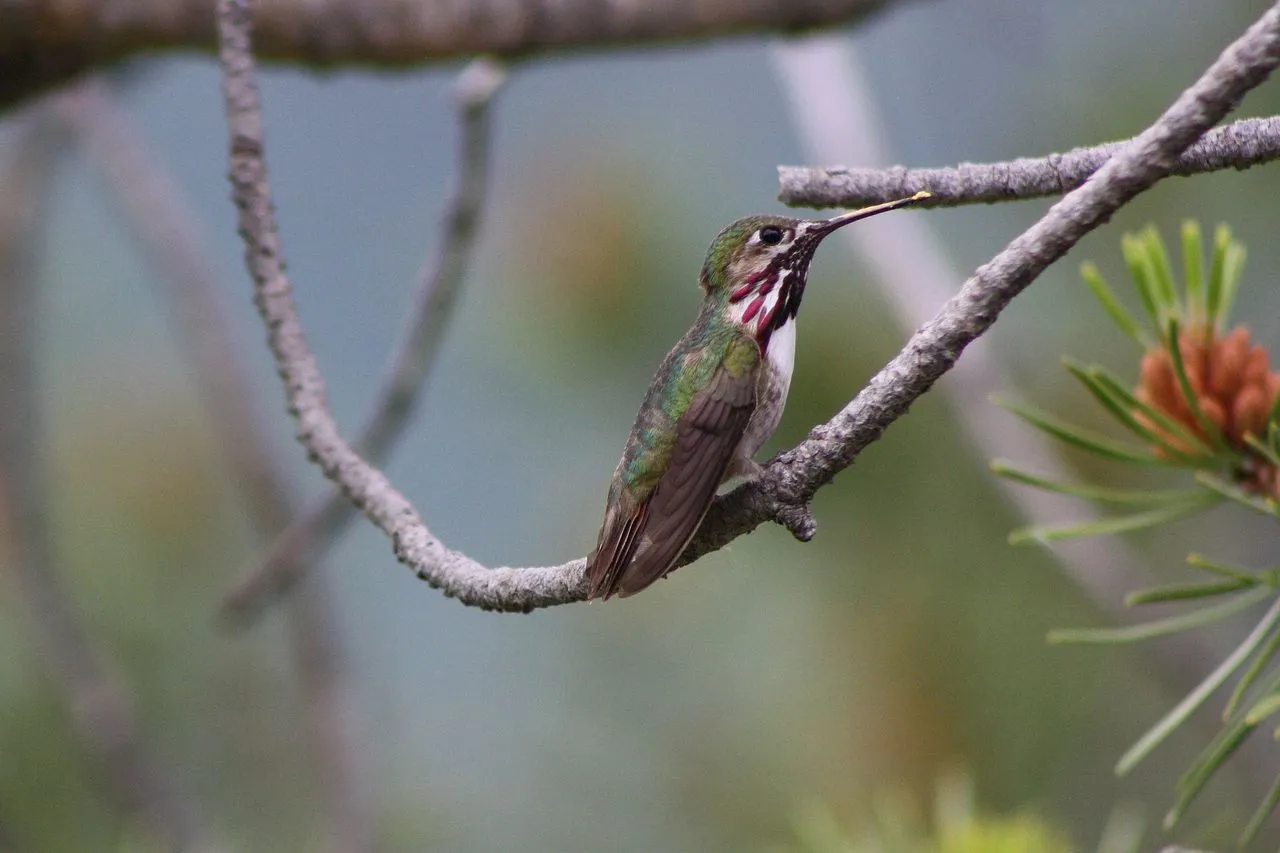
Calliope Hummingbird (Selasphorus calliope) is North America's smallest bird at 2.3–3.4g. Males have distinctive magenta gorget rays (not a continuous shield). They breed in mountain meadows across western North America and migrate through the interior West.
Selasphorus calliope, the Calliope Hummingbird, was described by Gould in 1847 and weighs roughly 2.3-3.4 g, making it the smallest regularly occurring bird in North America north of Mexico.
Small size is not the most useful field description unless measured. The more important fact is that this low-mass bird breeds in cool mountain systems, crosses large interior distances, and carries one of the most distinctive male throat patterns in the family: separated magenta rays rather than a continuous gorget shield.
Part of the Complete Hummingbirds Guide.
Identification
| Character | Calliope (S. calliope) | Other small Selasphorus |
|---|---|---|
| Body mass | 2.3-3.4 g | Usually larger, by species |
| Adult male gorget | Separated magenta rays | Continuous shield or orange-red gorget |
| Tail | Short, compact | Longer in Rufous, Allen's, Broad-tailed |
| Female-type cue | Small, short-tailed, limited rufous | More rufous or longer-tailed patterns |
| Caution | Size alone is unreliable | Use date, range, tail, and sound |
Visual
Adult male Calliope Hummingbird is short-tailed, compact, and green above with pale underparts. The gorget consists of narrow, elongated magenta to violet-magenta streaks that project downward and outward from the throat, leaving pale spaces between them. The colour is structural rather than pigmentary, so the throat can appear blackish or incomplete until the bird turns into direct light.
This ray-like gorget separates the adult male from Broad-tailed, Rufous, and Black-chinned in good views. The tail is short, and the posture often looks front-heavy compared with the longer-tailed Selasphorus species. Males average near 2.5-2.7 g in breeding condition.
Females and immatures are green above and whitish below with buff or cinnamon wash on the flanks. The tail is short with white-tipped outer rectrices and limited rufous. They can be difficult in migration, but the combination of small size, short tail, and mountain or interior-west context is useful. Do not assign female Calliope solely because a bird looks small; distance and posture mislead.
Audio
Male Calliope can produce a high, thin wing sound in display, but it is not the loud continuous wing-trill of male Broad-tailed Hummingbird. The male display includes rapid dives and shuttle flights, with mechanical sound produced by wings and tail. The wing sound is male-associated and display-linked; routine foraging birds may be nearly silent except for brief chips.
Distribution
Calliope breeds chiefly in the montane West: British Columbia, Alberta, the Pacific Northwest interior, Idaho, Montana, Wyoming, Nevada, Utah, and adjacent mountain systems. It favours elevations where late spring and summer flowering are compressed but abundant.
Migration is largely through the interior West, with many birds moving south through the Rocky Mountains and Great Basin to wintering grounds in Mexico. Spring arrival on breeding grounds is timed to early mountain bloom, while southbound movement often begins in July or August after breeding, when high meadows offer nectar before frost.
The species is an uncommon but regular migrant at feeders in appropriate western valleys. Vagrants occur east of the normal route, but identification requires care because immature Selasphorus hummingbirds can look deceptively similar in poor light.
Habitat
Breeding habitat includes open montane forest, regenerating burns, willow and alder edges, aspen stands, meadow borders, and shrubby slopes. A good Calliope site often contains both exposed male display perches and dense nesting cover nearby.
The species uses disturbance well when flowering plants follow. Post-fire landscapes can be productive if they support fireweed, paintbrush, penstemon, currant, and other nectar plants. Closed, dark forest with little understory bloom is much less suitable.
Diet and Feeder Behaviour
Calliope takes nectar from tubular flowers and consumes small arthropods gleaned from foliage and webs. Because its body mass is low, the time between profitable feeding bouts matters. Cold mornings in mountain valleys can be metabolically severe, especially after torpor.
At feeders it is often subordinate to Rufous, Broad-tailed, and Black-chinned hummingbirds. Rather than hold a port by force, a Calliope may use quick entries between dominant birds' patrol passes. Multiple small feeders placed apart are more useful than one defended central feeder.
Use the standard 1:4 sucrose solution: one part white refined sugar to four parts water. This matches the practical concentration used across North American hummingbird feeding and avoids the problems caused by honey, raw sugar, dye, or strong syrup.
Breeding Biology
Males establish small display territories and perform steep dives and close shuttle displays for females. The gorget rays are shown by orientation, not by pigment brightness alone; a male that looks plain from one angle can become unmistakable when the throat faces sun.
Females build the nest without male assistance, usually on a conifer branch, shrub stem, or sheltered horizontal support. The cup is made from plant down and spider silk with exterior camouflage. Two eggs are typical. Incubation and nestling care are female-only, as is usual in North American hummingbirds.
Mountain breeding imposes a short schedule. Females must complete nesting during the window when insects and nectar overlap. Late snowpack, cold rain, or mismatched bloom can reduce success without any obvious change at a feeder station downslope.
Notes
Calliope Hummingbird is now placed in Selasphorus by many taxonomic treatments, though older references used Stellula calliope. The change reflects phylogenetic work rather than any field-visible transformation; observers will still encounter the older genus in books and databases.
Its distinction is not ornamental smallness. A roughly 2.5 g bird breeding in cold mountain air and migrating to Mexico is operating with narrow energetic margins. Accurate identification depends on the male's streaked gorget, short tail, and context, not on the adjective usually attached to it.
See Also
Frequently Asked Questions
How do I identify a male Calliope Hummingbird?
Males have separated magenta rays on the throat, longitudinal streaks rather than a continuous gorget shield. The gorget appears dark from most angles but flashes magenta when the light catches the rays. Compare to other small Selasphorus.
Why is Calliope Hummingbird notable?
It's North America's smallest bird (2.3–3.4g). Despite tiny size, it breeds in cold mountain habitats and migrates long distances. Males perform a visual display, raising gorget rays like a fan during territorial interactions.
Where does Calliope Hummingbird breed?
Mountain meadows and forest edges across western North America, from British Columbia to California, Rockies to Pacific Northwest. They arrive late (June) due to cold breeding habitat and nest in subalpine zones.
Do Calliope Hummingbirds use feeders?
Less commonly than larger hummingbirds. They prefer native flowers in mountain habitats. In migration, they may stop at feeders in the interior West. Their small size limits competitive ability at crowded feeders.