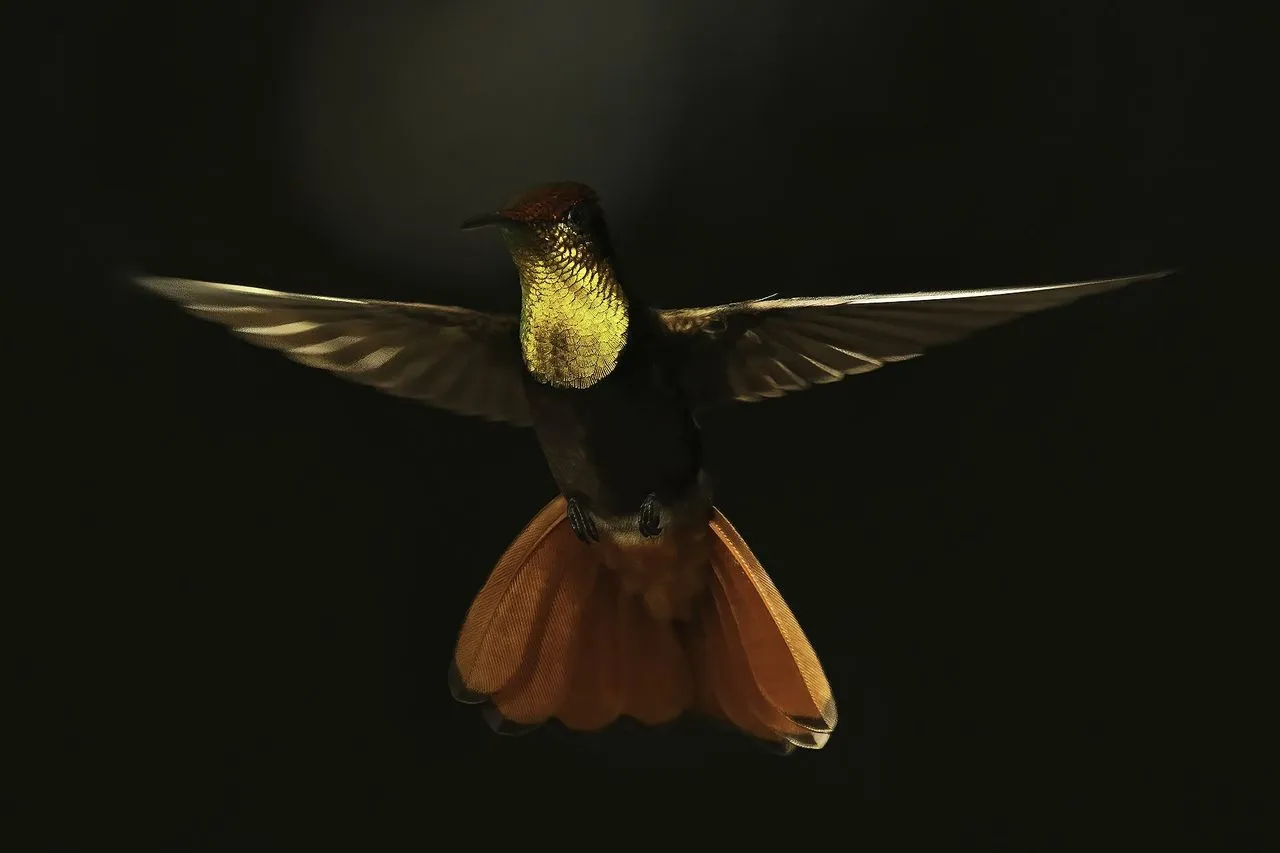
Feeder aggression in hummingbirds is normal resource-defence behaviour, not a sign that something is wrong. A dominant male treats a sugar-water feeder as he would a profitable flower patch: worth holding exclusively. Intervention is almost never warranted; the solution, when one is needed, is feeder layout, not bird management.
What looks like a dispute at a garden hummingbird feeder is not a behavioural aberration. It is a precision energy-economy calculation, and the bird that holds the feeder longest is operating correctly. Understanding why requires a short detour into hummingbird ecological energetics.
Quick answer: Feeder aggression in hummingbirds is a normal expression of resource-defence behaviour, not a sign that a bird is distressed. A dominant male that chases all visitors is maximising caloric intake, exactly as he would at a flower patch.
Best first step: If one bird is monopolising a single feeder, add a second placed at least 3 m away and out of direct sightline from the first. A dominant male cannot defend two feeding stations he cannot see simultaneously.
Avoid: Assuming that either the chasing bird or the bird being chased requires intervention. Physical injuries from hummingbird territorial encounters are uncommon, and capture or relocation is illegal under the Migratory Bird Treaty Act without federal authorisation.
Part of the Complete Hummingbirds Guide.
The Ecological Logic of Feeder Territoriality
Hummingbirds have a resting metabolic rate among the highest of any endotherm relative to body mass. A bird weighing 3 to 4 g must process enough sucrose daily to fuel continuous hovering flight, thermoregulation, and nocturnal torpor. In natural habitats, this requirement is met by defended patches of tubular flowers visited repeatedly across the foraging day.
When a sugar-water feeder enters this system, the bird's foraging circuitry treats it as a high-caloric flower patch: predictable, concentrated, and worth defending. The economics follow a standard optimal-defence model. A territory is worth holding when the caloric benefit of exclusive access exceeds the cost of continuous defence. A single feeder filled with 1:4 sucrose solution delivers a concentrated caloric package from a fixed location. The cost of chasing a rival is a brief burst of high-intensity flight. For a bird already in the area, that trade is almost always profitable.
This is why a single dominant Ruby-throated Hummingbird can hold a feeder station for weeks, and why removing the territory holder would simply result in a different individual taking the same position. The behaviour is tied to the resource, not to the individual.
Species Differences in Territorial Intensity
North American hummingbird species differ substantially in territorial aggression. Those differences correspond to ecological context, not species character.
| Species | Territorial intensity | Active season | Key feature |
|---|---|---|---|
| Rufous Hummingbird | Highest of common North American species | Migration stopovers and breeding | Pursues species larger than itself; stopover territories vary 100-fold in area |
| Anna's Hummingbird | High; year-round | Resident Pacific Coast | Persistent vocal defence; steep dive display up to 40 m |
| Ruby-throated Hummingbird | Moderate to high | May to mid-August (eastern breeding) | Male departs early July; juveniles less aggressive |
| Black-chinned Hummingbird | Moderate | Western breeding season | Less aggressive than Rufous; typically yields in overlap zones |
| Allen's Hummingbird | Moderate | Coastal California; some resident | Consistently loses to Rufous where ranges overlap |
Rufous Hummingbird
The Rufous Hummingbird (Selasphorus rufus) is the most aggressively territorial of the regularly occurring North American species. Cornell Lab documents it chasing resident Broad-tailed, Broad-billed, Violet-crowned, and Black-chinned hummingbirds even during brief one-to-two-week migration stopovers. It will pursue species considerably larger than its 3.1 to 3.6 g body mass.
The behaviour is resource economics. Kodric-Brown and Brown (1978) found that Rufous stopover territories vary 100-fold in area and roughly 5-fold in flower density, with each bird defending territory in proportion to the caloric value of the resource rather than a fixed spatial template. A rich stopover patch at a well-stocked feeder is worth aggressive defence; a sparse one is not worth the metabolic cost.
In overlap zones where Rufous meets Allen's Hummingbird (S. sasin), the Rufous typically wins contests for feeders and flower patches. This competitive asymmetry is the primary reason Allen's maintains a breeding range predominantly south of the main Rufous migration corridor.
Anna's Hummingbird
Anna's Hummingbird (Calypte anna) is year-round territorial along the Pacific Coast from Baja California north through California and into coastal Oregon and Washington. Unlike migratory species that defend territories seasonally, Anna's males hold territories continuously: courtship and nest defence in winter and spring, food-source defence in summer and autumn.
The territorial signal is primarily vocal. The male song runs to more than 10 seconds, long for a hummingbird, and is delivered from an exposed perch in a bush or small tree. Cornell documents males "noisily chattering" from these positions as a space-maintenance signal. When a rival enters the territory, the male shifts to the steep dive display: rising to approximately 40 m before plunging toward the target and producing a loud squeak at the bottom of the arc, generated by the outer tail feathers. This display is directed at rival males, potential mates, and occasionally at humans standing near the territory.
Ruby-throated Hummingbird
In eastern North America, the Ruby-throated Hummingbird (Archilochus colubris) is the only regularly breeding species, and feeder territorial behaviour peaks from May through early July. A dominant male holds a feeder territory roughly a quarter-acre in area across the breeding season, according to field data from Operation RubyThroat. The caloric value of a maintained feeder at the centre of such a territory justifies constant active defence.
The seasonal pattern has a clear structure. Males abandon breeding territories and move south from early July, well before females and juveniles. Feeder aggression from an adult male typically ends abruptly at departure, and the site becomes contested among younger and subordinate birds through August and September. For the regional calendar and the eight ranked causes of feeder absence, see why have hummingbirds stopped visiting.
Behaviours Often Misread as Aggression
Not all hummingbird flight activity at or near a feeder involves territorial intent. Several common behaviours are routinely misidentified.
| Behaviour observed | Ecological meaning | Action required |
|---|---|---|
| Male flies a steep U-shaped arc repeatedly over the same point | Courtship display directed at a female nearby | None |
| Bird hovers facing an observer at 1 to 2 m distance | Investigatory approach: assessing whether clothing or equipment is a flower | None |
| Single fast pass at an occupied feeder without landing | Territory-check flight to monitor current occupancy | None |
| Male perches nearby and chases every approaching bird | Active food-source territory defence | Add second feeder out of sightline if access is the concern |
| All feeder activity stops abruptly | Raptor in the area: check perches and nearby airspace | Wait; activity resumes when predator moves on |
Courtship Dive Displays
Both Ruby-throated and Rufous males perform dive displays directed at females entering or near their territory. The Ruby-throated male climbs steeply then arcs down through a U-shape repeatedly over the same ground point. The Rufous male performs a steep oval or J-shaped arc. Neither pattern is directed at feeders or rival males; the target in each case is a potential mate.
Anna's Hummingbird males direct their steep dive at both rival males and females. Cornell notes that a hovering display is sometimes directed at people standing near the territory. An Anna's male that hovers at 1 m from an observer and produces a sharp squeak at the end of the arc is performing a display sequence, not issuing a threat.
Investigatory Hovering
When a hummingbird hovers facing a person at close range, this is almost always exploratory: the bird is assessing whether a red or brightly coloured item is a flower. It is not a territorial signal. Holding still is the most useful response; sudden movement ends the interaction.
Territory-Check Fly-bys
A bird that makes a single rapid pass at an occupied feeder and then retreats is typically checking whether the site is accessible, not initiating a pursuit. This is standard foraging-loop behaviour and does not require the territory holder to engage in active defence.
When Is Intervention Warranted?
Almost never, for normal feeder territorial behaviour.
Physical injuries from hummingbird chases are rare. The loser of a territorial contest withdraws and locates an alternative nectar source. Natural habitats within a hummingbird's normal home range contain sufficient flower species and densities to support multiple individuals even when a feeder is monopolised.
Intervention is warranted only if a bird is grounded, injured, or entrapped. In those cases, the correct step is to contact a licensed wildlife rehabilitator. Attempting to handle, hand-feed, or relocate the bird is illegal under the Migratory Bird Treaty Act (MBTA) without federal authorisation. This applies regardless of the observer's intention.
Spreading Feeder Access: Practical Layout
The most effective response to a monopolised feeder is layout change, not bird management.
Place feeders out of direct sightline. A dominant bird defends a single feeder by perching nearby and chasing all comers. It cannot defend two stations it cannot see simultaneously. Cornell recommends four small single-port feeders positioned around a property over one large multi-port feeder. Two feeders on opposite sides of a building, or separated by dense planting, reduce the territorial overhead enough that subordinate birds can access one while the dominant bird holds the other.
Use more feeders, not larger ones. A feeder with eight ports visible from one perch is functionally a single territory. Four feeders with one port each, spaced at least 3 m apart and out of direct sightline, are substantially harder to monopolise. Full sizing and placement specifications are in Hummingbird Feeders Explained.
Add native nectar plants. Distributing caloric resources across a broader area reduces the strategic value of any single feeder. Relevant species for eastern gardens include cardinal flower (Lobelia cardinalis), bee balm (Monarda spp.), trumpet vine (Campsis radicans), and columbine (Aquilegia spp.). Western gardens benefit from penstemon, scarlet gilia, and Indian paintbrush. When natural nectar is available across the site, the feeder becomes one caloric resource among several rather than the only concentrated option, and monopoly behaviour decreases correspondingly.
Do not increase feeder size as a solution. A larger reservoir increases the caloric value of the resource and makes exclusive defence more worthwhile, not less.
Raptor Pressure: When the Feeder Goes Quiet
A complete cessation of feeder activity with no chasing visible is more likely to indicate raptor presence than hummingbird aggression. Three species are relevant at North American garden feeders:
Merlin (Falco columbarius) is a compact, fast falcon increasingly documented in suburban areas. It uses surprise to pursue small birds in open flight and will suppress hummingbird visits rapidly if hunting the approach lines to a feeder. The hunting approach is aerially direct rather than the low glide of an accipiter.
Sharp-shinned Hawk (Accipiter striatus) is a small-bird specialist and a regular presence at bird feeders during autumn migration. Cornell documents feeders as sites that attract Sharp-shinned Hawks precisely because small birds concentrate there. Its presence within sight of a hummingbird feeder will stop visits within minutes.
Cooper's Hawk (Accipiter cooperii) uses the same feeder-site hunting strategy, typically approaching from cover. Small birds including hummingbirds are within its prey range.
In all three cases the suppression is self-resolving. Raptors hunt and move on. Hummingbird activity resumes when the predator has been absent long enough for the birds to reassess the site as safe, typically within a few hours.
See Also
- The Complete Hummingbirds Guide: species accounts, migration schedules, and the full feeder protocol for all North American hummingbirds.
- Rufous Hummingbird: identification, the Pacific migration loop, and the ecological context behind the species' feeder dominance.
- Ruby-throated Hummingbird: the only regularly breeding eastern species, with feeder behaviour and the seasonal departure calendar.
- Hummingbird Feeders Explained: sugar ratios, cleaning intervals, feeder type selection, and the multiple-feeder layout that reduces territorial monopoly.
- Why Have My Hummingbirds Stopped Visiting?: the eight ranked causes of feeder absence, including raptor pressure and the migration calendar.
- The Complete Attracting Guide: cross-species reference for garden bird food, water, and feeding station design.
Frequently Asked Questions
Is it harmful for hummingbirds to chase each other?
Rarely. Physical injury from hummingbird territorial encounters is uncommon. The loser of a chase typically withdraws and locates an alternative nectar source. The energy cost of repeated chasing is a real metabolic concern for the territory holder, but this is offset by exclusive feeder access.
Will a dominant hummingbird starve the others by monopolising the feeder?
In practice, no. Subordinate birds shift foraging routes to alternative nectar sources, including natural flowers and additional feeders outside the dominant male's line of sight. The real cost is displacement, not starvation. Adding a second feeder out of direct sightline is the most reliable fix.
Is the dive display a form of aggression?
Not always. Dive displays in Ruby-throated and Rufous hummingbirds are primarily courtship signals directed at females. Anna's Hummingbird males perform a steep dive reaching up to 40 m, producing a sharp squeak at the bottom, and can direct this at rival males, potential mates, and occasionally at people standing near the territory.
Why does one hummingbird chase all the others, including much larger birds?
Resource-defence theory predicts that a territory holder will chase any competitor that could reduce caloric yield, regardless of body size. Rufous Hummingbirds in particular pursue species considerably larger than their 3.1 to 3.6 g frame because the energetic value of a profitable food source outweighs the cost of a short pursuit flight.
Do I need to contact wildlife authorities about an aggressive hummingbird?
No. All US hummingbird species are protected under the Migratory Bird Treaty Act (MBTA), which makes capture, relocation, and direct handling without a federal permit illegal. Normal feeder territorial behaviour does not warrant contact with authorities. A grounded or visibly injured bird is the exception: contact a licensed wildlife rehabilitator in that case.
Sources & References
- Cornell Lab of Ornithology / Birds of the World: Ruby-throated Hummingbird species account, feeding and territorial behaviour
- Cornell Lab of Ornithology / All About Birds: Rufous Hummingbird life history and interspecific aggression
- Cornell Lab of Ornithology / All About Birds: Anna's Hummingbird life history and year-round territoriality
- Kodric-Brown A, Brown JH (1978). Influence of economics, interspecific competition, and sexual dimorphism on territoriality of migrant Rufous Hummingbirds. Ecology 59(2): 285-296
- Project FeederWatch, Cornell Lab of Ornithology: community phenology data on hummingbird feeder use and territorial behaviour
- Cornell Lab of Ornithology / All About Birds: Feeding Hummingbirds, feeder design and multiple-feeder strategy
- International Hummingbird Society: territorial behaviour, feeder guidance, and species accounts
- US Fish and Wildlife Service: Migratory Bird Treaty Act (1918), protections applicable to native hummingbird species