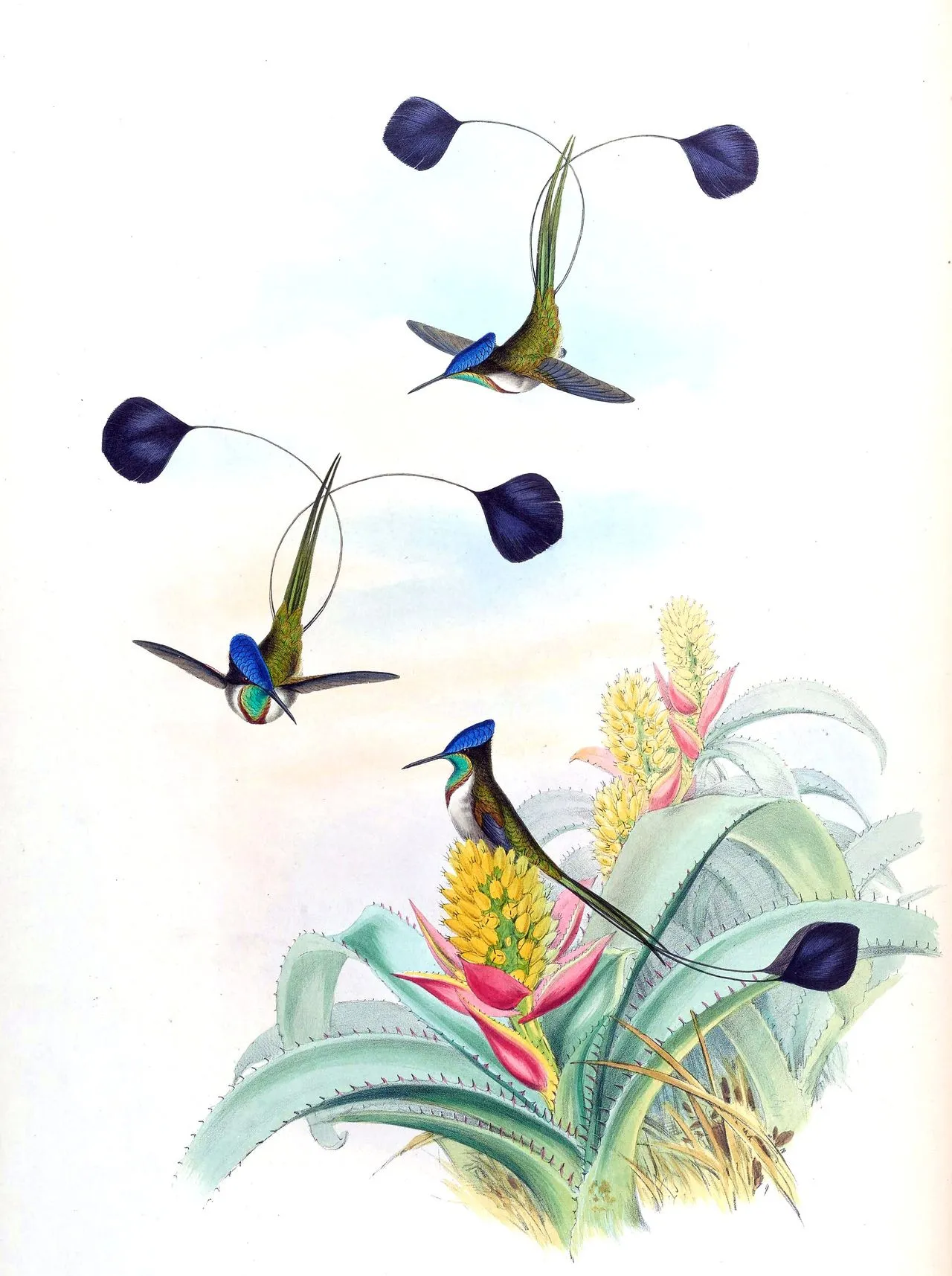
Marvelous Spatuletail (Loddigesia mirabilis) is an endangered Peruvian hummingbird with only 4 functional tail feathers in males, the outer two have blue-violet spatules. Found in northern Peru cloud forests. Population estimated in low hundreds.
Loddigesia mirabilis, the Marvelous Spatuletail, was described by Bourcier in 1847 and is known for an adult male tail reduced functionally to four feathers, including two elongated outer shafts ending in blue-violet spatules.
The species is not a general Andean showpiece. It is a highly local hummingbird of northern Peru, with a small and fragmented population often estimated in the low hundreds to perhaps around 1,000 individuals. Its display morphology is spectacular; its conservation position is precarious.
Part of the Complete Hummingbirds Guide.
Identification
| Character | Male Marvelous Spatuletail (L. mirabilis) | Female Marvelous Spatuletail (L. mirabilis) |
|---|---|---|
| Tail | Four-feather system with two spatules | Shorter tail, no elongated spatules |
| Display cue | Crossed shafts with blue-violet spatules | No male racket display |
| Upperparts | Green | Green |
| Underparts | Pale with iridescent head and throat elements | Pale and less conspicuous |
| Range cue | Restricted northern Peru | Same restricted northern Peru range |
Visual
Adult male Marvelous Spatuletail is unmistakable when the tail is developed. Two long bare shafts cross and move independently, each ending in a rounded iridescent spatule. The remaining tail is greatly reduced, so the display apparatus consists of a four-feather system rather than a broad tail fan.
The male also shows green upperparts, pale underparts, and iridescent throat and head elements, but the tail is the diagnostic structure. The spatules are structural colour surfaces, changing intensity with angle as the bird moves them during display.
Females lack the elongated spatules and are much less conspicuous: green above, pale below, with shorter tail feathers. Identification of females depends on range, structure, and local knowledge; they should not be expected to resemble the male ornament.
Audio
The species gives high chips and display-associated sounds, but the field centre is visual. Males display at close range in lek-like settings, hovering and swinging the spatules in controlled arcs. Any mechanical sound is secondary to the precise visual movement of the tail ornaments.
Distribution
Marvelous Spatuletail is endemic to a restricted area of northern Peru, especially in the Amazonas region of the eastern Andean slope. Its known range is small, fragmented, and tied to specific elevations and habitat patches.
It does not occur naturally in North America, Central America, or the Caribbean. Its inclusion in a hummingbird reference is justified by its extreme morphology and conservation importance, not by backyard likelihood.
Habitat
The species uses humid montane forest edge, secondary growth, scrubby slopes, and flowering patches within a narrow elevational band. It can occur in disturbed habitat if flowering shrubs and display sites remain, but broad habitat degradation reduces the continuity required for a viable population.
Conservation plantings of nectar shrubs have been used locally to support feeding opportunities. Such measures help, but they are not substitutes for retaining landscape-scale habitat structure, nesting cover, and movement corridors.
Diet and Feeder Behaviour
Marvelous Spatuletails feed on nectar from native flowers and take small arthropods. The male's display tail imposes aerodynamic cost, so reliable nectar near display areas matters. Females raising young require arthropods for protein, as in other hummingbirds.
Where managed feeders or gardens are used in conservation settings, the standard 1:4 white sugar solution is the appropriate baseline. Feeder use must be paired with strict hygiene; rare birds should not be concentrated at contaminated food sources.
The species' feeding ecology is inseparable from local plant communities. A display site without nearby nectar may attract observers but is not sufficient habitat.
Breeding Biology
Males display in small arenas or lek-like settings, using the tail spatules in rapid, symmetrical movements while hovering before females. The display is one of the clearest examples of sexual selection producing an ornament that appears aerodynamically costly but visually precise.
After mating, the female nests alone. The nest is a small cup built from plant material and spider silk, placed in vegetation. Two eggs are expected for the family pattern, though detailed breeding observations are limited compared with common North American species.
Male ornament does not translate into parental investment. The female's success depends on nest concealment, nectar access, arthropod supply, and weather conditions in a restricted montane landscape.
Notes
The Marvelous Spatuletail is often listed as Endangered or Critically Endangered depending on authority and assessment period, with population estimates commonly cited around 250-1,000 individuals. The exact number is less important than the order of magnitude: this is not a secure species.
Its tail is biologically extravagant, but the conservation lesson is plain. A bird can survive a costly ornament if habitat is intact and mate choice rewards it. Remove the flowering slopes and nesting cover, and the same ornament becomes irrelevant because the population base is gone.
See Also
Frequently Asked Questions
Why does male Marvelous Spatuletail have such an unusual tail?
The male's tail is reduced to 4 feathers, two central and two elongated outer with spatula-shaped tips. This is a sexual selection display. The tail is used in breeding displays, showing spatules to attract females.
Where is Marvelous Spatuletail found?
Extremely restricted range in northern Peru, cloud forest at 2,200–2,900m in the Andes. Found only in a few locations. Not found in North America. This limited range makes them vulnerable to habitat loss.
Is Marvelous Spatuletail endangered?
Yes, listed as Endangered with a population estimated at 250–999 individuals. Habitat loss and fragmentation are the main threats. Conservation relies on protecting remaining cloud forest habitat.
What is the spatuletail display?
Males perform a display flight showing the spatules, holding the tail feathers spread and raised, displaying the blue-violet tips. They lek, with multiple males displaying in proximity to attract females.