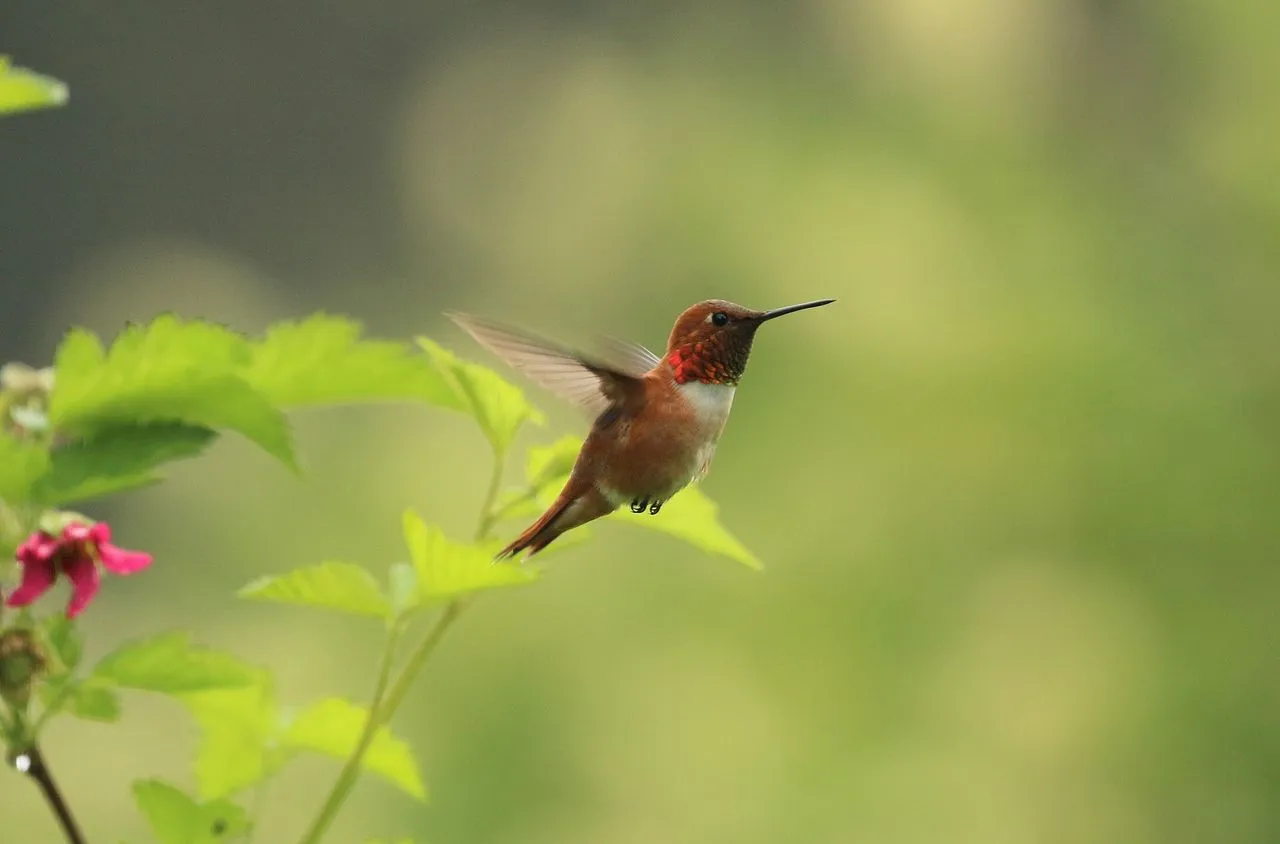
Rufous Hummingbird (Selasphorus rufus) weighs just 3.1–3.6g but migrates 6,000+ km from Mexico to Alaska, the longest migration relative to body size of any hummingbird. Males are bright rufous-orange; females have green back and rufous flanks. Known for extreme feeder territoriality.
Selasphorus rufus, the Rufous Hummingbird, was described by Gmelin in 1788 and weighs approximately 3.1-3.6 g, yet many individuals move more than 6,000 km between Mexican wintering grounds and breeding territories that reach coastal Alaska.
That distance is not merely long for a hummingbird. Relative to body length, it is among the most extreme annual migrations known in birds. A bird the length of a human thumb crosses latitudes used by shorebirds, raptors, and waterfowl, but does so on a metabolic system that must be refuelled every few hours whenever weather permits.
Part of the Complete Hummingbirds Guide.
Identification
| Character | Rufous (S. rufus) | Allen's (S. sasin) |
|---|---|---|
| Body mass | 3.1-3.6 g | 2.8-3.6 g |
| Adult male back | Usually entirely rufous | Green back with rufous rump |
| Female or immature | Often unsafe without range and tail detail | Often unsafe without range and tail detail |
| Migration cue | Mexico to Pacific Northwest and Alaska | Coastal California/Oregon breeder; some resident |
| Field caution | Green-backed males occur | Core breeding range helps most |
Visual
Adult male S. rufus is the most orange of the regularly occurring North American hummingbirds. The back, rump, flanks, and tail are rufous to copper-orange, with little or no green on the mantle in the typical male. The gorget is orange-red to copper-red, structural rather than pigmentary, and will appear black if the bird is turned even slightly away from direct light. In full sun the same feathers flash like polished copper.
The tail is tapered and rufous, with dark tips on the outer rectrices. The bill is straight and short to medium in length. Males are smaller than females on average, usually near 3.2 g in breeding condition. Females and immatures are green-backed with rufous flanks, white underparts, and a tail pattern that includes rufous at the base and white tips on the outer feathers. Female Rufous and female Allen's are not safely separable in many field views; date and location matter.
The most reliable male field distinction from Allen's Hummingbird is the back. Adult male Rufous usually shows an entirely rufous back, while adult male Allen's usually retains a green back. Exceptions occur, particularly green-backed Rufous males, which is why a single dorsal character should not be treated as absolute outside core range.
Audio
Rufous Hummingbirds do not produce the persistent wing-trill that makes male Broad-tailed Hummingbirds conspicuous in mountain meadows. Their soundscape at feeders is instead dominated by short, hard chips, rapid chase notes, and the dry wing noise of territorial pursuit. A male defending a patch often announces himself less by song than by repeated acceleration flights toward intruders.
Distribution
The breeding range extends farther north than that of any other hummingbird, from the Pacific Northwest through British Columbia and into coastal and south-central Alaska. Southbound migration begins early. Adult males can leave breeding territories in June or July, with females and juveniles following later.
The route is not a simple north-south line. Northbound birds move chiefly up the Pacific Coast, tracking early flowering along low elevations. Southbound birds often swing inland through the Rocky Mountains, using high-elevation meadows rich in late-summer tubular flowers. The result is a broad migration loop: coastal spring ascent, interior mountain autumn descent, and wintering mainly in Mexico.
Vagrants appear regularly across eastern North America in autumn and winter. Many eastern late-season hummingbird reports that are not Ruby-throated prove, on banding, to be Rufous. The species tolerates cool conditions better than its mass would suggest, but survival at winter feeders still depends on unfrozen solution and adequate arthropod intake.
Habitat
Breeding habitat is open or semi-open: forest edge, second growth, alder thickets, brushy clearings, riparian growth, and mountain meadows. In Alaska and British Columbia it often occupies cool coastal or subalpine sites where flowering phenology is compressed into a short season.
On migration it uses almost any nectar-rich habitat: montane meadows, burns with flowering fireweed, gardens, canyon edges, and desert oases. The species is quick to exploit feeders but does not become dependent in the ecological sense unless natural nectar is locally absent during cold periods.
Diet and Feeder Behaviour
Nectar supplies the rapid carbohydrate stream; small insects and spiders provide protein, lipid, and micronutrients. Rufous Hummingbirds take arthropods by hawking, gleaning from foliage, and robbing spider webs. A bird feeding only on sucrose solution is not being fully nourished.
At feeders this species is famously aggressive. A single Rufous may dominate ports against Ruby-throated, Black-chinned, Calliope, and even larger species. The behaviour is not temperamental excess. It is resource economics. A migrant carrying little margin cannot allow repeated losses at a profitable nectar source.
Use the standard 1:4 white sugar to water solution. Stronger mixtures are not superior; they change viscosity and move outside the common concentration of preferred flowers. Multiple feeders placed out of direct sightline reduce chase costs better than a single large feeder with many ports.
Breeding Biology
Males arrive early and establish display territories. Courtship includes steep J-shaped and oval display flights near the female, with the gorget flashed at specific angles. Males do not assist with nest construction, incubation, or feeding.
The female builds a compact cup of plant down, moss, lichen, and spider silk, usually on a descending conifer or shrub branch. Clutch size is normally two eggs. Incubation lasts about 15-17 days, and nestlings fledge roughly three weeks after hatching, depending on temperature and food supply. Spider silk allows the nest wall to expand as the young grow.
Notes
The Rufous Hummingbird is declining in several monitoring datasets, plausibly from a combination of habitat alteration along migration routes, changes in flowering phenology, and forest management effects on breeding habitat. Its life history leaves little slack. A delayed bloom sequence in the Rockies or poor coastal spring conditions can affect birds far from the point where the problem is observed.
Its migration remains the central fact of the species. A 3.3 g bird linking Mexican wintering grounds, Pacific coastal spring flowers, Alaskan breeding territories, and Rocky Mountain autumn meadows is a precision system built on timing. Feeders help when kept clean, but the species is ultimately tied to a continental chain of native nectar and insect pulses.
See Also
- Allen's Hummingbird
- Calliope Hummingbird
- Broad-tailed Hummingbird
- The Complete Attracting Guide
- The Complete Hummingbirds Guide
- Why Is My Hummingbird Aggressive?: why Rufous wins almost every territorial encounter, with feeder-layout fixes.
- Allen's vs Rufous Hummingbird: why 5 percent of Rufous males show green backs identical to Allen's, and what marks resolve the ID.
Frequently Asked Questions
How do I identify a Rufous Hummingbird?
Male: brilliant rufous-orange on back, tail, and gorget, with white chest patch. Female: green upperparts, rufous flanks and tail base, white throat with variable streaking. The rufous colour is distinctive, compare to Allen's (green-backed).
Why is the Rufous Hummingbird's migration remarkable?
They travel 6,000+ km from Mexican wintering grounds to breeding territories in Alaska, nearly the full length of the continent. Relative to body size (about 8cm), this is the longest migration of any hummingbird. They refuel every few hours.
Are Rufous Hummingbirds aggressive at feeders?
Extremely, they establish and defend feeding territories with intense aggression. A single male may dominate a feeder, driving away other hummingbirds. This territorial behaviour intensifies during spring migration when they arrive on breeding grounds.
Where does Rufous Hummingbird breed?
From southern California (breeding in late winter) north through the Pacific Northwest to coastal Alaska. They follow a loop migration, northbound through the Rockies, southbound along the Pacific Coast.