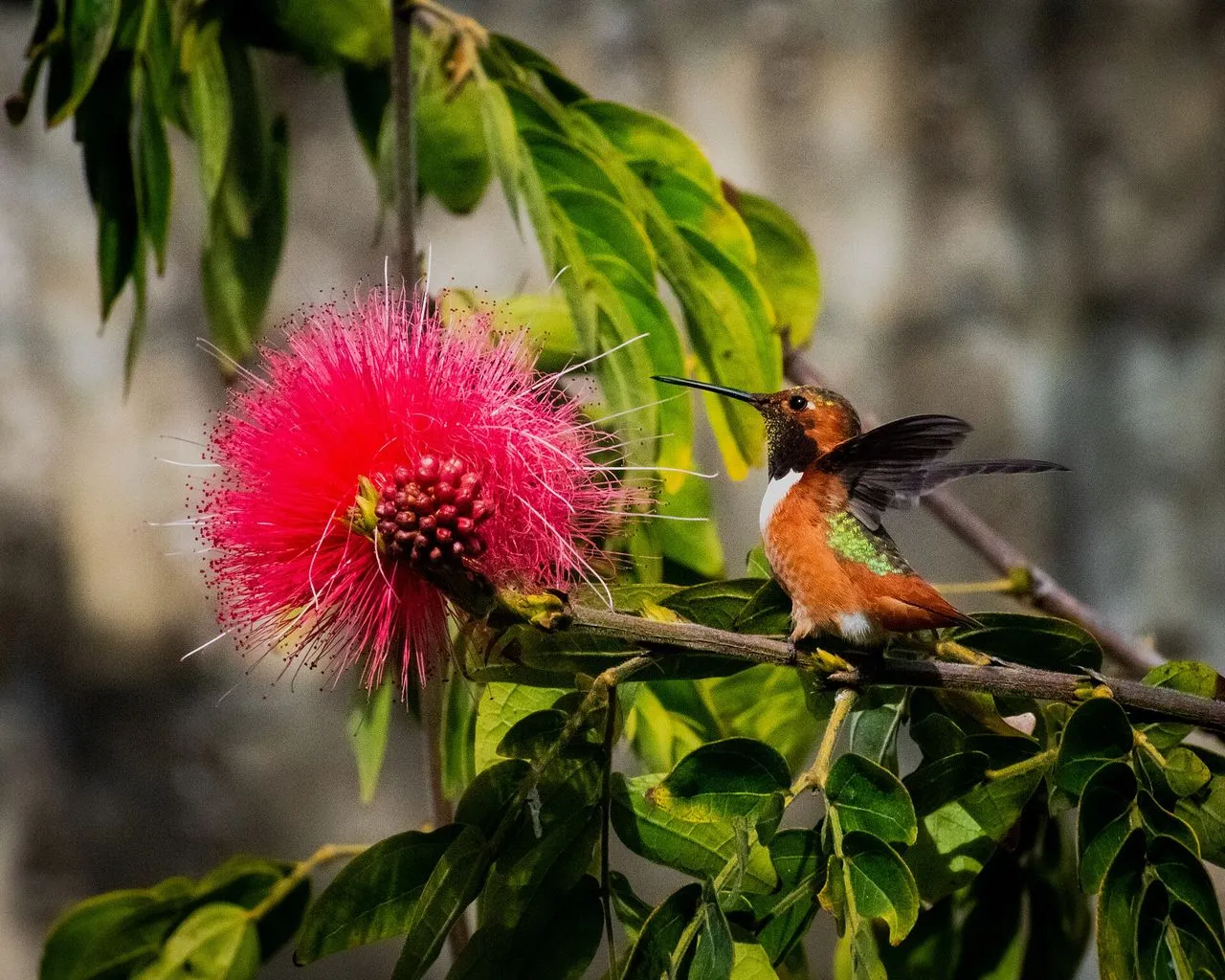
Allen's Hummingbird (Selasphorus sasin) is a coastal California specialist (2.8–3.6g). Males have green back (not rufous like Rufous), orange gorget, and distinctive pendulum display flight. A resident population exists on Catalina Island and urban areas. Often confused with Rufous.
Selasphorus sasin, Allen's Hummingbird, was described by Lesson in 1829 and is a 2.8-3.6 g coastal specialist whose breeding distribution is concentrated along California and southern Oregon rather than spread broadly across western North America.
The species is often introduced as a Rufous Hummingbird look-alike. That is true but insufficient. Allen's is the coastal Selasphorus with a compressed range, a distinctive male display, and a resident southern California island and urban population that behaves differently from the migratory birds farther north.
Part of the Complete Hummingbirds Guide.
Identification
| Character | Allen's (S. sasin) | Rufous (S. rufus) |
|---|---|---|
| Body mass | 2.8-3.6 g | 3.1-3.6 g |
| Adult male back | Green, with rufous rump | Usually entirely rufous |
| Female or immature | Often unsafe away from range context | Often unsafe away from range context |
| Core breeding cue | Coastal California and southern Oregon | Pacific Northwest to Alaska |
| Field caution | Use date, place, tail details | Green-backed males occur |
Visual
Adult male Allen's Hummingbird shows a green back, green crown, rufous flanks, rufous rump, and a flaring orange-red gorget. The gorget colour is structural, not pigmentary; at the wrong angle it turns dark bronze or black, then burns orange when the bird faces light. The tail is rufous with dark tips and is used actively in display.
The male's green back is the practical field mark against typical male Rufous Hummingbird, which usually has an all-rufous back. The word usually matters. Green-backed Rufous males occur, and female or immature Allen's and Rufous are often beyond safe field separation without measurements of tail feathers and wing formula. In coastal California in the breeding season, Allen's is the default Selasphorus; in autumn away from the immediate coast, caution is required.
Females are green above, pale below, and washed rufous on the sides. The tail has rufous bases, dark subterminal markings, and white tips on the outer rectrices. Immature males resemble females until gorget feathers appear in scattered patches.
Audio
Allen's Hummingbird produces sharp chip notes and a buzzy, mechanical quality during display flights. It lacks the sustained, diagnostic wing-trill of male Broad-tailed Hummingbird. In breeding territories, sound often arrives as a sequence: a sharp vocal note, a high-speed display pass, and a brief dry wing or tail component produced by air moving across feathers.
Distribution
The migratory form breeds along a narrow Pacific strip from southern Oregon through coastal California, especially where scrub, woodland edge, and coastal gardens provide sequential flowering. It winters primarily in central Mexico.
The sedentary form associated with southern California, including the Channel Islands and the Los Angeles Basin, is often treated as S. s. sedentarius. These birds may breed in winter or early spring and are now common in irrigated urban and suburban landscapes where ornamental plants and feeders supply nectar through dry periods.
This split between migratory and resident strategies is important for interpretation. A February Allen's in coastal Los Angeles is not behaving like a May breeder in northern California. Same species, different annual schedule, different local ecology.
Habitat
Allen's is tied to coastal scrub, chaparral edge, eucalyptus groves, riparian strips, gardens, and open woodland. In the north it often breeds near moist coastal vegetation where spring flowering is reliable. In the south it uses human-modified habitats extensively, particularly where flowering exotics fill gaps left by seasonal drought.
Territories are small but vigorously defended when nectar is concentrated. Males favour exposed perches with clear display space. Females select nest sites in shrubs or low trees, often within structurally dense vegetation that conceals the cup from above.
Diet and Feeder Behaviour
The diet is nectar plus arthropods. Flower use includes native sages, currants, monkeyflowers, penstemons, and a long list of ornamental tubular flowers. Arthropods are taken from foliage, spider webs, and aerial sallies; they are essential during egg formation and nestling growth.
At feeders Allen's behaves like a typical Selasphorus: fast, territorial, and intolerant of close competitors. A male may hold a feeder, a flowering shrub, and several lookout perches as a single defended unit. Standard feeder solution remains 1 part white refined sugar to 4 parts water. Red dye is unnecessary; the feeder structure, not coloured liquid, draws the bird.
Where resident birds remain year-round, hygiene cannot be relaxed simply because visitation is familiar. Warm coastal conditions ferment sugar solution quickly, and a feeder that looks clear can still carry yeast film in the ports.
Breeding Biology
Male Allen's perform pendulum and shuttle displays close to the female, often tracing repeated arcs while exposing the gorget. As in most Trochilidae, the male's parental contribution ends with mating. There is no pair bond in the passerine sense.
The female constructs a small elastic cup of plant down and spider silk, camouflaged with lichen or plant fragments. Placement is commonly in shrub or tree forks from low height to several metres above ground. The usual clutch is two eggs. Incubation is by the female alone, and she feeds nestlings a mixture of nectar and partially digested arthropods.
In southern California, nesting can begin very early, sometimes in winter, because ornamental flowering and feeders reduce the seasonal bottleneck that would otherwise prevent breeding before native spring bloom.
Notes
Allen's Hummingbird is not simply a smaller-range Rufous. Its restricted coastal distribution, resident southern populations, and heavy use of urban plantings make it a useful species for observing how hummingbird life histories respond to human-altered nectar calendars.
The caution for field observers is identification humility. Adult males in core breeding range can be named quickly. Female and immature Selasphorus away from breeding context deserve restraint. A confident false Allen's is less useful than a correctly labelled Selasphorus species with date, location, photographs, and tail details.
See Also
- Rufous Hummingbird
- Anna's Hummingbird
- Black-chinned Hummingbird
- The Complete Attracting Guide
- The Complete Hummingbirds Guide
- Allen's vs Rufous Hummingbird: the Pacific Coast ID nightmare; back colour, tail feather shape, and why females are inseparable in the field.
Frequently Asked Questions
How do I separate Allen's from Rufous Hummingbird?
Males: Allen's has green back and rufous rump; Rufous is rufous throughout. Females: Allen's shows limited rufous at tail base; Rufous shows extensive rufous. In coastal California, if it's late winter/spring, it's likely Allen's. Rufous passes through later.
What is the Allen's Hummingbird display flight?
Males perform a distinctive 'pendulum' display, flying in a wide arc with a clicking sound, pausing at each end of the swing. This is different from the diving display of other Selasphorus. It functions as both territorial and courtship display.
Are there resident Allen's Hummingbirds?
Yes, a resident population exists on Catalina Island and in urban areas of Southern California. These non-migratory birds breed year-round with multiple broods. The migratory population breeds in coastal California and Oregon, then migrates to Mexico.
Where does Allen's Hummingbird breed?
Coastal California and southern Oregon, concentrated in the fog belt from Santa Barbara to northern California. They prefer coastal scrub, chaparral, and gardens. Range is much more restricted than the widespread Rufous Hummingbird.