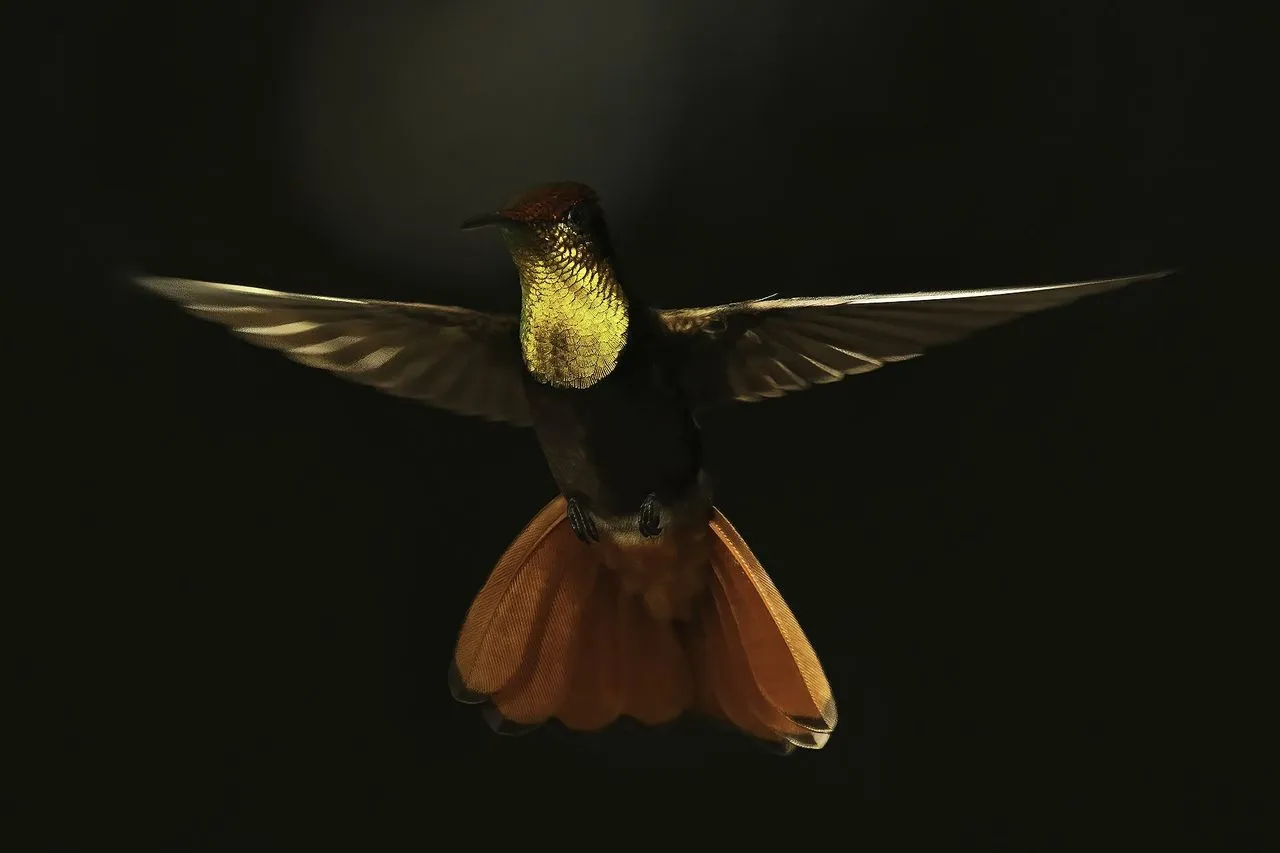
Ruby-Topaz Hummingbird (Chrysolampis mosquitus, 2.5–4g) is a Caribbean and northern South American species. Males have a ruby-red crown and golden-orange throat, structural iridescence that shifts with light angle. Found on Caribbean islands and coastal regions.
Chrysolampis mosquitus, the Ruby-Topaz Hummingbird, was described by Linnaeus in 1758 and weighs about 2.5-4.0 g, with adult males showing a ruby-red crown and a golden to orange throat under direct light.
The bird is a lesson in angular colour. A male can look dark-headed and plain-throated until the crown and gorget meet the sun, at which point the head becomes red and the throat turns metallic topaz. Those colours are structural, not pigment laid flat on the feather.
Part of the Complete Hummingbirds Guide.
Identification
| Character | Male Ruby-Topaz (C. mosquitus) | Female Ruby-Topaz (C. mosquitus) |
|---|---|---|
| Body mass | 2.5-4.0 g | 2.5-4.0 g range |
| Crown | Ruby-red when lit | Greenish, less dramatic |
| Throat | Golden to orange gorget | Pale, sometimes with limited colour |
| Tail | Chestnut or rufous tones, darker edges | Plainer, use range and structure |
| Field cue | Red crown plus golden throat | Small Caribbean or northern South American hummingbird |
Visual
Adult male Ruby-Topaz Hummingbird has a ruby crown, golden-orange throat, dark chest band, and warm-toned underparts, with greenish to bronzy upperparts depending on light. The tail often appears chestnut or rufous with darker edges. The combination of red crown and golden throat is distinctive when lit.
At poor angles the crown and throat may appear blackish, leading inexperienced observers to underestimate the bird. Hummingbird iridescence is a directional optical effect. Field identification requires waiting for the bird to turn or moving the observer's position when possible.
Females are greenish above and pale below with a less dramatic head and tail pattern. They can be more difficult, especially where several small Caribbean or South American hummingbirds overlap. Range, tail tone, bill structure, and behaviour should be used together.
Audio
Calls are high chips and thin notes, often given during interactions at flowers. The species is not defined by a diagnostic wing-trill. Males may display from exposed perches and make short flights, but the most conspicuous signal is the head and throat iridescence.
Distribution
Ruby-Topaz Hummingbird occurs in parts of the Caribbean and northern South America, including the Lesser Antilles and regions of Venezuela, the Guianas, and nearby mainland areas. Its local status varies, and movements can be seasonal in response to flowering.
On islands, it may be one of the more visible hummingbirds in dry scrub, gardens, and coastal vegetation. On the mainland, it uses open and semi-open habitats rather than closed forest interiors alone.
Habitat
The species favours dry scrub, savanna edge, woodland edge, gardens, plantations, coastal vegetation, and flowering shrubs. It often thrives where sunlit flowers are distributed through open habitat.
It is not restricted to pristine vegetation. However, productive modified habitat still requires nectar plants, insects, and nesting cover. A garden with flowers and pesticide pressure is not equivalent to functioning habitat.
Diet and Feeder Behaviour
Ruby-Topaz Hummingbirds take nectar from a range of flowers and supplement with insects and spiders. Males may defend profitable flower patches, while females and subordinate birds use less conspicuous routes.
At feeders, use the standard 1:4 white sugar solution. Tropical and subtropical heat makes hygiene urgent. Sugar solution can ferment quickly, and ants, bees, and microbial growth must be managed without applying toxins near feeding ports.
The bird's brilliant colours do not require red liquid or coloured additives. The feeder's external colour and position are sufficient; the solution should remain plain sucrose water.
Breeding Biology
Breeding timing varies with locality and rainfall-linked flowering. Males display and defend, but do not assist with nesting. Female-only nest construction, incubation, and feeding are expected as in most Trochilidae.
The nest is a small cup of plant fibres, down, and spider silk, often placed on a branch or shrub support. Two eggs are typical. The female feeds nestlings with a mixture of nectar and arthropods, delivering protein that flowers cannot supply.
Because flowering can be seasonal and patchy in dry habitats, breeding success depends on the match between nest timing, nectar availability, and insect abundance.
Notes
Ruby-Topaz Hummingbird is sometimes treated by casual observers as a colour spectacle first and an organism second. The better field approach is to ask why those colours appear: male signalling through structural feather surfaces, made visible only from particular angles.
Its distribution across islands and northern mainland habitats also makes it useful for studying movement in response to flowering. A local absence may indicate a shift in resource distribution, not necessarily a population crash at the scale of the whole range.
See Also
Frequently Asked Questions
How do I identify Ruby-Topaz Hummingbird?
Male: ruby-red crown and golden-orange throat (gorget) that shifts with light, structural iridescence. Female: green upperparts, pale underparts, often with some colour on throat. The colour shift with angle is distinctive.
Where does Ruby-Topaz Hummingbird range?
Caribbean islands (Jamaica, Hispaniola, Cuba, Puerto Rico) and northern South America (Colombia, Venezuela, coastal Brazil). Found in varied habitats including gardens, forest edges, and scrub.
Does Ruby-Topaz Hummingbird migrate?
Some seasonal movement, more common in some areas during certain seasons. They may move between islands or to mainland areas. Not a long-distance migrant like North American species.
What does Ruby-Topaz Hummingbird eat?
Nectar from a variety of flowers plus insects and spiders. They feed from a wide range of flowering plants in their range. They are generalist feeders compared to some specialised species.