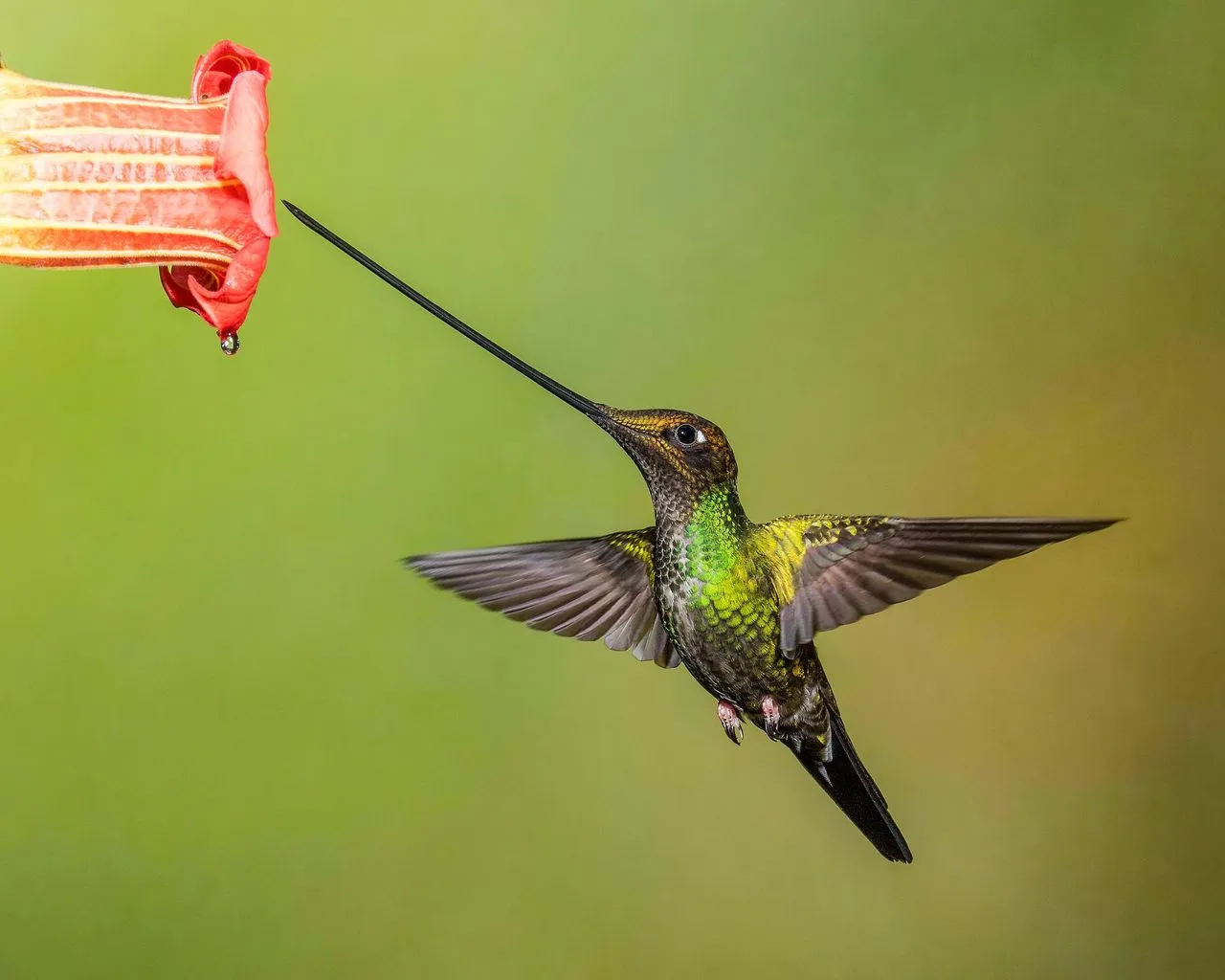
Sword-billed Hummingbird (Ensifera ensifera) has a bill 9–11cm, longer than its body, the only bird with this proportion. Endemic to Andean cloud forests. The extreme bill is specialised for long-tubed flowers like passion vines. They perch with bill pointing up.
Ensifera ensifera, the Sword-billed Hummingbird, was described by Boissonneau in 1840 and carries a bill approximately 9-11 cm long, in many individuals longer than the rest of the body excluding the tail, an extreme that makes even the Marvelous Spatuletail look conventional by comparison.
No other living bird has a bill that exceeds body length in this way. The measurement is not a curiosity added to an otherwise normal hummingbird. It changes perching, preening, feeding angle, flower choice, and the evolutionary relationship between bird and plant.
Part of the Complete Hummingbirds Guide.
Identification
| Character | Sword-billed (E. ensifera) | Other Andean hummingbirds |
|---|---|---|
| Bill length | 9-11 cm (3.5-4.3 in) | Shorter than body in normal proportions |
| Main field mark | Bill longer than body excluding tail | Plumage, gorget, or tail usually decisive |
| Feeding niche | Long-tubed flowers such as Passiflora | Shorter or mixed corolla use |
| Perching | Bill often angled upward | Standard hummingbird posture |
| Range cue | Andean cloud forest and highland shrub | Varies by species and elevation |
Visual
The identification is immediate if the bill is seen. Sword-billed Hummingbird is greenish to bronze-green above, paler below, and relatively large, but the bill dominates the silhouette. It projects forward as a straight dark lance, far beyond the proportions of any other hummingbird.
The gorget is not the field centre in this species. Structural iridescence still occurs in the plumage, but bill length and feeding posture are decisive. The bird often perches with the bill angled upward, reducing strain and allowing balance. Preening requires the feet more than in shorter-billed hummingbirds because the bill cannot reach parts of the body efficiently.
Females and males are similar compared with strongly dimorphic species, though size and plumage details vary. A poor view of the bill is still usually enough; a long dark projection in front of a hovering Andean hummingbird leaves few alternatives.
Audio
Calls are sharp and relatively unobtrusive. The species is not known to field observers by a diagnostic wing-trill comparable to Broad-tailed Hummingbird. Most detections come from visual encounters at long-tubed flowers or from birds crossing forest openings with the bill held conspicuously forward.
Distribution
Sword-billed Hummingbird inhabits the Andes from Venezuela and Colombia south through Ecuador, Peru, and Bolivia. It is a montane species, generally associated with cloud forest, forest edge, elfin woodland, and highland shrub where long-tubed flowers occur.
Elevation varies regionally, but many observations fall in the middle to high montane zone. Its distribution follows floral resources as much as forest structure. Where long-corolla plants are absent, the bird's extreme bill becomes less useful and energetically costly.
Habitat
The species uses humid montane forest edges, shrubby slopes, ravines, and gardens near cloud forest. It is frequently associated with plants such as Passiflora, Datura, Brugmansia, and long-tubed Andean flowers. The most famous ecological association is with long Passiflora corollas that exclude shorter-billed hummingbirds.
This is a case of reciprocal specialisation. Long flowers protect nectar from most visitors; the hummingbird gains access through bill length. The relationship is not exclusive in every locality, but the fit between bill and corolla is one of the clearest examples of hummingbird-flower coevolution.
Diet and Feeder Behaviour
Nectar from long-tubed flowers is the primary visible food source, supplemented by insects and spiders. The bill allows access but imposes handling costs. The bird must hover or perch at specific angles, and flowers that are awkwardly placed may be less profitable despite containing nectar.
At artificial feeders, Sword-billed Hummingbirds can feed if port design accommodates the bill, but ordinary shallow feeders may force unnatural approach angles. A standard 1:4 sucrose solution remains the appropriate mixture where feeding is legally and ethically managed. No hummingbird benefits from honey or dyed syrup.
The bird's long bill does not mean it feeds only from long flowers. It can take insects and may use shorter flowers opportunistically, but its competitive advantage lies where other hummingbirds cannot reach. Compared with a generalist like Rivoli's Hummingbird, the Sword-billed is far more constrained by corolla length.
Breeding Biology
Breeding biology is less familiar to most backyard observers than that of North American species, but the family pattern holds: males do not provide parental care, and females build and tend nests. The nest is a cup of plant fibres, moss, and spider silk placed in protected vegetation.
Courtship and territorial behaviour occur around flower resources. In species with such specialised feeding morphology, territory quality may depend heavily on the presence and renewal rate of long-corolla flowers.
The female must provision young with arthropods as well as nectar. Even a bird named for its bill remains constrained by protein demand during reproduction.
Notes
The Sword-billed Hummingbird is the cleanest answer to a common misconception: hummingbird bills are not all minor variations on the same probe. In this species, bill length is the axis around which the entire ecology turns.
Its coevolution with Andean flowers also illustrates a risk. Specialisation can be efficient when the partner resource is intact, but habitat degradation that removes long-tubed flowering plants removes the advantage and leaves the bird carrying an expensive instrument in a poorer landscape.
See Also
- Marvelous Spatuletail: another highly modified Andean hummingbird for bill comparison and habitat overlap.
- Rivoli's Hummingbird: the large generalist for comparison of feeding flexibility and range overlap.
- Bee Hummingbird: the world's smallest bird for size and extreme morphology comparison.
- Hummingbird Feeders Explained: practical guidance on sugar solution mixtures and feeder design for Andean garden observers.
- The Complete Hummingbirds Guide: full family reference: taxonomy, identification, and migration.
Frequently Asked Questions
Why does Sword-billed Hummingbird have such a long bill?
The bill is specialised for deep, long-tubed flowers, especially Passiflora (passion vines) and certain ericads. This co-evolutionary relationship means the bird is the primary pollinator for these flowers. No other bird can reach their nectar.
How does Sword-billed Hummingbird perch?
They often perch with the bill pointing upward, resting on the chest. The extreme bill length makes normal perching awkward. They may also hover to feed rather than perch at flowers.
Where does Sword-billed Hummingbird range?
Andean cloud forests of Venezuela, Colombia, Ecuador, Peru, and Bolivia. Found at 1,500–3,000m elevation in forest edges and shrubby areas. Not found in North America but occasionally in zoos or collections.
Can Sword-billed Hummingbird be kept in captivity?
No, extremely specialised diet and temperature requirements make captive care nearly impossible. They require constant access to fresh nectar and insects. Wild birds should never be captured.