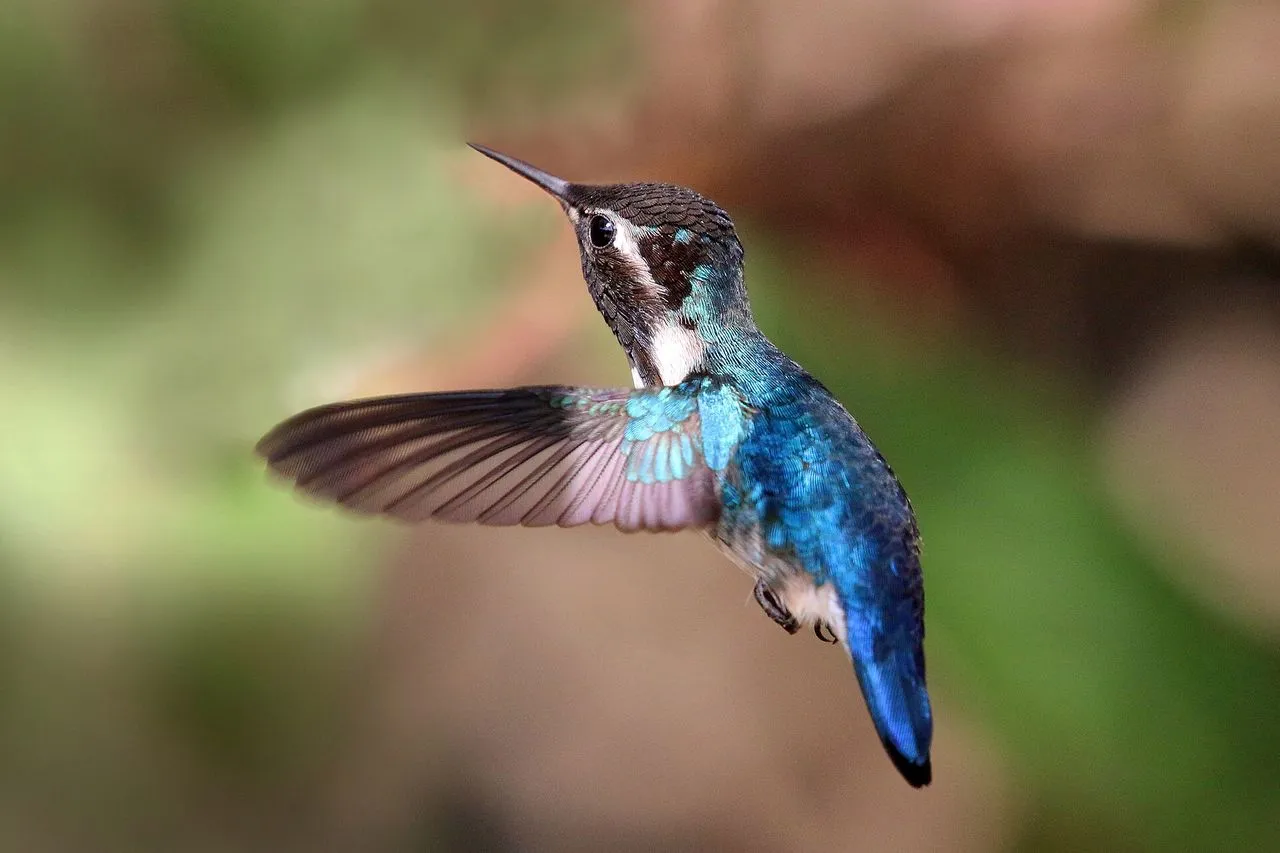
First step: For ID, judge size only after checking behavior, bill shape, hover posture, and the male's red head in breeding plumage.
Avoid: Do not assume every tiny hummingbird in the Caribbean is a Bee Hummingbird; range matters, and the species is endemic to Cuba.
Mellisuga helenae, the Bee Hummingbird, was described by Lembeye in 1850 and weighs approximately 1.6-2.6 g, making it the smallest living bird species by mass and length.
That measurement is often repeated as trivia, but it has biological consequences. A bird near 2 g has minimal fasting reserve, extreme surface-area-to-volume heat exchange, and little tolerance for gaps in nectar and insect supply. Its scale is not decorative; it is the central constraint of its life.
Part of the Complete Hummingbirds Guide.
Identification
| Character | Male Bee (M. helenae) | Female Bee (M. helenae) |
|---|---|---|
| Body mass | 1.6-2.6 g | 1.6-2.6 g range, larger on average |
| Head and throat | Iridescent red to pinkish-red | No full red head |
| Upperparts | Bluish to greenish | Greenish |
| Tail | Elongated outer feathers | White-tipped tail |
| Field cue | Tiny bird may read insect-like | Still smaller than other Cuban birds |
Visual
Adult male Bee Hummingbird is exceptionally small, with iridescent red to pinkish-red head and throat in breeding plumage, bluish upperparts, and pale greyish underparts. The head colour is structural rather than pigmentary and can appear dark or black when the bird is not angled to light.
Females are greenish above and pale below, with white tail tips and no full red head. They are larger than males on average but remain smaller than any other bird likely to be encountered in Cuba. The bill is short and straight, proportionate to the bird's scale.
In the field, size must be interpreted with context. A Bee Hummingbird can be confused with a large insect by observers expecting a bird silhouette. The hovering posture, bill, and repeated visits to flowers resolve the confusion quickly.
Audio
Vocalisations are high and fine, with thin chips and short twittering notes. Wingbeat frequencies in very small hummingbirds can exceed those of larger species; estimates for Bee Hummingbird commonly fall in the high tens of beats per second and may approach around 80 Hz during hovering. The acoustic impression is correspondingly fine and insect-like.
Distribution
Bee Hummingbird is endemic to Cuba, including the main island and some associated localities, and does not occur naturally in North America outside that Cuban range. Reports elsewhere require extraordinary documentation.
Within Cuba it is local rather than uniformly distributed. It occurs in several regions where suitable flowering habitat remains, including forest edge, thickets, gardens, and scrub. Habitat loss and fragmentation have reduced its security, even where the species is still present.
Habitat
The species uses woodland edge, secondary growth, coastal vegetation, gardens, and shrublands with reliable small flowers. It is not simply a deep-forest bird. Productive habitat must provide a dense fine-scale nectar network because each feeding trip carries proportionally high energetic cost.
Small flowers that exclude larger nectar competitors can be important. A 2 g hummingbird can exploit floral resources that are inefficient for larger species, but that advantage disappears if the plant community is simplified.
Diet and Feeder Behaviour
Bee Hummingbirds feed on nectar from small flowers and take minute insects and spiders. Arthropods are essential, particularly for females forming eggs and feeding young. Nectar supplies energy; it does not supply the complete diet.
Where feeders are used in Cuba, the same physiological rule applies: 1 part white refined sugar to 4 parts water. The small size of the bird does not justify honey, dye, or stronger syrup. Cleanliness is critical because a bird with minimal body reserve has little margin for illness or reduced digestive efficiency.
You won't attract a Bee Hummingbird outside Cuba, but the 1:4 sugar-to-water rule carries over to any hummingbird species in your garden. A simple wide-mouth design like the First Nature 16 oz hummingbird feeder is easy to take apart and scrub, and with nectar feeders, cleanability matters more than capacity. A small feeder you wash twice a week does more good than a large one left to ferment.
As an Amazon Associate, we earn from qualifying purchases, at no extra cost to you.
Competition at flowers can include other hummingbirds, insects, and territorial individuals of its own species. The Bee Hummingbird's advantage is manoeuvrability and access to small corollas, not physical dominance.
Breeding Biology
Males display in small territories, showing the iridescent head and throat by angle control. The colour is visible only when light, feather surface, and observer align. Females select nest sites and perform all nesting duties.
The nest is correspondingly minute, built of plant down, fibres, cobweb, and lichen or plant fragments. It is placed on a fine branch or twig. Clutch size is normally two eggs, each extremely small but still a major investment relative to female mass.
Nestlings require frequent feeding with nectar and minute arthropods. At this scale, weather and food interruption matter quickly. A cool wet period that reduces insect activity can affect breeding success even if flowers remain available.
Notes
The Bee Hummingbird's conservation issue is not that it is rare everywhere, but that it is endemic, small-ranged, and dependent on suitable flower-rich habitats within a changing Cuban landscape. Endemism converts local habitat loss into global population loss.
It is the world's smallest bird, but that phrase should not obscure the more important point. Mellisuga helenae is an extreme physiological design: a vertebrate near the lower functional limit for avian size, surviving by matching high-frequency flight to dense nectar and arthropod availability.
See Also
- Calliope Hummingbird
- Ruby-Topaz Hummingbird
- Marvelous Spatuletail
- The Complete Attracting Guide
- The Complete Hummingbirds Guide
Watching tiny hummingbirds without disturbing them
Bee Hummingbirds are not backyard feeder birds for most readers, and they should not be chased for a closer look. The same field rule still applies to hummingbird watching anywhere: use optics, stay back, and let the bird feed normally. Compact binoculars such as Nikon Trailblazer 8x25 ATB Binoculars are easier to carry on walks than full-size glass, though you still need distance and patience. Good viewing should reduce pressure on birds, not create it.
As an Amazon Associate, we earn from qualifying purchases, at no extra cost to you.
Frequently Asked Questions
Why is Bee Hummingbird the smallest bird?
At 1.6–2.6g, Bee Hummingbird is the smallest living bird species by mass and length (5–6cm). This size creates extreme constraints: minimal fat reserves, high heat loss, and constant feeding requirements, smallest fasting tolerance of any bird.
Where is Bee Hummingbird found?
Endemic to Cuba, in forest edges, gardens, and coastal areas. Found throughout the island but most common in semi-open habitats with flowering plants. Not found anywhere else in the world.
How do I identify male Bee Hummingbird?
Males have iridescent red-orange head and throat (gorget), with elongated outer tail feathers that project beyond the rest of the tail. The iridescence varies with light angle. Females are plain with white breast and green back.
Does Bee Hummingbird have conservation concerns?
Listed as Near Threatened due to habitat loss and potentially climate change affecting flower availability. Small size makes them vulnerable to environmental changes. They have extremely high metabolic demands.
Where can you see a Bee Hummingbird?
Bee Hummingbirds are endemic to Cuba. They are associated with forest edges, gardens, and shrubland where nectar plants and small insects are available. Ethical viewing means staying back, using binoculars or a camera, and avoiding nest disturbance.