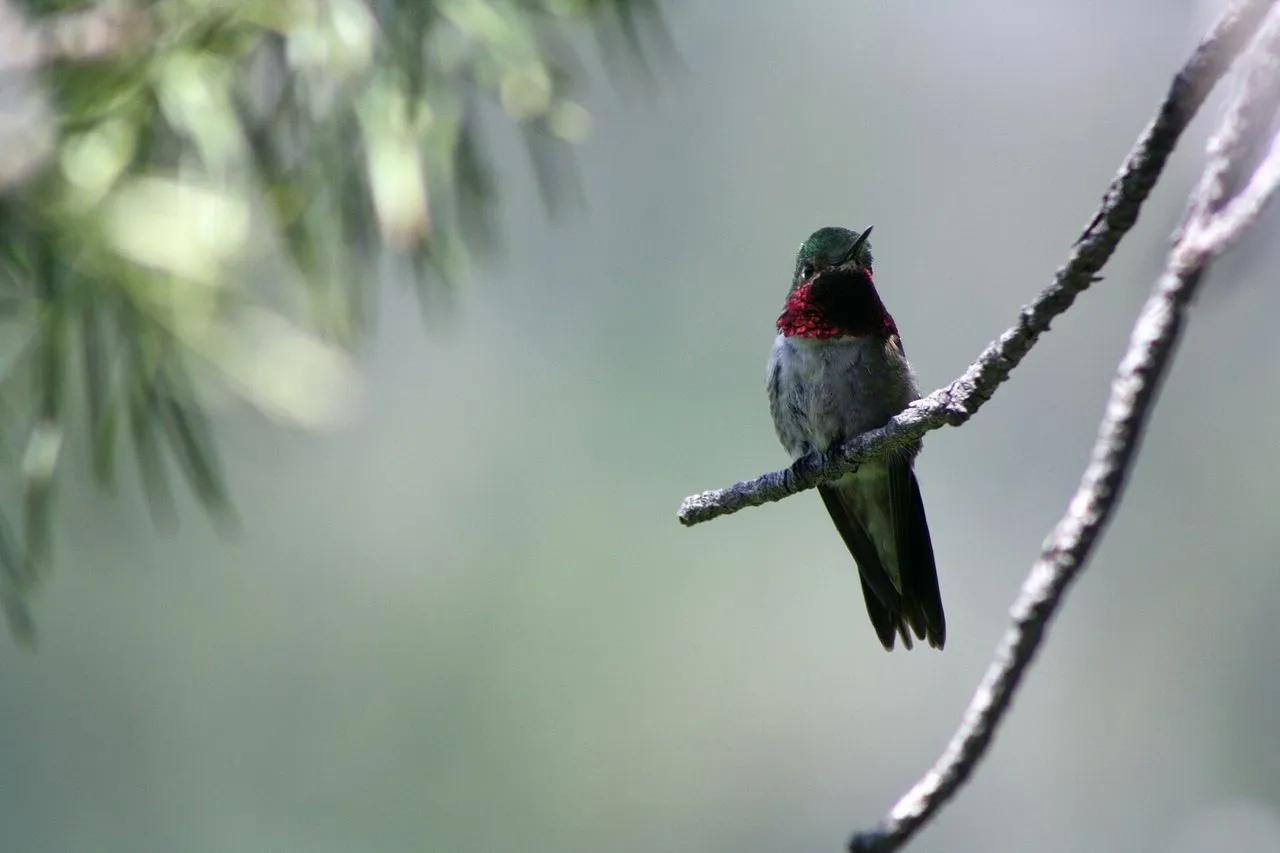
Broad-tailed Hummingbird (Selasphorus platycercus, 3.2–4.5g) is a mountain species known for the male's diagnostic wing-trill, a metallic sound from modified outer primaries. Found in high-elevation meadows and canyons of the Rockies and western US. Males trill in flight, not from perches.
Selasphorus platycercus, the Broad-tailed Hummingbird, was described by Swainson in 1827 and weighs about 3.2-4.5 g, with males producing a sustained metallic wing-trill caused by modified outer primaries.
That wing sound is often detected before the bird is seen. In a Colorado meadow or a high New Mexico canyon, a passing male gives a bright, insect-like trill audible at distance. It is not a song and not a throat call. It is flight feather mechanics.
Part of the Complete Hummingbirds Guide.
Identification
| Character | Broad-tailed (S. platycercus) | Calliope (S. calliope) |
|---|---|---|
| Body mass | 3.2-4.5 g | 2.3-3.4 g |
| Adult male gorget | Rose-red to magenta shield | Separated magenta rays |
| Tail impression | Relatively broad, longer | Short, compact |
| Sound | Sustained metallic male wing-trill | High, thin display sound; not sustained trill |
| Breeding context | Rocky Mountain and western highlands | Montane West, often smaller and shorter-tailed |
Visual
Adult male Broad-tailed Hummingbird is green above, pale below, and carries a rose-red to magenta gorget that appears black when not lit directly. The gorget is structural rather than pigmentary, and the perceived colour changes sharply with angle. The tail is relatively broad and extends beyond the folded wing more than in Calliope.
Females are green above with whitish underparts, buffy flanks, and white-tipped outer tail feathers. They are larger and longer-tailed than female Calliope, less extensively rufous than typical Rufous or Allen's, and strongly associated with mountain habitats during breeding season.
The adult male can resemble Ruby-throated Hummingbird in a static photograph: green back, pale underparts, red throat. Range solves many cases. In the Rocky Mountains, the male's wing-trill and broader tail are decisive; in the East, a Ruby-throated is far more likely.
Audio
The diagnostic sound is the male wing-trill, produced in flight by the narrowed outer primary feathers. It is a continuous metallic trill, loud enough to identify birds passing overhead or behind vegetation. Females and immatures do not produce the same pronounced sound because they lack the male's modified feather structure.
The call notes are short chips, but for field purposes the trill is the signature. A hummingbird moving through a mountain meadow with a sustained bright trill is a male Broad-tailed until evidence indicates otherwise.
Distribution
Broad-tailed Hummingbird breeds through the Rocky Mountains and adjacent highlands from the southwestern United States north into Wyoming, Idaho, and parts of Montana, with strong presence in Colorado, Utah, New Mexico, and Arizona mountain systems.
It winters mainly in Mexico and returns to breeding elevations as flowering advances. Arrival at high sites can occur while snow remains in shaded areas. Birds use lower valleys early, then move upslope as meadows and forest edges open. Southbound movement begins in late summer, with individuals appearing at feeders and flower patches downslope.
Habitat
This is a montane hummingbird: aspen groves, open conifer forest, meadow edges, willow thickets, stream corridors, and subalpine clearings. It is particularly associated with places where flowering plants occur in dense seasonal pulses.
Cold nights are a regular part of its breeding ecology. Torpor is not an emergency anomaly but a routine physiological tool. A bird may feed hard at dusk, drop body temperature overnight, and resume activity after a costly morning arousal.
Diet and Feeder Behaviour
Broad-tailed Hummingbirds feed on nectar from paintbrush, penstemon, larkspur, gilia, currant, and other montane flowers, plus small insects and spiders. Nesting females require arthropods; nectar alone cannot build eggs or nestlings.
At feeders they are assertive but often less relentlessly combative than Rufous. Males may defend a feeder near a display route, while females use feeders as part of a wider foraging circuit. In mountain towns, feeders can be heavily used during cold spells when flowers are closed or snow-covered.
The correct mixture is 1 part white refined sugar to 4 parts water. Keep ports clean. Cool mountain air slows fermentation but does not prevent biofilm, especially when feeders hang in sun during warm afternoons.
Breeding Biology
Males establish display areas and advertise through flight, gorget flashing, and the wing-trill. The sound likely functions as both a presence signal and a condition-linked mechanical signal because feather shape, wear, and flight performance affect acoustic output.
Females build the nest alone, often on a horizontal branch in aspen, willow, or conifer. The cup uses plant fibres, down, and spider silk, with exterior material that blends into bark or lichen. Two eggs are usual. The female incubates and provisions without male assistance.
High-elevation weather can be severe. Cold rain, late snow, and delayed insect emergence are real nesting constraints. A female's ability to use torpor, switch among flower species, and exploit arthropod pulses determines whether a nest survives more than any single display trait of the male.
Notes
The Broad-tailed Hummingbird is one of the best North American examples of a field-identifiable mechanical sound. Many birds vocalise; this species carries part of its identity in feather aerodynamics.
For observers, that means listening matters. A silent female-type hummingbird in a mountain meadow may require careful visual study. A trilling male passing at 50 m can be named with more confidence than a perched bird glimpsed for two seconds in poor light.
See Also
Frequently Asked Questions
What is the wing-trill of Broad-tailed Hummingbird?
Males produce a sustained metallic 'trill' sound in flight caused by modified outer primary feathers vibrating. This is NOT a vocalization, it's mechanical flight sound. The trill is audible at distance and is a reliable identification clue.
Where does Broad-tailed Hummingbird breed?
High-elevation habitats in the Rocky Mountains and western US, meadows, subalpine zones, mountain canyons from Montana to Arizona. They arrive on breeding grounds later than lowland species (May–June) due to cold temperatures.
How does Broad-tailed differ from other Selasphorus?
The wing-trill is unique to Broad-tailed among North American hummingbirds. Males have a pink-red gorget, green back, and grey-white underparts. The trill is the key identification feature, other species don't produce this sound.
Do Broad-tailed Hummingbirds use feeders?
Yes, but less commonly than lowland species. They prefer montane habitats with native flowers. In mountain communities, they'll visit feeders, especially in late summer when flowers become scarce.