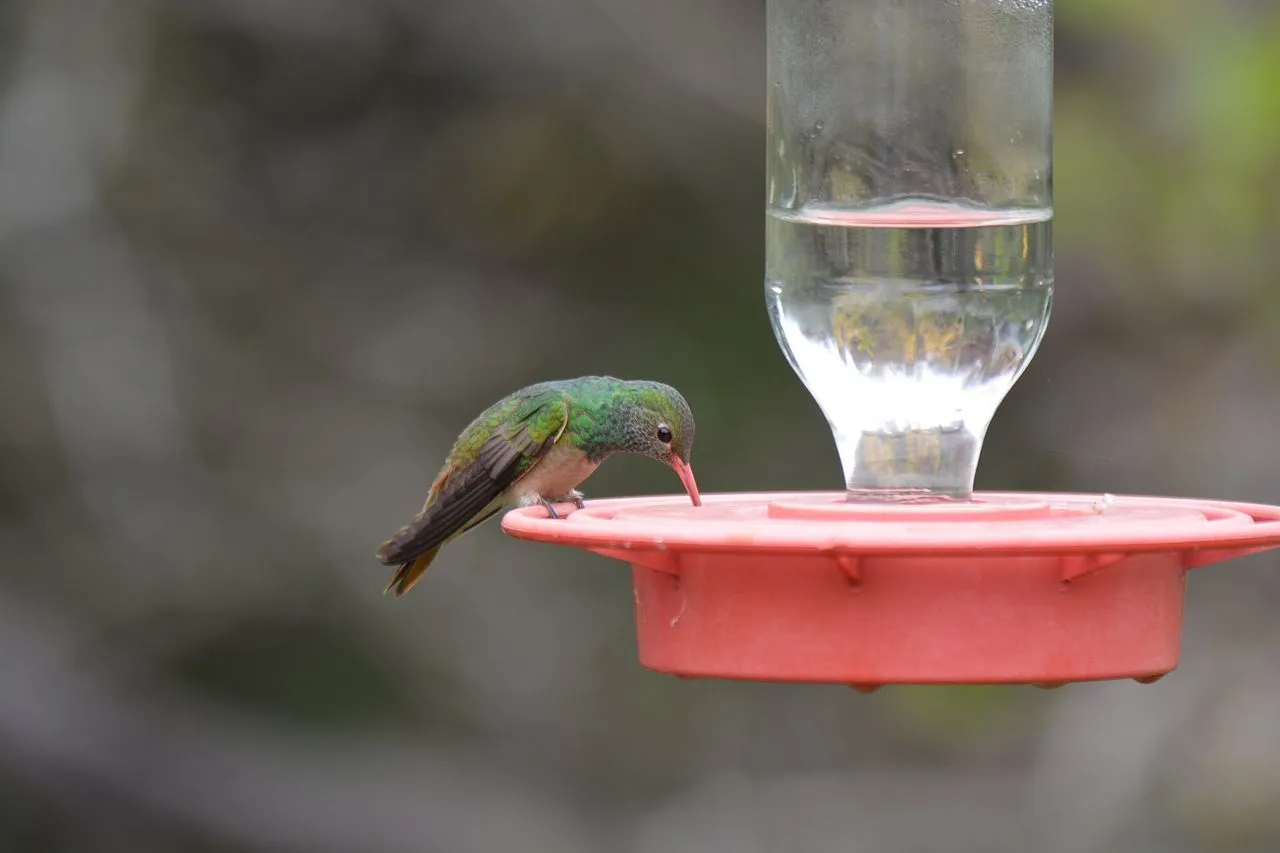
Buff-bellied Hummingbird (Amazilia yucatanensis, 4–5g) is a Texas coast and Gulf lowlands resident. Features include buff underparts, green throat, rufous tail, and red bill base. Larger than Ruby-throated. Year-round in the Lower Rio Grande Valley.
Amazilia yucatanensis, the Buff-bellied Hummingbird, was described by Cabot in 1845 and weighs approximately 4.0-5.0 g, larger and heavier-bodied than Ruby-throated and Black-chinned hummingbirds at the same Gulf Coast feeders.
The species is the characteristic resident hummingbird of the lower Texas coast and adjacent Mexican Gulf lowlands. Its buff underparts, green throat, red bill base, and rufous tail form a combination unlike the migratory Archilochus species most eastern observers know.
Part of the Complete Hummingbirds Guide.
Identification
| Character | Buff-bellied (A. yucatanensis) | Migrant Archilochus |
|---|---|---|
| Body mass | 4.0-5.0 g | 2.7-4.2 g range |
| Belly | Warm buff | White to grey-white |
| Tail | Rufous, often cinnamon in flight | Dark with white tips in female-type birds |
| Bill | Red to reddish base, dark tip | Mostly dark, straighter |
| South Texas cue | Resident in Lower Rio Grande Valley | Seasonal migrants or breeders by species |
Visual
Buff-bellied Hummingbird is green above with a green throat and breast, a warm buff belly, and a rufous tail. The bill is red to reddish at the base with a dark tip, slightly decurved, and longer than that of Ruby-throated. The tail often flashes cinnamon-rufous as the bird turns.
The green throat is iridescent and structural, changing intensity with light angle, but the buff belly and rufous tail remain useful when the throat is dull. Sexes are broadly similar compared with strongly dimorphic species, though males tend to show stronger throat colour.
Ruby-throated Hummingbird lacks the buff belly and rufous tail. Black-chinned lacks the same warm underparts and red-based bill. In south Texas, a large green-and-buff hummingbird with a rufous tail should immediately suggest A. yucatanensis.
Audio
The species gives sharp chips and chatter, especially in territorial interactions. It does not have a Broad-tailed wing-trill or Anna's-style song. At feeders, it can be detected by repeated chases from a concealed perch near dense vegetation.
Distribution
The main range runs from the lower Rio Grande Valley and Texas Gulf Coast south through eastern Mexico to the Yucatan Peninsula and parts of Central America. In the United States it is most regular in south Texas, especially the lower Rio Grande Valley, with occasional movement northward along the Gulf Coast.
Unlike Ruby-throated in the East, Buff-bellied can be resident where climate and food supply permit. Some individuals disperse after breeding, and records outside the core range occur, but the Texas coast remains the key U.S. area.
Habitat
Buff-bellied Hummingbird uses subtropical woodland, thorn forest, riparian growth, gardens, citrus areas, coastal scrub, and edges with flowering shrubs. Dense cover is important; the bird often feeds in openings but retreats quickly into vegetation.
In the lower Rio Grande Valley, habitat loss has reduced native subtropical woodland, making gardens and reserves with appropriate plantings more important as observation and support sites. Native flowering shrubs and trees provide both nectar and arthropods.
Diet and Feeder Behaviour
Nectar sources include turk's cap, coral bean, salvia, trumpet-shaped flowers, and many subtropical shrubs. The species also takes insects and spiders. Arthropod supply is not optional, particularly for breeding females.
At feeders Buff-bellied is often assertive and may dominate smaller hummingbirds. It can hold a feeder from a nearby hidden perch, making short direct attacks on intruders. Multiple feeders separated by vegetation reduce conflict.
Use the standard 1:4 white refined sugar solution. South Texas heat requires frequent replacement and cleaning. Ant guards and feeder placement help, but chemical insecticides near ports are unacceptable because birds contact those surfaces with bill and tongue.
Breeding Biology
Breeding occurs in subtropical woodland and dense edge habitats. Males defend territories and court females, but do not participate in nesting. The female builds the nest alone, using plant down, fibres, and spider silk, usually on a small branch in a shrub or tree.
Two eggs are typical. The female incubates and feeds young with nectar and arthropods. Nest concealment in dense vegetation is important because open coastal and thorn-scrub environments hold many visual predators.
Breeding timing varies with local conditions and food availability. In mild climates with extended flowering, the season can be less compressed than in temperate migrants.
Notes
Buff-bellied Hummingbird is the best reminder that Texas is not simply eastern or western in hummingbird terms. The lower Rio Grande Valley belongs biologically to the Gulf tropics as much as to the United States.
For field observers, the durable characters are buff belly, rufous tail, and red-based bill. Gorget brightness may fail with angle, but those structural features persist. For feeder hosts, the durable rule is the same as elsewhere: plain 1:4 sucrose, no dye, and cleaning before the solution becomes visibly spoiled.
See Also
Frequently Asked Questions
How do I identify Buff-bellied Hummingbird?
Buff-coloured belly (obviously), green throat and upperparts, rufous tail with no white tips (unlike some species), and red at the base of the bill. Larger and more heavy-bodied than Archilochus species.
Where does Buff-bellied Hummingbird range?
Resident along the lower Texas coast and adjacent Mexican Gulf lowlands. Year-round in the Lower Rio Grande Valley. Some seasonal movement within this range but no long migration.
Do Buff-bellied Hummingbirds migrate?
No, unlike most US hummingbirds, this is a permanent resident in its range. They do not migrate to Mexico or Central America. Some local movement between seasons but no long-distance migration.
Are Buff-bellied Hummingbirds common at feeders?
Yes, readily come to feeders in the Texas Lower Rio Grande Valley. They often coexist with migrating Ruby-throated and Black-chinned Hummingbirds during migration seasons.