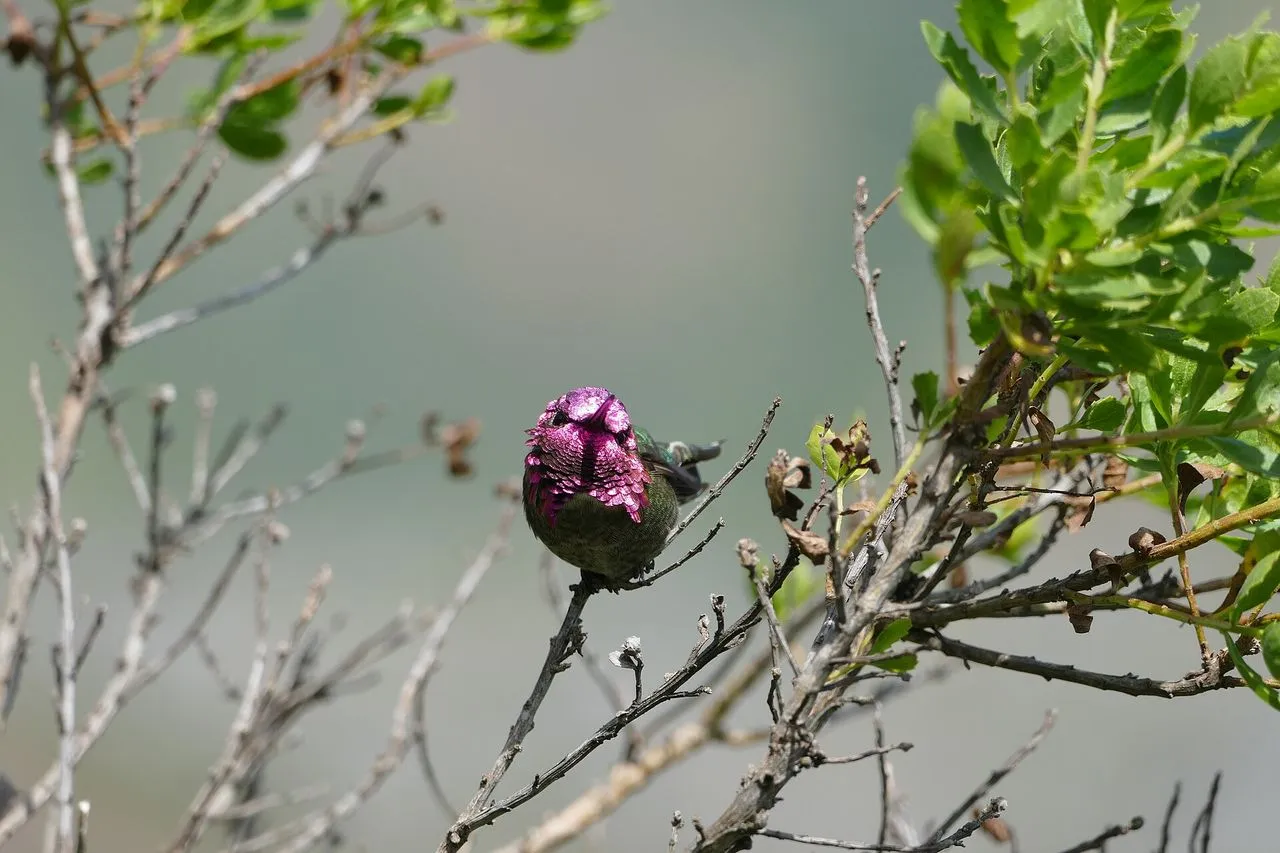
Anna's Hummingbird (Calypte anna) is the only North American hummingbird with iridescent plumage on both crown and gorget. Males have a full rose-red gorget extending over the forehead. This Pacific Coast resident has expanded northward using feeders and introduced Eucalyptus. The dive display produces a mechanical chip sound.
Calypte anna, Anna's Hummingbird, is a resident of the Pacific states and southern British Columbia, the most abundant year-round hummingbird in the continental United States, and the only North American hummingbird in which the adult male carries iridescent plumage on both the throat and the crown.
The species was described by René Lesson in 1829 and named for Anna de Belle Massena, Duchess of Rivoli. It occupies a range that has expanded substantially northward over the past century, a shift with a documented causal mechanism rather than the vague attribution to climate that accompanies many such discussions. That mechanism is covered under Year-round Residency below.
Part of the Complete Hummingbirds Guide.
Identification
| Character | Anna's (C. anna) | Costa's (C. costae) |
|---|---|---|
| Body mass | 3.5-5.2 g | 2.5-3.2 g |
| Male crown | Iridescent rose-red to magenta | Violet to purple with hooded effect |
| Gorget shape | Full throat and crown, no side plumes | Long lateral plumes beyond cheek line |
| Bill impression | Medium, straight | Short, slightly decurved |
| Habitat cue | Chaparral, gardens, Pacific suburbs | Desert scrub, arid canyons, dry gardens |
Adult Male
The adult male C. anna weighs 3.5-5.2 g and is the most distinctively patterned hummingbird in the Pacific states. The iridescent gorget extends upward to cover the entire forehead and crown, a character unique among regularly occurring North American hummingbirds. Under direct light at a favourable angle, both the throat and crown read rose-red to magenta-pink with a slight violet cast at the margins. At unfavourable angles, the entire gorget and crown appear flat grey-brown or black. Upperparts are metallic green. Underparts are grey-green, with flanks washed green and a small white post-ocular streak. The tail is square to slightly rounded, not forked. The bill is straight and medium-length.
The full crown gorget is the definitive field mark. No other regularly occurring North American hummingbird shows iridescence on the crown. A bird with a fully coloured forehead that matches the throat is an adult male C. anna until proven otherwise. The colour is structural, not pigmentary, and the same angle-dependence that governs all hummingbird gorget colour applies here: a bird seen from behind in shade will appear entirely dark-headed.
Costa's Hummingbird (Calypte costae), the closest potential confusion species, shows a gorget that extends in dramatically elongated lateral plumes beyond the cheek line. Anna's gorget is larger in total area but does not project sideways. Costa's is also a distinctly smaller, shorter-billed bird and favours drier desert scrub rather than the chaparral and suburban habitats where C. anna is most common.
Female and Immature
Females and immatures present the usual challenges of the family. Upperparts are metallic green; underparts are grey-white with variable light streaking on the flanks. The bill is proportionally slightly longer than in Archilochus colubris, a useful but subtle character.
The most practically useful separator from other female hummingbirds in the Pacific states is the throat patch: most adult female C. anna show at least a few rose-red iridescent feathers in the centre of the throat. This feature is absent in nearly all female A. colubris and inconsistent in other species that might overlap with C. anna geographically. A female-type hummingbird on the Pacific Coast with any central gorget iridescence is almost certainly C. anna.
Immature males show patchy gorget development through the first winter. A bird with scattered iridescent crown feathers preceding full gorget development is almost certainly a first-year C. anna male. Full adult plumage is typically attained by the first spring.
Year-round Residency and Range
Calypte anna is resident year-round from northern Baja California north through California, Oregon, and Washington into southwestern British Columbia, with the breeding range extending inland into southern Nevada and Arizona at lower elevations. Unlike the large majority of Trochilidae, which vacate temperate latitudes entirely in winter, C. anna maintains territory and breeds in its Pacific Coast range through the coldest months. Nesting has been recorded in December and January at low-elevation California sites, among the earliest nesting dates of any bird of comparable size in North America.
Early 20th-century records confine C. anna largely to Baja California and the southern California coast. The subsequent northward expansion into Oregon, Washington, and British Columbia has been studied in sufficient detail to identify two contributing factors. The first is the establishment of introduced and ornamental plants that provide winter nectar sources at latitudes where native flowering plants are largely dormant: introduced species of Eucalyptus and a range of exotic garden plants with winter bloom periods changed the energy landscape of Pacific Coast suburbs in ways that made winter survival viable for hummingbirds that would previously have starved. The second factor is the proliferation of year-round sugar-water feeders in suburban gardens, which provide a caloric buffer during cold snaps when flowers are unavailable or inaccessible.
The British Columbia population is the clearest case. Natural nectar sources in coastal BC in January are negligible. Birds that persist there through winter are doing so largely on feeder subsidy. This is relevant to feeder management: a feeder that is allowed to freeze overnight in a Vancouver suburb in January is not merely an inconvenience but a removal of what may be a bird's primary energy source at the moment of highest need, the post-torpor arousal period when metabolic demand is at its peak.
The Dive Display
The male's territorial and courtship display involves a steep powered dive from a height of 25-40 m toward a perched female or a territorial intruder. At the lowest point of the dive, the bird produces a brief, sharp sound described consistently by observers as vocal in quality: a loud, bright chip audible at considerable distance. The sound is not produced by the syrinx.
Research by Clark and colleagues demonstrated through a combination of high-speed video analysis and wind-tunnel experiments that the sound is generated mechanically by the outermost tail feathers, the fifth pair of rectrices (R5), vibrating at resonant frequency in the high-velocity airstream at the base of the dive. The feather shape is such that it flutters at the airspeeds reached during the dive, producing a tonal note that is, in spectral structure, similar to a syrinx-generated call but entirely aeroelastic in origin. Experimental manipulation confirmed the mechanism: birds with R5 feathers removed produced no sound on subsequent dives; birds with R5 feathers from other individuals attached produced a sound at the pitch corresponding to the donor feathers' resonant frequency rather than the recipient bird's.
The implication is that the dive chip is not subject to the same voluntary modulation as a vocalisation. The bird cannot choose to alter its pitch the way it can modify a syrinx-produced call; pitch is determined by the physical properties of the feather. This has been proposed as a potential honest signal of male quality, since feather condition is a direct correlate of nutrition and moult timing.
The dive display is most frequent from January through April but occurs year-round on established territories. Observers new to the species sometimes mistake the dive chip for a loud call from a nearby passerine; the brief, single-note character and the visible steep-dive behaviour of the male are the diagnostic combination.
Vocal Behaviour
Unlike most North American hummingbirds, C. anna produces a true song: a long, scratchy, buzzy series of syllables delivered from a prominent exposed perch, most commonly a dead branch with clear sightlines. Song is most frequent and sustained from January through April but persists at reduced frequency through the summer and autumn on occupied territories.
The song shows individual variation and evidence of a learned component, making C. anna one of a small number of hummingbird species examined for vocal learning. The structure is not innate in the way that most bird calls are; young males produce incomplete or incorrect song sequences that converge toward adult form with exposure to conspecific song, a pattern more typical of oscine passerines than of most non-passerine birds. The mechanism and extent of this learning are active areas of study.
At the Feeder in Winter
In Oregon, Washington, and British Columbia, C. anna may be the only hummingbird species present from October through March. Feeder management in this season has a different priority set from warm-weather management. Fermentation is slow in cold temperatures and the hygiene interval can be extended somewhat, but the freezing point of the standard 1:4 sugar solution is approximately -1 degree C, meaning a feeder left outdoors on a freezing night will be solid by morning.
Practical approaches include bringing the feeder indoors overnight and returning it before dawn, using an insulated feeder wrap designed for winter use, or rotating two feeders and keeping one warm indoors while the other is in use. Concentrating the solution to 1:3 lowers the freezing point marginally but pushes the sucrose concentration above the range of natural nectar and is not recommended for routine use. The standard 1:4 formula with a freeze-prevention strategy is the correct approach.
For the full sugar-water recipe, the specific reasons each alternative fails, and the feeder hygiene protocol, see the Complete Hummingbirds Guide.
See Also
Frequently Asked Questions
How do I identify a male Anna's Hummingbird?
Male Anna's has a full iridescent rose-red gorget that extends over the entire forehead and crown, a unique feature among North American hummingbirds. The gorget appears dark from some angles and brilliant magenta-pink from others due to structural coloration.
Where does Anna's Hummingbird range extend?
Year-round from northern Baja California through California, Oregon, Washington, into southwestern British Columbia. The northward expansion is linked to introduced ornamental plants (Eucalyptus) and winter feeders in suburban gardens.
What is the mechanical sound in the dive display?
The dive produces a sharp 'chip' sound generated mechanically by the outermost tail feathers (R5) vibrating at resonant frequency in the high-velocity airstream. This is not a vocalization, the bird cannot modulate the pitch.
Do Anna's Hummingbirds migrate?
Anna's is largely sedentary along the Pacific Coast but withdraws from high-elevation breeding sites in autumn. Some individuals now winter as far north as southern British Columbia, a range extension enabled by feeders.