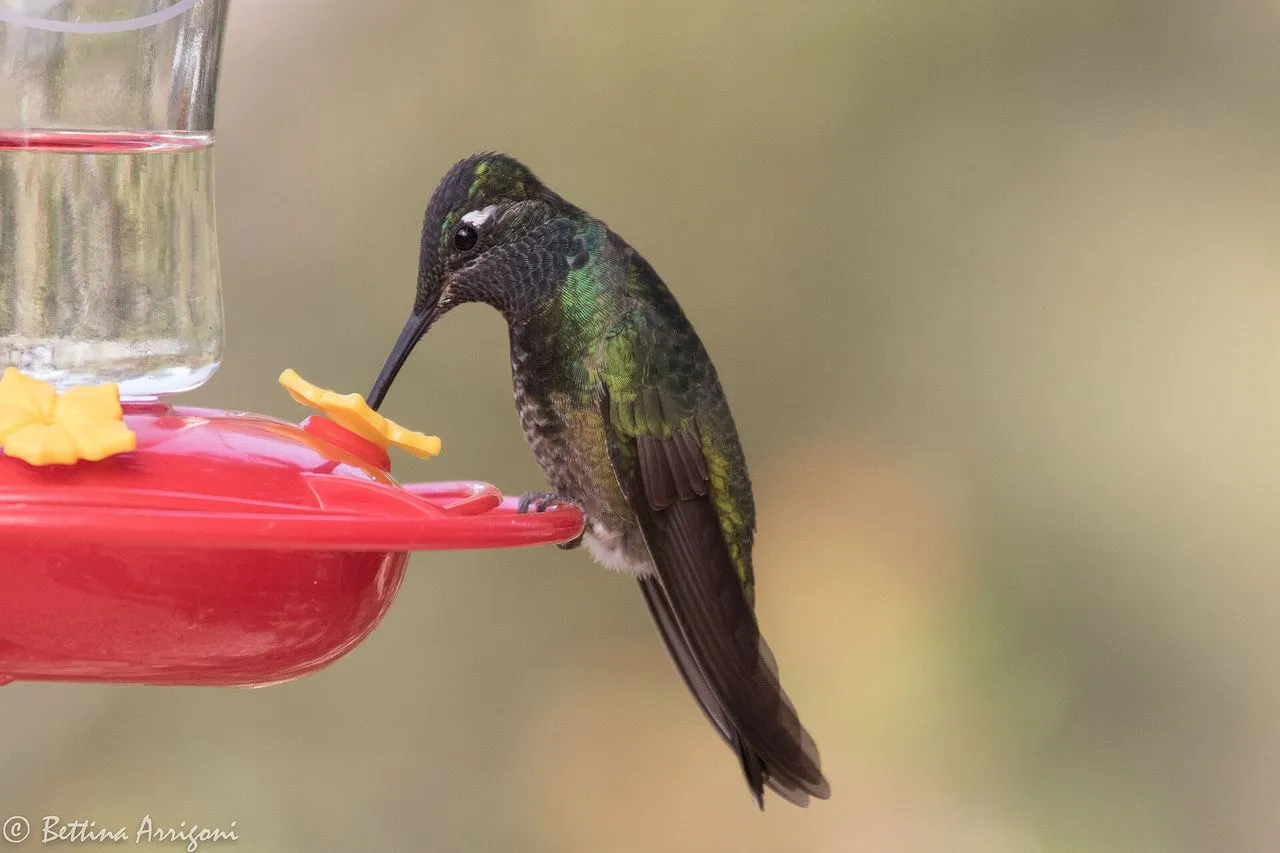
Rivoli's Hummingbird (Eugenes fulgens) is a large (7–10g) montane species. Males have dark body with iridescent green crown and purple crown (visible in good light). Previously 'Magnificent Hummingbird'. Found in Arizona sky islands and Mexican highlands.
Eugenes fulgens, Rivoli's Hummingbird, was described by Swainson in 1827 and commonly weighs 7-10 g, making it conspicuously larger than the familiar Archilochus and Selasphorus hummingbirds at North American feeders.
The species, long known in many field guides as Magnificent Hummingbird before taxonomic revision split the complex, is a montane bird of Mexico and Central America that reaches the United States chiefly in the sky-island ranges of southeastern Arizona and southwestern New Mexico.
Part of the Complete Hummingbirds Guide.
Identification
| Character | Rivoli's (E. fulgens) | Blue-throated Mountaingem (L. clemenciae) |
|---|---|---|
| Body mass | 7-10 g | 7.5-10.5 g |
| Adult male crown | Violet to blue-violet | Green, not a contrasting violet cap |
| Adult male throat | Green to emerald | Deep blue, often black in shade |
| Tail | Broad and dark | Dark with white corners |
| Female face | White post-ocular stripe, dusky cheek | Bold white stripes above and below eye |
Visual
Adult male Rivoli's is large, long-billed, and dark-bodied. The crown is iridescent violet to blue-violet, and the gorget is green to emerald. Both colours are structural; in poor light the head and throat can collapse into a nearly black silhouette. The contrast between dark underparts, green throat, and violet crown is diagnostic when light cooperates.
Females are green above and greyish below with a white post-ocular stripe and dusky cheek. They are large and long-billed, with a steadier, heavier impression than smaller species. Size is useful at feeders, especially beside Broad-billed, Black-chinned, or Broad-tailed hummingbirds, but lone birds still require attention to bill length, tail, and face pattern.
The bill is straight to slightly decurved and proportionally long. The tail is broad and dark. The wingbeats appear slower than those of smaller hummingbirds because the bird is larger, though the metabolic demands remain intense.
Audio
Vocalisations include sharp chips and dry chatter. Rivoli's does not have the loud continuous wing-trill of Broad-tailed Hummingbird. At feeders, the sound of arrival is often a heavier wing hum and abrupt displacement of smaller birds rather than a diagnostic song.
Distribution
The main range lies in montane Mexico and Central America, where the species occupies pine-oak forest, cloud forest edges, and highland clearings. In the United States it is regular but local in southeastern Arizona canyons and mountains, including the Huachuca, Santa Rita, Chiricahua, and nearby ranges, and less commonly southwestern New Mexico.
Seasonality varies with elevation and flowering. In Arizona it is most expected from spring through early autumn, though local records can extend outside that window. Its presence north of Mexico is tied to the sky-island system: isolated mountain ranges with Mexican affinities rising from desert basins.
Habitat
Rivoli's is a mountain hummingbird. It uses pine-oak woodland, sycamore canyons, humid ravines, forest edge, and clearings with flowering agaves, salvias, penstemons, and other nectar plants. It is particularly associated with canyons that combine shade, water, and bloom.
In the United States, many observations come from established feeding stations in mountain canyons. Feeders make the bird visible; they do not define its habitat. The surrounding forest and canyon plant community remain the ecological base.
Diet and Feeder Behaviour
Nectar is taken from larger tubular flowers and from feeders, but arthropods remain essential. A bird of 8 g still cannot live on sugar alone. It gleans and hawks small insects, especially around foliage openings and shaded canyon edges.
At feeders, Rivoli's can dominate by size, though it is not always as hyper-aggressive as Rufous. It often feeds in repeated visits, perching between bouts. Use the standard 1:4 white sugar solution. In Arizona summer heat, cleaning intervals must be short; canyon shade does not make old solution safe.
Large hummingbirds can drain feeders quickly. Refill frequency should not be confused with cleaning frequency. A reservoir that empties daily still needs disassembly and port cleaning because biofilm forms where bills contact the feeder.
Breeding Biology
Breeding occurs mainly in montane forest within the core range. Males display and defend access to nectar resources or display spaces but do not provide parental care. Female-only nesting is the rule.
The female builds a cup nest of plant fibres, down, moss, and spider silk, often placed on a branch in shaded woodland or canyon vegetation. Two eggs are typical. Nest placement must balance concealment, access, and the cool damp microclimates of mountain forest.
In the U.S. portion of the range, breeding evidence is more local and should be documented carefully. Presence at a feeder does not by itself indicate nesting; repeated female activity, nest material carrying, or dependent young are stronger evidence.
Notes
Rivoli's Hummingbird is one of the species that makes southeastern Arizona biologically Mexican as much as North American. Its occurrence follows mountain habitat continuity, not political borders.
The bird's dark appearance also teaches a general hummingbird lesson: iridescence can hide. A male Rivoli's in shade may look plain and heavy. The same bird, turning crown and gorget through the correct angles, shows violet and green fields that are structural optical surfaces, not fixed paint.
See Also
Frequently Asked Questions
How do I identify Rivoli's Hummingbird?
Large size, dark body, and male's iridescent crown are distinctive, green above with purple crown visible in good light. The crown shimmers as the bird moves. Female has pale throat and white post-ocular stripe.
Where does Rivoli's Hummingbird range?
Highlands of Mexico and Central America, reaching the US in Arizona's sky islands and southwestern New Mexico. They occur in pine-oak woodland and montane canyons, often at higher elevations than other US hummingbirds.
Do Rivoli's Hummingbirds use feeders?
Yes, they regularly visit feeders in Arizona sky island canyons. Their large size allows them to dominate smaller hummingbirds. They often perch and wait rather than hover continuously.
What is the difference between Rivoli's and Magnificent?
Taxonomic split, 'Magnificent' now applies to Eugenes spectabilis (Central America). Rivoli's (E. fulgens) is the species in Mexico and the US. The US bird should be called Rivoli's Hummingbird.