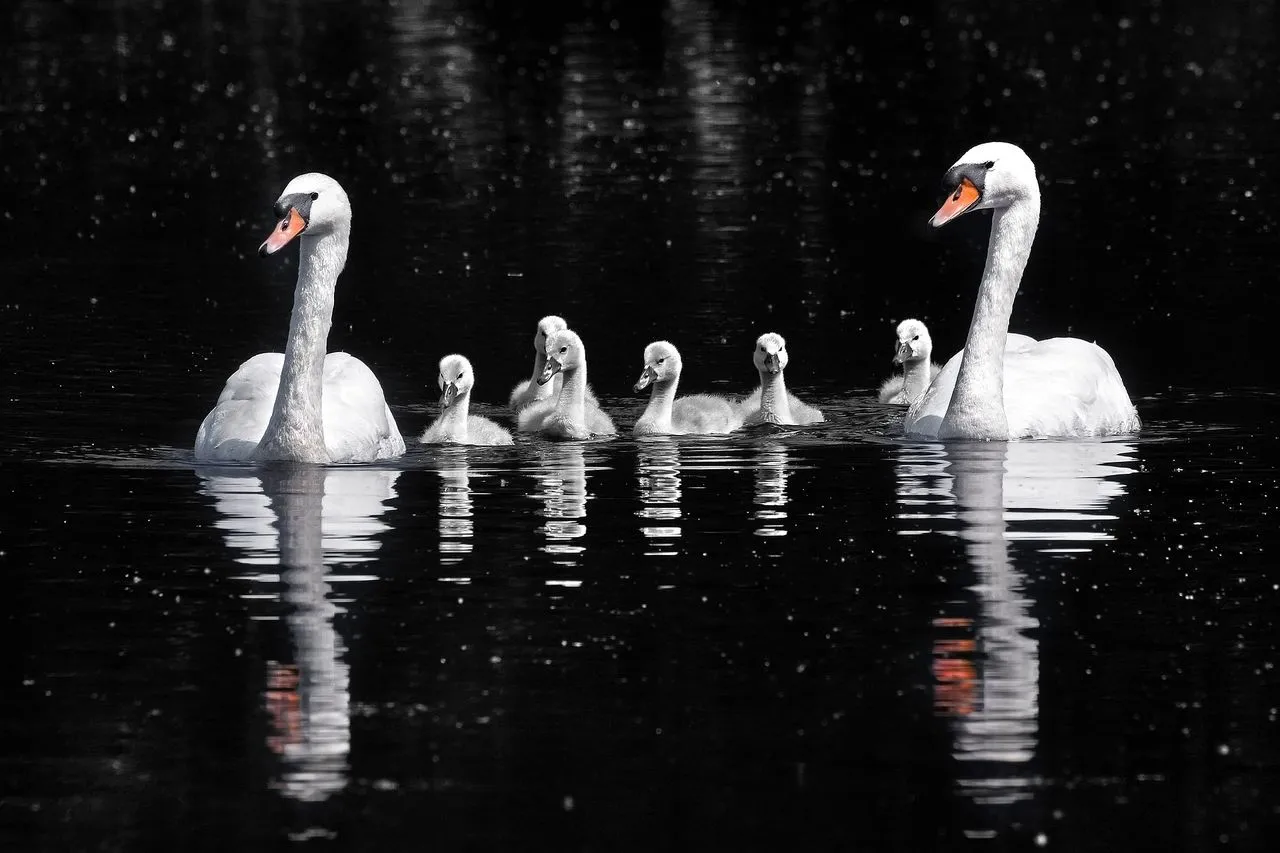
Cygnus olor (Gmelin, 1789), the Mute Swan, is not mute in the literal sense, but it lacks the loud bugling flight calls of Whooper and Tundra swans. Its flight produces a rhythmic throbbing or singing from the wings, audible at close range, and the adult's orange bill with black basal knob is diagnostic in Europe and North America.
Part of the Complete Waterfowl Guide.
Identification at a glance
| Character | Mute Swan | Whooper Swan | Tundra Swan |
|---|---|---|---|
| Length | 125–160 cm (49–63 in) | 140–165 cm (55–65 in) | 115–150 cm (45–59 in) |
| Bill | Orange with black basal knob | Yellow-and-black, no knob | Mostly black, often small yellow spot |
| Neck posture | Often S-curved | Straighter, upright | Straighter, shorter-looking |
| Flight sound | Rhythmic wing throbbing; usually no loud call | Loud bugling calls | High, loud flight calls |
| Status | Native Europe; introduced North America | Wild breeder and migrant | Arctic breeder and migrant |
Identification
Visual
Adults are large white swans, typically 125-160 cm long with a wingspan around 200-240 cm. The bill is orange with black along the base and cutting edge, and a black knob at the forehead. Males average larger and develop a larger knob, especially in the breeding season, but plumage is otherwise alike. The neck is often held in an S-curve, and aggressive birds arch the wings over the back in the familiar busking posture.
Juveniles are grey-brown or dirty white with dull bills, becoming whiter through their first year. The bill colour separates adults from Whooper Swan, which has a yellow-and-black bill without a knob, and from Tundra Swan, which has mostly black bill with a small yellow spot in many individuals.
There is no eclipse plumage in the duck sense. Swans moult flight feathers but do not pass through a female-like alternate body plumage.
Audio
Adults hiss, snort, grunt, and give low contact calls. The wing sound in flight is a key character: a pulsing, mechanical wouff-wouff-wouff that carries when birds pass overhead. Whooper and Tundra swans call loudly in flight; Mute Swans usually do not.
Distribution
Mute Swan is native across much of temperate Europe and western Asia, with complex histories of semi-domestication, pinioning, estate keeping, and local releases. In Britain it is both native and historically managed; in North America it is introduced, with established populations in the Great Lakes, Atlantic coast, and scattered inland sites. European birds are mostly resident or locally dispersive, while northern and eastern populations may move in hard weather.
Habitat
The species uses lowland lakes, slow rivers, canals, park ponds, gravel pits, reservoirs, coastal lagoons, and sheltered estuaries. It favours water with accessible submerged vegetation and secure nesting edges. Urban tolerance is high where persecution is low, which explains its abundance on ornamental and municipal waters.
Territory size varies with food supply and shoreline structure. On a narrow canal, a pair may defend a long linear section; on a productive lake, several pairs may nest in sight of one another if visual barriers reduce direct conflict. Non-breeding birds gather in moulting flocks on larger waters, where they replace flight feathers and remain flightless for several weeks. These moulting sites are important even when no nesting occurs there.
Diet and Foraging
Mute Swan is primarily herbivorous. It feeds on submerged macrophytes, algae, pondweeds, eelgrass, waterweed, and emergent vegetation, also grazing grass and taking grain or bread where people feed birds. The long neck allows feeding at depths unavailable to ducks, commonly up to about 1 m and sometimes more by upending.
Heavy feeding by dense swan populations can reduce submerged plant biomass in enclosed waters. This is a management issue in parts of North America where the species is introduced and locally abundant. Animal food is incidental rather than central.
Breeding Biology
Pairs are long-term and often territorial. The nest is a large mound of reeds, sticks, and aquatic vegetation, built on islands, reedbeds, banks, or floating platforms. Clutches usually contain 4-7 eggs. Incubation lasts about 35-38 days, mainly by the female, while the male guards the territory.
Cygnets leave the nest soon after hatching and are led by both parents. Adults defend broods vigorously against other swans, geese, dogs, and sometimes people. Young remain with the parents for several months and may be expelled before the next breeding season.
Notes
In the United Kingdom, Mute Swan is protected under the Wildlife and Countryside Act 1981; injuring birds, taking eggs, or disturbing nests is unlawful except under licence. The old claim that the monarch owns all swans is imprecise: royal prerogative historically applied to unmarked Mute Swans on certain open waters, especially the Thames, alongside rights of the Vintners' and Dyers' companies. In North America the management context is different because the species is introduced and can conflict with native wetland vegetation and waterbirds.
Field observers should distinguish aggression from abnormal behaviour. Territorial males routinely chase geese, ducks, other swans, kayaks, and dogs during nesting; this is expected breeding defence in a large herbivore with cygnets to protect. Feeding by people changes local behaviour by concentrating birds and increasing approach tolerance. Bread is nutritionally poor and encourages crowding, but the larger ecological issue is artificial density on small ponds.
Ageing immatures is useful in winter groups. First-year birds retain grey-brown feathering, duller bills, and less developed knobs; second-year birds may be mostly white but still show muted bare-part colour. Non-breeding subadults often gather away from territories and are the birds most likely to appear suddenly on small ponds after being driven from breeding areas by territorial adults.
Lead poisoning remains a historical and local issue for swans because they feed from sediments and ingest grit. Restrictions on lead fishing weights in Britain reduced one major source of mortality, but birds can still encounter old shot or contaminated sediments. Weakness, green droppings, and inability to fly require wildlife-rescue assessment, not casual feeding.
See Also
- Canada Goose: large introduced waterfowl of similar suburban and park habitats
- Sandhill Crane: tall wading bird sometimes sharing open wetland and agricultural habitats
- Dealing with Invasive Birds: relevant to the introduced status and management of Mute Swan in North America
- Birdbaths and Water Features: useful context for ornamental ponds and managed urban waterbodies
- The Complete Waterfowl Guide: full family overview including swan identification and introduced species context
Frequently Asked Questions
How do I identify a Mute Swan?
Adults are large white swans with an orange bill featuring black along the base and a black basal knob. The neck is often held in an S-curve. In flight, a rhythmic throbbing or singing from the wings is distinctive. Juveniles are grey-brown with dull bills.
How do I separate Mute Swan from other swans?
Mute Swan has an orange bill with black basal knob, unlike Whooper Swan (yellow-and-black bill without knob) or Tundra Swan (mostly black bill with small yellow spot). Mute Swans usually do not call loudly in flight like other swans.
Why are Mute Swans considered invasive in North America?
Mute Swan is introduced to North America from Europe. Established populations in the Great Lakes, Atlantic coast, and inland sites can conflict with native wetland vegetation and waterbirds through overgrazing of submerged plants.
What do Mute Swans eat?
They are primarily herbivorous, feeding on submerged macrophytes, algae, pondweeds, eelgrass, and emergent vegetation. They also graze grass and take grain or bread where available. Their long neck allows feeding at depths up to about 1 meter.
Sources & References
- Ehrlich, P.R., Dobkin, D.S. & Wheye, D. (1988). The Birders Handbook. Simon & Schuster.
- Cornell Lab of Ornithology. (2024). All About Birds: Mute Swan. birds.cornell.edu
- Sibley, D.A. (2014). The Sibley Guide to Birds (2nd ed.). Knopf.
- Carboneras, C. & Kirwan, G.M. (2024). Mute Swan (Cygnus olor). Birds of the World.