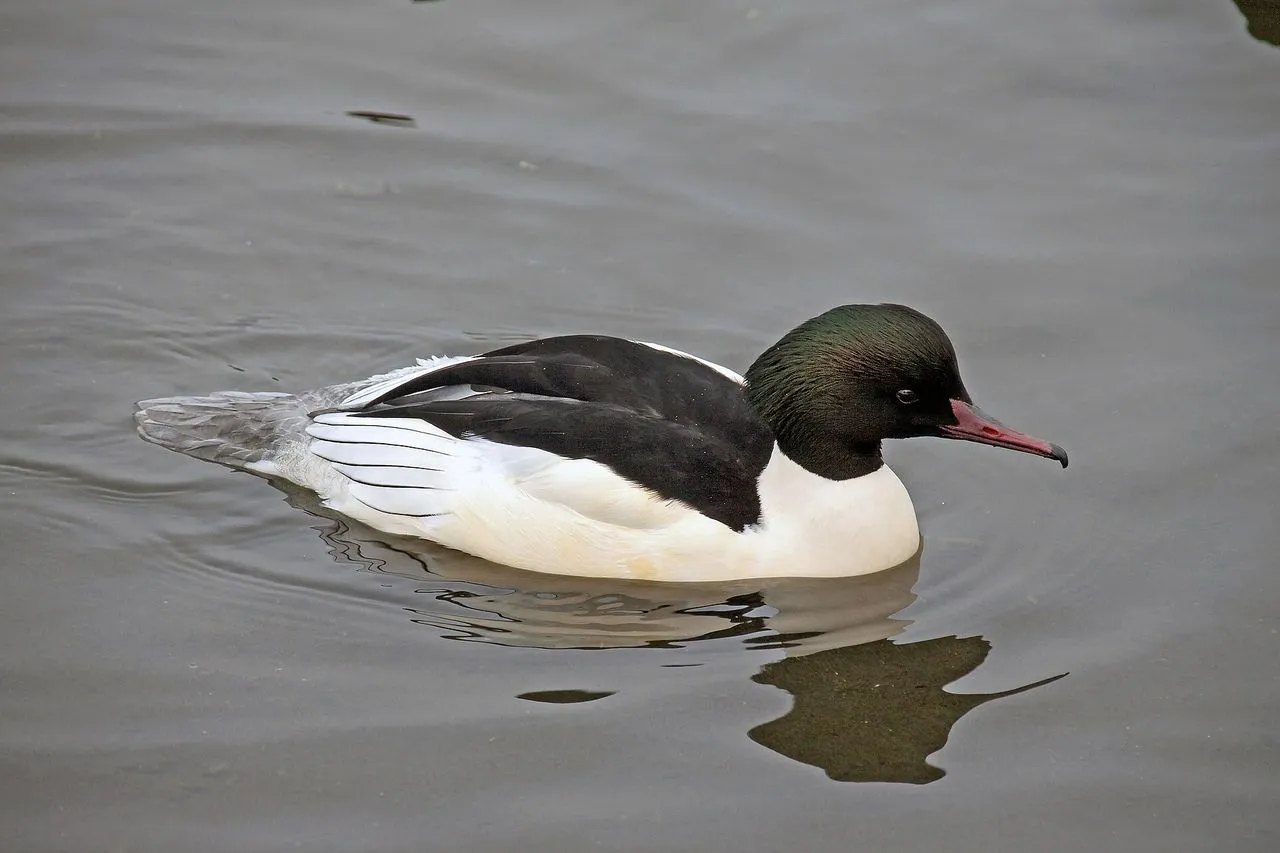
Mergus merganser (Linnaeus, 1758), the Common Merganser, called Goosander in Britain, is a large sawbill whose narrow red bill carries backward-pointing serrations for gripping fish. It is not a seed-filtering duck with a modified diet; it is a pursuit diver shaped by fish capture, with the legs set well back and a low, elongated body on the water.
Part of the Complete Waterfowl Guide.
Identification at a glance
| Character | Common Merganser male | Hooded Merganser male |
|---|---|---|
| Length | 54–71 cm (21–28 in) | 40–49 cm (16–19 in) |
| Head shape | Smooth, rounded; dark green-black | Tall fan crest with white centre patch |
| Bill | Long, narrow, red | Short, narrow, dark |
| Body | Pale flanks, white body, dark back | Black-and-white pattern; chestnut flanks |
| Habitat | Clear rivers, lakes, reservoirs | Wooded swamps, ponds, slow streams |
Identification
Visual
The adult male in breeding plumage has a dark green-black head, red bill with hooked tip, white body often flushed salmon-pink in fresh plumage, black back, and white wing patches. The head looks smoothly rounded, not shaggy. On water the bird sits long and low, with a straight-backed profile.
The female has a warm rufous-brown head with a ragged rear crest, sharply demarcated from a pale grey neck and body. The throat is white. This clean boundary between brown head and pale neck helps separate female Common Merganser from Red-breasted Merganser, which has a more diffuse, shaggy-headed look and slimmer structure. Juveniles resemble females.
Eclipse males become female-like but usually retain more white in the wing and a heavier body. The bill remains red and narrow in all plumages.
Audio
Common Mergansers are generally quiet. Females can give harsh croaking calls near broods or when disturbed. Courtship includes low calls, but the species is usually detected by structure and behaviour rather than voice.
Distribution
The breeding range spans boreal and montane regions of North America and Eurasia, wherever clear rivers, lakes, fish, and cavity sites coincide. In North America it breeds across Alaska, Canada, and northern states, wintering south on ice-free lakes, reservoirs, and rivers. In Europe it breeds in Scandinavia, Scotland, northern England, Wales, and parts of central Europe, moving to lowland waters in winter. British birds have expanded from upland river strongholds into additional catchments where nest sites and fish are available.
Habitat
Breeding habitat is clear freshwater: fast rivers, wooded lakes, upland lochs, and large streams with fish populations. Nesting requires cavities in trees, rock crevices, banks, buildings, or nest boxes. In winter the species uses larger rivers, reservoirs, gravel pits, estuaries, and sheltered coastal water, provided feeding visibility is adequate.
Water clarity is not a decorative preference. A pursuit diver that catches fish by sight is disadvantaged in heavily silted water. Birds may abandon a river stretch after spate conditions and return when clarity improves. On reservoirs they often work along dam edges, inflows, and fish shoals rather than distributing evenly across the basin. Winter counts should therefore include repeated scans of linear edges, not just the open centre.
Diet and Foraging
This is a diver, not a dabbler. Birds submerge from the surface, propel themselves with the feet, and pursue fish underwater. Prey includes minnows, trout parr, salmonids, sticklebacks, perch, and other small to medium fish, with aquatic insects and crustaceans taken opportunistically. Dive duration is commonly under half a minute but varies with depth and prey behaviour.
The serrated bill edges are keratinous projections, not true teeth. They prevent slippery fish from sliding free when seized crosswise. Birds often surface with prey, manipulate it head-first, and swallow it whole. Feeding flocks may drive fish in loose coordination, but many birds hunt singly.
Breeding Biology
Pairs form in winter and early spring. The female selects the nest cavity, often in a mature riverside tree, and lines it with down. Clutches usually contain 8-12 eggs, though dump-laying can increase counts. Incubation lasts about 30-35 days and is by the female alone.
Ducklings leave the cavity shortly after hatching and are led to water. They can dive almost immediately and take small aquatic prey, though the female broods and guards them. Brood amalgamation occurs: one female may be seen with unusually large numbers of young, not all her own. Fledging takes roughly 60-70 days.
Notes
Conflict with fisheries has followed the species in Britain and parts of Europe, especially on salmonid rivers. The biological point is specific: mergansers do take juvenile fish, but their impact depends on fish density, river structure, stocking practice, and alternative prey. Presence alone is not evidence of population-level damage. For field identification, separate Common Merganser from Red-breasted by body bulk, head smoothness in males, and the female's clean brown-head-to-pale-neck boundary.
In Britain, the name Goosander is standard and avoids confusion with Red-breasted Merganser on sea lochs and estuaries. On inland winter waters, a large sawbill flock is usually Goosander unless proven otherwise. Females can look superficially alike at distance; the Common Merganser's heavier bill base, paler body, and abrupt head-neck contrast are the practical marks.
Brood counts require caution. Creches can make one female appear extraordinarily productive, and broods move quickly downstream after hatching. A count of 20 ducklings with one female is not evidence of a 20-egg successful clutch. It is more likely an amalgamation of broods or the result of dump-laying and subsequent brood mixing, both common enough in cavity-nesting waterfowl to affect local productivity estimates.
Ageing males in winter is possible with care. First-winter males often show duller head gloss, less clean body white, and traces of female-like grey. Adult males are crisper and more contrasting. Do not force every transitional bird into adult categories when moult timing and distance make the evidence inadequate.
See Also
- Hooded Merganser: smaller sawbill of more enclosed wooded wetlands; compare size, structure, and prey
- Bufflehead: tiny cavity-nesting diver often sharing sheltered winter water
- Wood Duck: another cavity-dependent duck of wooded freshwater systems
- Great Blue Heron: fish-eating wader that occupies a similar prey niche on shallow waters
- The Complete Waterfowl Guide: full family overview including sawbill structure, fish-capture adaptations, and river ecology
Frequently Asked Questions
How do I identify a Common Merganser?
Males have a dark green-black head with a red bill, white body, and black back. Females show a rufous-brown head with a ragged crest, sharply demarcated from a pale grey neck and body. The clean boundary between brown head and pale neck is distinctive.
How do I separate Common Merganser from Red-breasted Merganser?
Common Merganser has a smoother, more rounded head profile and heavier bill. Female Common Merganser shows an abrupt boundary between brown head and pale neck, while Red-breasted has a more diffuse, shaggy-headed look.
What do Common Mergansers eat?
They are pursuit divers that catch fish underwater. Prey includes minnows, trout parr, sticklebacks, perch, and other small to medium fish. The serrated bill edges prevent slippery fish from sliding free when seized.
Where do Common Mergansers nest?
They nest in tree cavities, rock crevices, banks, buildings, or nest boxes near clear freshwater rivers, wooded lakes, and upland lochs with fish populations. They breed across boreal and montane regions of North America and Eurasia.
Sources & References
- Ehrlich, P.R., Dobkin, D.S. & Wheye, D. (1988). The Birders Handbook. Simon & Schuster.
- Cornell Lab of Ornithology. (2024). All About Birds: Common Merganser. birds.cornell.edu
- Sibley, D.A. (2014). The Sibley Guide to Birds (2nd ed.). Knopf.
- Carboneras, C. & Kirwan, G.M. (2024). Common Merganser (Mergus merganser). Birds of the World.