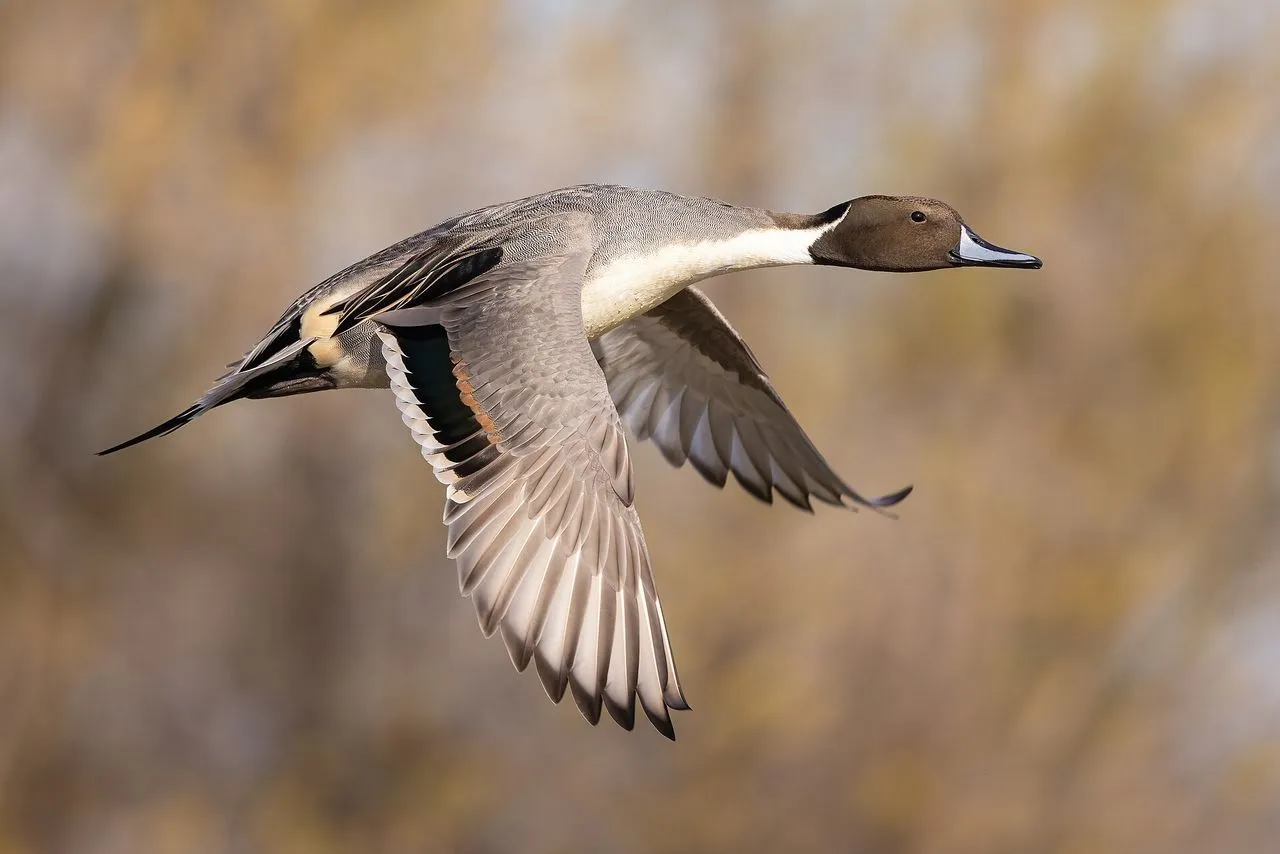
Anas acuta (Linnaeus, 1758), the Northern Pintail, is the aerodynamic dabbler: long neck, narrow wings, and in the adult male a pair of elongated central tail feathers that can add several centimetres to the rear profile. Body length is commonly 51-76 cm, but much of that measurement is neck and tail; mass overlaps smaller dabblers more than the outline suggests.
Part of the Complete Waterfowl Guide.
Identification at a glance
| Character | Northern Pintail | Mallard |
|---|---|---|
| Length | 51–76 cm (20–30 in) | 50–65 cm (20–26 in) |
| Female bill | Plain grey | Orange with dark mottling |
| Structure | Long neck, narrow wings, pointed tail | Stockier body, shorter tail |
| Male head | Chocolate-brown with white neck line | Green head with white neck ring |
| Foraging depth | Uses long neck in shallow-to-moderate water | Upends in shallow water to about 40 cm (16 in) |
Identification
Visual
The breeding male is sharply patterned. The head is chocolate-brown, the neck white, with a white line running up each side of the neck into the brown head. The breast and belly are white, flanks grey and finely vermiculated, undertail black, and central tail feathers long and pointed. The bill is blue-grey with a black central stripe. In flight the wings look narrow and swept, and the speculum is greenish-bronze bordered by buff and white.
The female is brown and cryptic but structurally distinctive. She is slimmer than a female Mallard, longer-necked, and longer-tailed, with a relatively plain grey bill rather than orange-and-black mottling. The head is more refined, the body less bulky, and the tail tapers to a point. At distance, structure is often more reliable than plumage.
Eclipse males lose the clean brown-white head pattern but retain a greyer bill, longer tail, and often a smoother grey cast to the body than females. By autumn the white neck stripe begins to reappear.
Audio
The male gives a soft, fluted whistle, thinner than the wigeon whistle and less carrying than teal calls. Females give a low quack, usually drier and less emphatic than Mallard.
Distribution
Northern Pintail has a near-circumpolar breeding distribution across northern North America, Iceland, northern Europe, and Asia, extending south into prairie and steppe wetlands where seasonal water is abundant. North American birds use all major flyways, with important wintering areas in California's Central Valley, the Gulf Coast, Mexico, and the lower Mississippi. Eurasian birds winter around western Europe, the Mediterranean, the Middle East, India, East Asia, and sub-Saharan wetlands.
The species is strongly migratory. In Britain it is mainly a winter visitor and passage bird, with small and irregular breeding numbers. In North America it is tied closely to prairie pothole water conditions, and breeding numbers can shift markedly with drought.
Habitat
Pintail favours shallow, open wetlands: prairie potholes, flooded grassland, brackish marsh, seasonal pools, estuarine lagoons, and rice fields. It often uses more open and less vegetated water than teal, though nesting cover must be available nearby. During winter, large tidal marshes and flooded agricultural land can hold hundreds or thousands.
Water depth is important. Pintail are most efficient where the substrate is reachable by upending and neck extension, not where the bird must dive. A productive pintail wetland often looks unimpressive to a casual visitor: sheet water over short vegetation, muddy margins, seed-rich annual plants, and little deep open water. Managed drawdowns that expose and then reflood seed-producing plants can be excellent for wintering birds.
Diet and Foraging
This is a dabbling duck adapted to shallow feeding. It upends readily, reaching submerged seeds, tubers, and invertebrates with the long neck, and also feeds by surface sieving. The bill lamellae filter small seeds and aquatic invertebrates; animal food is especially important for laying females and ducklings. Winter diet often includes seeds of sedges, grasses, smartweeds, and agricultural grain, particularly rice and waste cereal.
The long neck has a practical foraging consequence. Pintail can exploit water slightly deeper than many smaller dabblers without diving, often feeding in zones where teal are confined to margins and Mallard are less efficient.
Breeding Biology
Pairs form during winter. Nesting is on the ground, frequently in short or moderate grass, sometimes far from water compared with other dabblers. This exposed nesting habit makes the species vulnerable to mammalian predation and agricultural operations. Clutch size is usually 7-9 eggs, incubated by the female for about 22-24 days.
Males abandon incubation and move to moulting sites, becoming flightless during the wing moult. Broods require shallow wetlands rich in invertebrates. Young fledge at about 6-7 weeks. Renesting occurs after early failure, but success depends heavily on water remaining available through the brood period.
Notes
Pintail declines in parts of North America are not explained by hunting alone. Prairie drought, conversion of grassland to cropland, nest predation in fragmented landscapes, and the species' tendency to nest in comparatively sparse cover all interact. For field observers, the main trap is calling any elegant female dabbler a Pintail. Confirm the plain grey bill, long tail point, and attenuated rear body; a female Mallard can look deceptively slender when alert.
Sex ratios in winter flocks can appear male-biased, partly because adult males are easier to identify and partly because survival and migration schedules differ. Counts made during migration should record age and sex when possible, rather than treating all pintail as an undifferentiated block. A flock's use of flooded rice or shallow estuary also changes through the day: birds may roost on open water at midday and feed intensively at dusk or night.
The species is sensitive to disturbance on open wetlands because it relies on long sight lines and quick flight rather than dense cover. A distant flock lifting repeatedly from a scrape may stop feeding long before a person reaches the shoreline. For observation, a fixed position and patient scanning produce better notes than walking the whole edge and repeatedly flushing birds.
See Also
- Mallard: primary comparison species for female dabbler identification; note bill colour and body bulk differences
- Northern Shoveler: fellow prairie-breeding dabbler; compare bill structure, feeding mode, and migration timing
- Snow Goose: shares open prairie staging and agricultural wintering landscapes with pintail
- Sandhill Crane: open-country species that overlaps in flooded fields and grassland wetlands
- The Complete Waterfowl Guide: full family overview including long-tailed dabbler structure and flyway movements
Frequently Asked Questions
How do I identify a Northern Pintail?
Look for the long, pointed tail feathers in males and the slim, elongated profile in females. Males have a chocolate-brown head with white neck and breast; females have a plain grey bill (not orange like Mallard) and a sleek, refined head shape.
When do Northern Pintails migrate?
Northern Pintails migrate early compared to other dabblers. Adults leave breeding areas in August, with large numbers reaching wintering grounds by September. Spring migration is also rapid as pairs move north when shallow water appears.
What do Northern Pintails eat?
They are dabbling ducks that feed by upending in shallow water and surface sieving. Diet includes seeds of sedges, grasses, and smartweeds, plus aquatic invertebrates especially for breeding females and ducklings. They also eat waste grain in agricultural fields.
Where do Northern Pintails nest?
They nest on the ground in grasslands, often some distance from water. Nesting habitat includes prairie potholes, hayfields, and native grassland. The exposed nesting habit makes them vulnerable to predation and agricultural operations.
Sources & References
- Ehrlich, P.R., Dobkin, D.S. & Wheye, D. (1988). The Birders Handbook. Simon & Schuster.
- Cornell Lab of Ornithology. (2024). All About Birds: Northern Pintail. birds.cornell.edu
- Sibley, D.A. (2014). The Sibley Guide to Birds (2nd ed.). Knopf.
- Carboneras, C. & Kirwan, G.M. (2024). Northern Pintail (Anas acuta). Birds of the World.