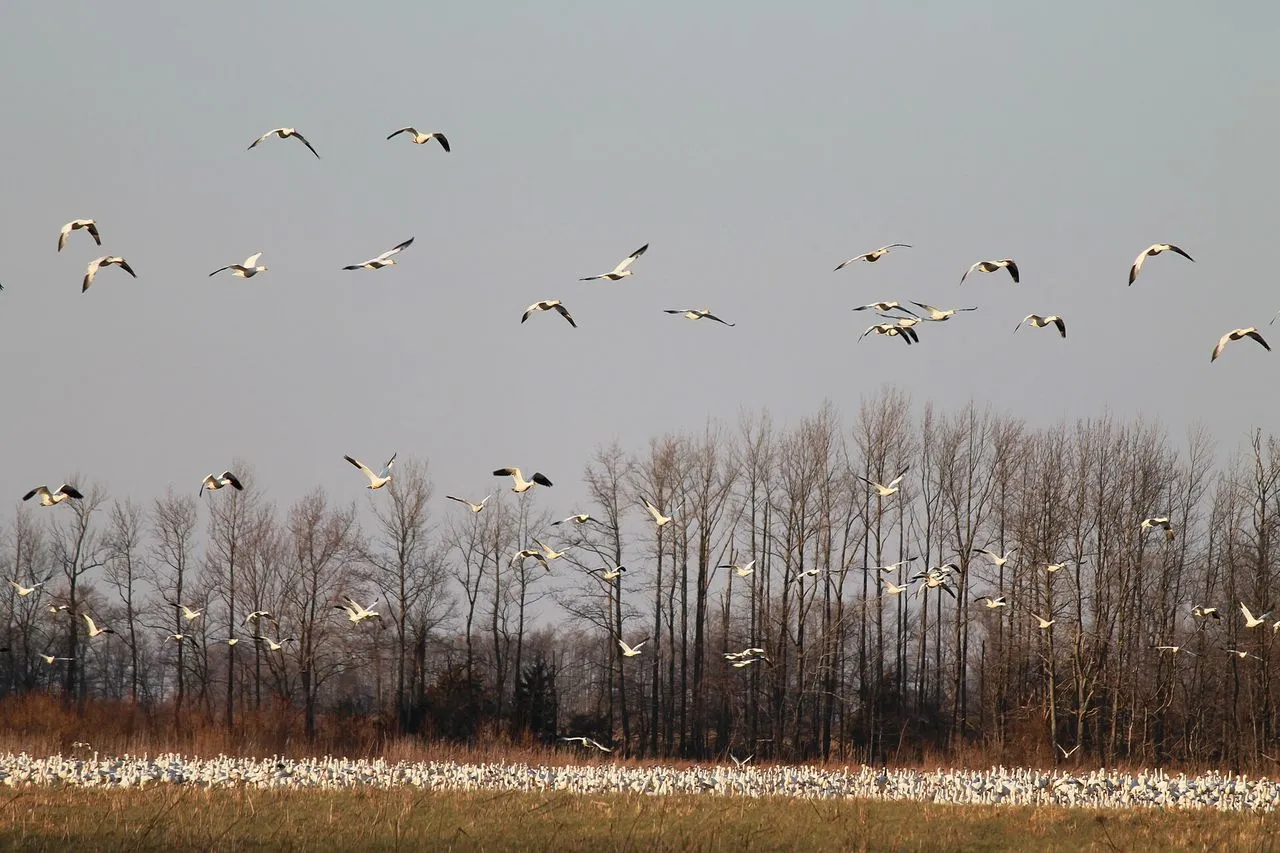
Anser caerulescens (Linnaeus, 1758), the Snow Goose, is a high-Arctic breeding goose with two common colour morphs controlled largely by a dominant allele: white morph birds are white with black primaries, while blue morph birds have dark grey-brown bodies and white heads. Mixed winter flocks can therefore look like two species until structure and voice are checked.
Part of the Complete Waterfowl Guide.
Identification at a glance
| Character | Snow Goose | Ross's Goose |
|---|---|---|
| Length | 63–80 cm (25–31 in) | 53–66 cm (21–26 in) |
| Bill | Pink, longer, strong black grin patch | Short, stubby, weak or absent grin patch |
| Head shape | Longer-faced and heavier-billed | Rounder head, shorter face |
| Morphs | White and blue morphs common | Mostly white; blue morph rare |
| Flock context | Large noisy flocks; fields and marshes | Often mixed within Snow Goose flocks |
Identification
Visual
White morph adults are white-bodied with black wingtips, pink bill, pink legs, and a black cutting-edge patch on the bill known as the grin patch. Blue morph adults have dark body plumage, white head and upper neck, and the same pink bill and legs. Juveniles are duller: white morph juveniles are grey-washed, while blue morph juveniles are darker with less clean white on the head.
Size varies by population. Lesser Snow Goose is smaller and more numerous across much of North America; Greater Snow Goose breeds in eastern High Arctic Canada and winters mainly on the Atlantic coast. Ross's Goose is the main confusion species: smaller, shorter-necked, with a stubby bill lacking the strong grin patch and often showing bluish wart-like bill base in adults.
There is no eclipse plumage equivalent to male ducks; sexes are similar, with males averaging larger.
Audio
Flocks are noisy. The typical call is a high, nasal, barking whouk or kowk, sharper than Canada Goose and less musical than many white-fronted geese. Large skeins produce a continuous yelping chorus that carries over marsh and farmland.
Distribution
Snow Goose breeds in Arctic and subarctic colonies across Greenland, Canada, Alaska, and eastern Siberia. Major North American movements follow the Pacific, Central, Mississippi, and Atlantic flyways. Wintering areas include California's Central Valley, the Gulf Coast, the lower Mississippi Alluvial Valley, the southern Great Plains, Mexico, and Atlantic marshes from the mid-Atlantic states southward. In Britain and Ireland, wild birds occur mainly as scarce winter visitors, with some records complicated by feral or escaped birds.
Habitat
Breeding habitat is tundra near ponds, lakes, and coastal marsh. Migration and winter habitats are broad: saltmarsh, freshwater marsh, wet meadows, rice fields, corn stubble, pasture, and managed impoundments. Modern agricultural landscapes have greatly increased winter food availability, allowing higher survival and larger populations than historical marsh-only systems could support.
Staging sites are traditional and can hold extraordinary numbers. Birds move between night roosts on open water or protected marsh and daytime feeding areas in fields. Disturbance at the roost can displace an entire local concentration, while disturbance in one feeding field may simply move birds to another field in the same landscape. Surveys must therefore treat roost counts and feeding counts differently to avoid double-counting.
Diet and Foraging
Snow Goose is herbivorous. On Arctic breeding grounds it grubs for roots and rhizomes of sedges and grasses, clips shoots, and feeds on mosses and other tundra plants. In winter it grazes marsh vegetation, pasture grasses, waste grain, rice, corn, and winter wheat. The bill is strong, with lamellae suitable for cropping and tearing vegetation rather than fine duck-like filtration.
Grubbing can be destructive at high density. Birds pull below-ground plant parts and disturb soils; repeated use can convert vegetated saltmarsh or tundra into exposed mud with slow recovery, especially in short growing seasons.
Breeding Biology
Snow Geese nest colonially, often in dense aggregations on tundra islands, coastal plains, or raised ground near water. Pairs are long-term. Clutch size usually ranges from 3-5 eggs, with incubation around 23-25 days by the female while the male guards nearby. Goslings leave the nest soon after hatching and feed themselves under parental attendance.
Family groups remain cohesive through migration and winter. Young birds learn routes and staging areas from parents, which matters in a species using traditional flyways and colony sites. Breeding success varies strongly with snowmelt timing, predator abundance, and plant phenology on Arctic nesting grounds.
Notes
The blue morph is not a separate species. Inheritance is strongly associated with variation at the melanocortin-1 receptor locus; mixed pairs occur, and offspring morph ratios depend on parental genotype. Population growth in mid-continent Lesser Snow Geese has produced serious habitat degradation in parts of the Arctic and subarctic. Liberalised harvest regulations in North America, including spring conservation orders in some jurisdictions, are a response to overabundance, not ordinary sport-hunting policy.
Snow Goose flocks should be checked carefully for Ross's Goose, Greater White-fronted Goose, and neck-collared individuals. Collars have produced valuable survival and movement data because family groups and site fidelity make marked birds highly informative. In Europe, single Snow Geese among Barnacle or Greylag flocks require status caution: wild vagrants occur, but escapes and feral-origin birds are part of the recording problem.
The black primaries of white morph birds are visible at rest as folded black wingtips and in flight as a sharp trailing contrast. Domestic geese can be white with orange or pink bills, but they lack the Snow Goose structure, grin patch, flock behaviour, and long-distance flight formation. A genuine migrant usually arrives with wild geese, behaves warily, and fits a plausible weather and migration context.
Family groups are useful in ageing flocks. Juveniles remain with parents through their first winter and show duller plumage, especially grey-washed white morph birds. A flock with many juveniles indicates successful Arctic breeding that year; a flock dominated by adults can reflect poor nesting conditions, late snowmelt, or heavy predation on the breeding grounds.
See Also
- Canada Goose: large goose sharing migration flyways and winter staging areas; compare size, call, and bill structure
- Mallard: dabbling duck frequently encountered in the same wetland and agricultural habitats
- Sandhill Crane: open-country migrant that overlaps in fields, marshes, and staging landscapes
- Native Plants for Birds: useful context for grazing lawns and the vegetation structure geese exploit
- The Complete Waterfowl Guide: full family overview including goose identification, morph genetics, and flyway movements
Frequently Asked Questions
How do I identify a Snow Goose?
White morph birds are white with black wingtips. Blue morph birds have dark grey-brown body with white head. Both have pink bill, pink legs, and a black grin patch (cutting-edge patch) on the bill. Size varies by subspecies, Lesser and Greater Snow Goose.
What is the difference between Snow Goose and Ross's Goose?
Ross's Goose is smaller with a stubby bill lacking the strong grin patch of Snow Goose. Ross's often shows bluish wart-like bill base in adults. They can occur together in winter flocks.
Why have Snow Goose populations increased so much?
Modern agricultural landscapes have greatly increased winter food availability, waste grain, rice, corn, allowing higher survival and larger populations. This has caused habitat degradation in parts of the Arctic and subarctic from overgrazing.
Do Snow Geese migrate?
Yes, they migrate along major flyways (Pacific, Central, Mississippi, Atlantic) from Arctic breeding grounds to wintering areas in California's Central Valley, Gulf Coast, Mississippi Alluvial Valley, Mexico, and Atlantic marshes.
Sources & References
- Ehrlich, P.R., Dobkin, D.S. & Wheye, D. (1988). The Birders Handbook. Simon & Schuster.
- Cornell Lab of Ornithology. (2024). All About Birds: Snow Goose. birds.cornell.edu
- Sibley, D.A. (2014). The Sibley Guide to Birds (2nd ed.). Knopf.
- Carboneras, C. & Kirwan, G.M. (2024). Snow Goose (Anser caerulescens). Birds of the World.