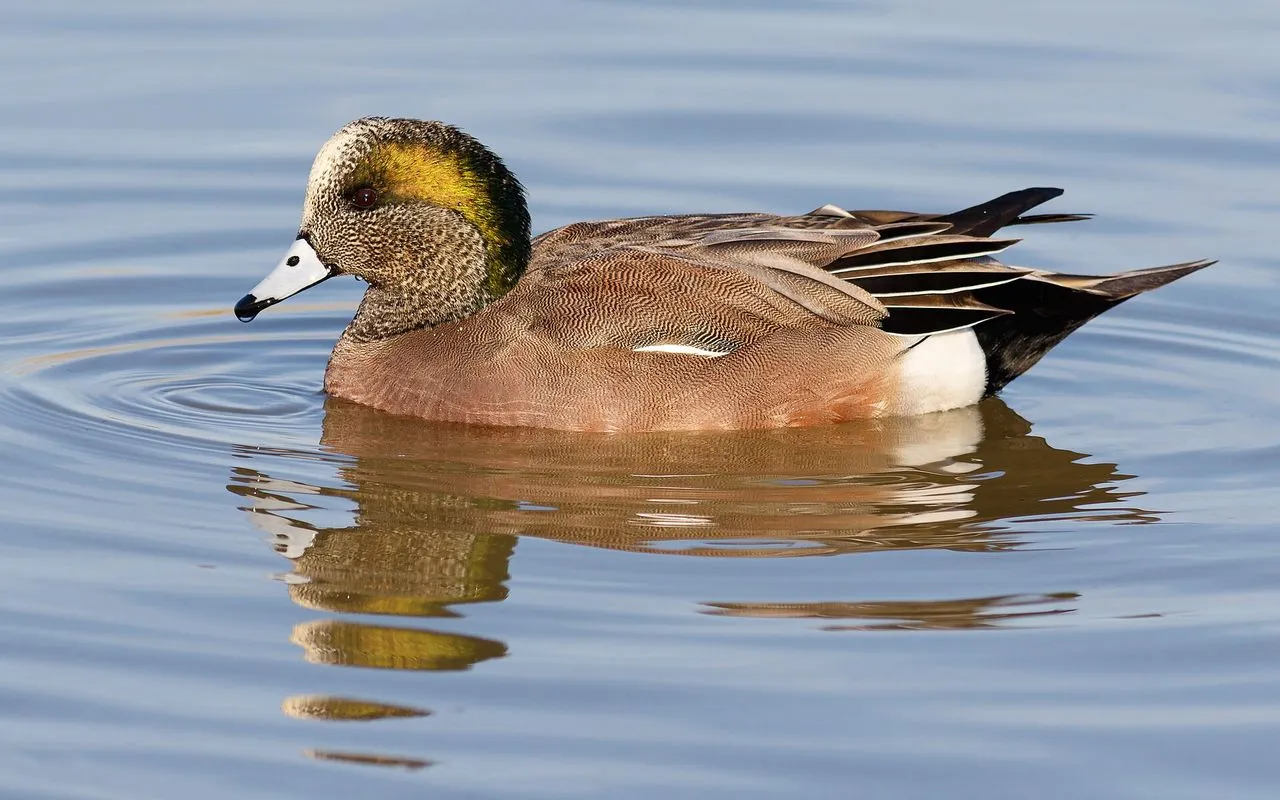
Mareca americana (Gmelin, 1789), the American Wigeon, is a dabbling duck built less for deep upending than for grazing and surface theft. Its short blue-grey bill is proportionally smaller than that of Mallard, with lamellae suited to clipping vegetation and filtering fine plant fragments; in winter flocks it is often the duck feeding on pond margins as if it were a small goose.
Part of the Complete Waterfowl Guide.
Identification at a glance
| Character | Male American Wigeon | Female American Wigeon |
|---|---|---|
| Length | 42–59 cm (17–23 in) | 42–59 cm (17–23 in) |
| Head | Pale cream forehead; green eye patch | Warm brown to grey-brown; dark eye smudge |
| Bill | Small blue-grey bill with black tip | Small blue-grey bill with black tip |
| Wing | White upperwing coverts; green speculum | White upperwing coverts less bold; green speculum |
| Voice | Clear whistled whee-WHEW-whew | Low quacks and grating notes |
Identification
Visual
The breeding male has a pale cream to white forehead and crown, a broad green iridescent patch sweeping from the eye toward the nape, pinkish-brown breast and flanks, black undertail, and a small blue-grey bill tipped black. At distance the bird can look pale-headed and compact, with a steep forehead and rounded crown. The white upperwing coverts show conspicuously in flight and during wing-flapping.
The female is warm brown to grey-brown, with a neat head, dark smudging around the eye, and the same small blue-grey bill. She is shorter-billed and rounder-headed than female Mallard, with less orange in the bill and less heavy streaking on the body. Both sexes show a green speculum bordered black; it may be hard to see on a resting bird but flashes in flight.
Eclipse males resemble females from mid-summer, but retain paler head contrast, white wing coverts, and often traces of the green face patch. Juveniles are duller and may show buff-fringed upperparts.
Audio
The male call is one of the cleanest field marks: a clear, whistled, three-part whee-WHEW-whew or squeaky whew. Females give low quacks and grating notes, weaker and less ringing than female Mallard.
Distribution
American Wigeon breeds across Alaska, western and central Canada, and locally in the northwestern United States, using the Pacific, Central, Mississippi, and Atlantic flyways in migration. Wintering concentrations are strongest along the Pacific coast, Gulf Coast, lower Mississippi Valley, Mexico, and the southern Atlantic seaboard. It is a scarce but annual vagrant to western Europe, most often found among Eurasian Wigeon flocks in winter.
Migration is protracted but shows a clear north-south seasonal rhythm. Adult males often leave breeding areas before females with broods, as in many dabblers, and move to moulting wetlands where they are briefly flightless. Autumn flocks can accumulate on prairie staging lakes before pushing south during cold fronts. On the Atlantic coast, wintering birds use brackish impoundments and estuarine edges; in the Pacific flyway, they are common on coastal marshes and inland agricultural water.
Habitat
During breeding it uses shallow freshwater marshes, prairie potholes, sedge ponds, and slow channels with emergent cover. In migration and winter it broadens into reservoirs, coastal lagoons, estuaries, flooded fields, sewage lagoons, golf-course ponds, and grazed wet meadows. It is more willing than many dabblers to feed on short grass, especially where water lies nearby for escape.
Diet and Foraging
American Wigeon is strongly herbivorous for a dabbling duck. Leaves, stems, rhizomes, algae, pondweeds, wigeon-grass, eelgrass, and sedges dominate much of the annual diet, with seeds and invertebrates increasing during breeding. The short bill clips vegetation efficiently; birds also skim the surface for floating fragments.
A characteristic behaviour is kleptoparasitism from diving waterfowl and coots. Wigeon wait near American Coots, Canvasbacks, or other divers and seize plant material brought to the surface. This is not incidental scavenging; it allows a surface-feeding duck to exploit submerged vegetation otherwise beyond its normal reach. Flocks also graze turf in a tight, goose-like front, lifting their heads frequently to scan.
Breeding Biology
Pairs form on the wintering grounds and during spring passage. Nesting occurs on dry ground, often well concealed in grass, sedge, or low shrub cover, sometimes tens of metres from water. The female lines the nest with down as laying progresses. Clutches usually contain 7-10 eggs. Incubation is by the female alone and lasts about 23-25 days.
Males depart once incubation is established and gather on moulting waters, where they become flightless during the simultaneous wing moult. Broods move to shallow wetlands with abundant emergent cover and invertebrate production. Young feed themselves immediately and fledge at roughly 6-7 weeks.
Notes
American and Eurasian Wigeon hybridise occasionally, and vagrant American Wigeon in Europe should be checked for hybrid characters: intermediate head pattern, reduced green face patch, or Eurasian-style rufous head tones. In North America, the species is also a useful indicator of wetland vegetation condition. A winter pond holding many wigeon usually has accessible submerged or marginal plant growth; a pond holding only loafing birds may be structurally suitable but nutritionally poor.
The old name "baldpate" refers to the pale forehead of the male and remains useful because that pale crown is often the first mark seen in low winter light. Avoid using the green face patch alone: angle and cloud cover can suppress iridescence completely. The small bill, rounded head, white wing coverts, and whistled call are less dependent on lighting and therefore better field characters.
Ageing autumn birds is difficult without close views, but juveniles tend to show fresher feather edges and less settled flank pattern than adults. During moult, many flocks contain drakes that are neither full eclipse nor full breeding birds. Record what is visible: bill colour, wing covert colour, crown contrast, and call. These characters remain useful when the flank and head pattern is transitional.
See Also
- Mallard: abundant dabbling duck of the same open wetland habitats; useful size and structure reference
- Northern Pintail: elegant long-tailed dabbler that often shares migration staging grounds with wigeon
- Blue-winged Teal: early-migrating teal that uses similar shallow marshes and staging ponds
- Great Blue Heron: common marsh-edge wader in the same shallow wetlands
- The Complete Waterfowl Guide: full family overview including dabbler foraging modes and eclipse plumage
- Mallard vs American Black Duck: the most-confused eastern dabbling-duck pair; useful context for any dark-bodied dabbler.
- Gadwall: the same genus (Mareca) and similar vegetable-grazing ecology; often associates with Wigeon flocks.
Frequently Asked Questions
How do I identify an American Wigeon?
Males have a distinctive pale cream to white forehead and crown with a green iridescent patch behind the eye. The small blue-grey bill is diagnostic. Females have a warm brown plumage with the same small blue-grey bill. In flight, white wing coverts are conspicuous.
What is kleptoparasitism in wigeons?
American Wigeons often steal food from diving waterfowl and coots. They wait near American Coots or Canvasbacks and seize plant material brought to the surface. This allows a surface-feeding duck to exploit submerged vegetation otherwise beyond its normal reach.
What do American Wigeons eat?
They are strongly herbivorous, feeding on leaves, stems, rhizomes, algae, pondweeds, and sedges. They clip vegetation efficiently with their short bill and also skim the surface for floating fragments. In winter they often graze on short grass near water.
Where do American Wigeons breed?
They breed across Alaska, western and central Canada, and locally in the northwestern United States. They use shallow freshwater marshes, prairie potholes, and sedge ponds with emergent cover for nesting.
Sources & References
- Ehrlich, P.R., Dobkin, D.S. & Wheye, D. (1988). The Birders Handbook. Simon & Schuster.
- Cornell Lab of Ornithology. (2024). All About Birds: American Wigeon. birds.cornell.edu
- Sibley, D.A. (2014). The Sibley Guide to Birds (2nd ed.). Knopf.
- Carboneras, C. & Kirwan, G.M. (2024). American Wigeon (Mareca americana). Birds of the World.