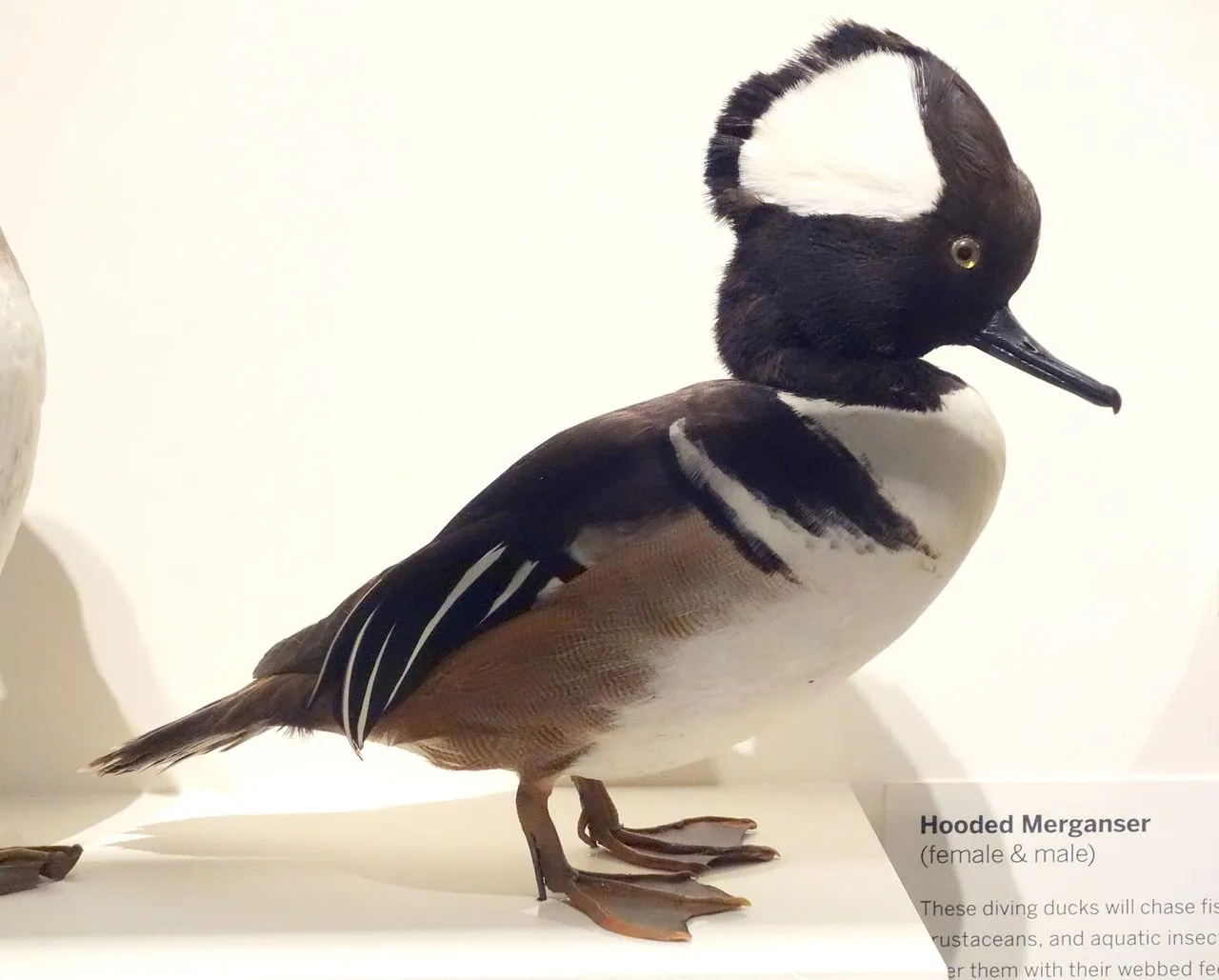
Hooded Merganser (Lophodytes cucullatus) is North America's smallest sawbill (40–49cm). Males have dramatic black-and-white crest. Cavity nester, uses nest boxes near water. Dives for fish and crustaceans.
Lophodytes cucullatus (Linnaeus, 1758), the Hooded Merganser, is the smallest North American sawbill and the only living species in its genus. The male's crest is not a minor ornament: when fully raised it forms a white-centred fan bordered black, changing the head outline from narrow and merganser-like to almost circular.
Part of the Complete Waterfowl Guide.
Identification at a glance
| Character | Hooded Merganser | Common Merganser |
|---|---|---|
| Length | 40–49 cm (16–19 in) | 54–71 cm (21–28 in) |
| Male head | Raised black-and-white fan crest | Smooth dark green-black head |
| Female head | Warm cinnamon crest; no sharp neck break | Rufous-brown head sharply divided from pale neck |
| Bill | Short, narrow, dark sawbill | Longer, heavier, red sawbill |
| Habitat | Wooded ponds, swamps, beaver wetlands | Clear rivers, large lakes, reservoirs |
Identification
Visual
The breeding male is compact, low in the water, and sharply patterned. The head is black with a large white crest patch, the breast white with black bars, the flanks rich chestnut, and the back black. The bill is narrow, dark, and hooked at the tip. When the crest is lowered, the white patch becomes a compressed stripe; when raised, the bird is unmistakable.
The female is grey-brown with a warm cinnamon crest, pale lower face, dark eye, and slender bill. The crest can look ragged in wind or when wet. Female Hooded Merganser is smaller and shorter-billed than female Common Merganser, with a warmer, more rounded head and no clean rufous-head-to-grey-neck division. Juveniles resemble females.
Eclipse males lose some body contrast but retain dark-and-white head pattern and male wing characters. The species' proportions--short body, high head when alert, thin bill--remain useful in every plumage.
Audio
The male's display call is a low, hollow, frog-like crrrrooo or rolling croak, given during courtship. Females produce harsh calls when alarmed or attending broods. Away from breeding and display, the species is quiet.
Distribution
Hooded Merganser breeds across eastern North America, the Great Lakes region, parts of the Pacific Northwest, and wooded river systems where cavity sites persist. It is largely absent from open treeless prairie except during movement. Northern birds migrate south to ice-free wetlands in the southeastern United States, lower Mississippi Valley, Gulf Coast, and Pacific lowlands. It is a rare vagrant in Europe.
Habitat
The species is a bird of wooded freshwater: swamp forest, beaver ponds, oxbows, sloughs, forested streams, cypress-tupelo wetlands, and small lakes with standing dead timber. It is less tied to large open rivers than Common Merganser and more likely to appear on small enclosed water. Nest boxes installed for Wood Duck may also be used by Hooded Merganser if the entrance and internal dimensions are suitable.
Beaver-created wetlands are particularly valuable because they combine standing dead trees, shallow prey-rich water, and complex cover. A single abandoned beaver pond can provide cavity trees, brood-rearing shallows, and winter loafing structure. Conversely, a manicured pond with clear banks may attract a passing pair but rarely supports successful breeding unless cavities and cover occur nearby.
Diet and Foraging
Hooded Merganser is a diving predator. It takes small fish, crayfish, aquatic insects, tadpoles, frogs, and other small aquatic animals. The narrow serrated bill grips mobile prey; the eyes are adapted for underwater pursuit. Birds dive from the surface, often in short sequences, surfacing close to the dive point in shallow water or farther away in deeper channels.
Compared with Common Merganser, it uses smaller prey and more wooded, structurally complex wetlands. Invertebrates and crayfish can dominate where small fish are scarce. Ducklings take aquatic insects and larvae from the first days after leaving the cavity.
Breeding Biology
Pairs form in winter. Nesting is in tree cavities, broken trunks, old woodpecker holes, or nest boxes, sometimes 3-15 m above ground and occasionally higher. Clutch size is commonly 7-13 eggs, but dump-laying by multiple females can create much larger clutches. Incubation lasts about 29-37 days and is by the female alone.
Within about 24 hours of hatching, the young jump from the cavity and follow the female to water. The brood requires shallow, prey-rich cover with escape structure; open ponds without vegetation expose ducklings to raptors, turtles, and large fish. Fledging usually takes about 10 weeks.
Notes
Hooded Merganser and Wood Duck often share the same wooded wetlands and nest-box programmes, but their feeding ecology is different. The Wood Duck is substantially herbivorous outside the breeding season; Hooded Merganser remains an animal-feeding diver. Mixed broods and dump nests in boxes should be recorded carefully, because an oversized clutch does not represent the reproductive output of one female.
The raised crest is under behavioural control. A relaxed male can look narrow-headed and surprisingly plain; an displaying or alert male expands the white fan so dramatically that scale is distorted. Field sketches should record crest state. The same individual may appear to have two different head shapes within a minute, which is why bill shape, body size, and diving behaviour should accompany any plumage description.
Winter birds often use shaded water under trees, where the male's white crest patch may be the only obvious mark. Females in the same light can disappear against root tangles and leaf litter. Watch for the repeated short dive, the small sawbill profile, and the warm crest. A female Wood Duck beside a female Hooded Merganser shows the difference immediately: broad-billed surface feeder versus narrow-billed diver.
The species is usually seen in pairs or small parties, not in the large open-water rafts formed by scaup or goldeneye. A concentration of Hooded Mergansers often indicates a local prey pulse, such as crayfish or small fish trapped in a shallow wetland after water levels fall.
See Also
- Common Merganser: larger sawbill of open rivers and reservoirs; compare size, structure, and prey
- Bufflehead: fellow small cavity-nesting diver; compare bill structure and habitat use
- Wood Duck: another cavity-nesting duck that shares nest boxes and wooded wetlands
- Attracting Woodpeckers: relevant because cavity supply often depends on flickers and dead timber
- The Complete Waterfowl Guide: full family overview including sawbill identification and cavity-nesting ecology
Frequently Asked Questions
How do I identify Hooded Merganser?
Male: black crest with white border (can raise into fan), brown sides. Female: rusty-brown crest, grey-brown body. Both have thin, serrated bill for catching fish.
Do Hooded Mergansers use nest boxes?
Yes, cavity nesters like Wood Ducks. Use boxes near water with 4–5 inch entrance holes. They're one of the few ducks that will accept nest boxes readily.
What do mergansers eat?
Fish, crustaceans, aquatic insects, 'sawbills' have thin, serrated bills for gripping slippery prey. Diving ducks, they pursue prey underwater.
Where do Hooded Mergansers live?
Wooded swamps, ponds, slow rivers with trees nearby for nesting. Found in eastern North America and Pacific Northwest.