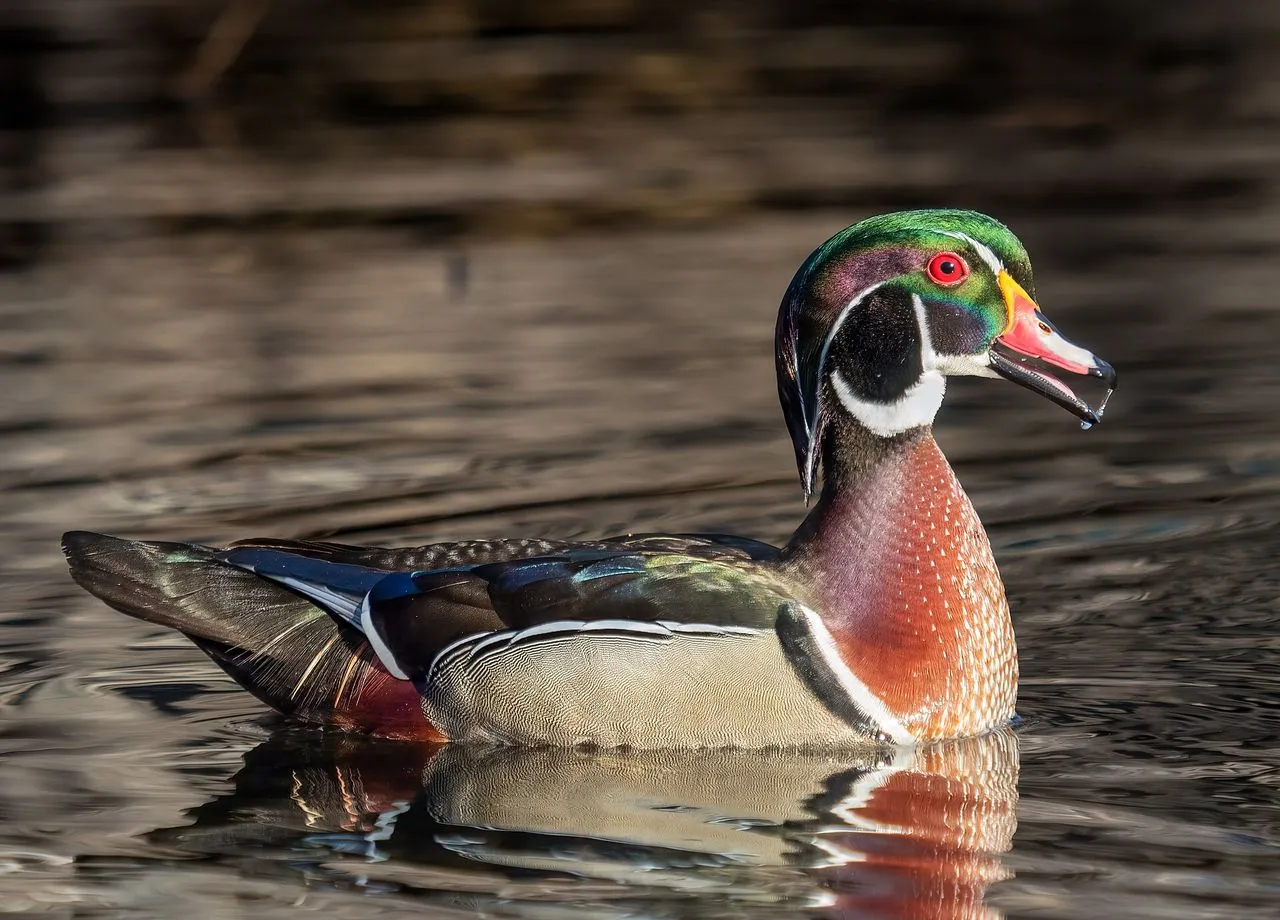
Gadwall (Mareca strepera) is a medium dabbling duck distinguished by the white speculum, the only duck in North America with this mark. The male is subtly patterned with fine grey-brown vermiculation, a black stern, and a dark grey bill; the female resembles a Mallard hen but smaller with an orange-edged dark bill and the same white speculum. Increasingly common across temperate North America, with breeding stronghold in the prairie potholes.
Mareca strepera (Linnaeus, 1758), the Gadwall, is a dabbling duck that rewards a second look. At a distance the male appears grey-brown and unremarkable; closer attention reveals fine vermiculation across the breast and flanks, a clean black stern, and a dark grey bill that no other North American dabbling duck combines in the same way. The single most reliable mark, the white speculum, is shared by both sexes and stands alone as a character unique to this species among the continent's dabblers.
Part of the Complete Waterfowl Guide.
Identification at a glance
| Character | Male Gadwall | Female Gadwall |
|---|---|---|
| Scientific name | Mareca strepera | Mareca strepera |
| Length | 46-58 cm (18-23 in) | 46-58 cm (18-23 in) |
| Mass | 590-1,300 g | 590-1,300 g |
| Head and body | Grey-brown with fine vermiculation; black stern | Brown with pale feather edges; paler overall than female Mallard |
| Speculum | White, conspicuous in flight and at rest | White, conspicuous in flight and at rest |
| Bill | Dark grey | Dark with orange cutting edges |
| Voice | Nasal single-note reep | Low quack, lower-pitched than Mallard |
Identification
Visual
The breeding male is a study in restraint. The body is covered in grey-brown feathers edged with buff and lined with fine dark vermiculation, producing a textured, scaled appearance that becomes striking at close range. The breast shows similar close-barring on a buff ground. The stern, meaning the rump and undertail coverts together, is solidly black and contrasts cleanly with the pale body. The bill is dark grey; the legs and feet are yellow-orange. There is no iridescent head colour, no bold facial stripe, and no striking breast patch. The male Gadwall's elegance is tonal, not chromatic, and it is frequently underestimated as a result.
The female is brown, patterned broadly like a female Mallard but smaller and built differently. The key separation from female Mallard is the bill: female Gadwall shows a dark bill with orange along the cutting edges and sides, compared to the predominantly orange, dark-mottled bill of female Mallard. Body tone tends toward warmer buff on fresh autumn plumage. The overall structure is slightly slimmer than Mallard, with a flatter crown and a somewhat longer tail at rest.
Juveniles of both sexes resemble the female, with fresh buff fringes to the upperpart feathers wearing down to a duller tone through the first autumn and winter. First-year males begin acquiring vermiculated grey-brown body feathers from late autumn but may show a patchy interim plumage through early winter before full breeding dress is achieved.
The single most reliable field mark across sexes, ages, and plumages is the white speculum. In flight, both male and female show a clear white wing patch on the secondaries, bordered by black on both edges. No other North American dabbling duck carries a white speculum. At rest the speculum is often partially hidden under the tertials, but it typically shows as a clean white-and-black patch at the rear of the folded wing. When a brown duck in a mixed winter flock catches light on a white wing patch, it is almost certainly Gadwall.
Voice
The male call is a nasal, one-syllable reep, softer and less whistled than the calls of American Wigeon, and easy to miss in a noisy flock. The female call is a rough quack broadly similar to that of female Mallard but pitched slightly lower and delivered in shorter series. Neither call carries as far as the female Mallard's descending decrescendo quack, which makes the species easier to overlook by sound than by sight.
Distribution
Gadwall has a Holarctic distribution, breeding across temperate and boreal North America and across much of Eurasia from Britain and Iceland east through Russia to the Pacific coast. In North America the core breeding range covers the prairie pothole region of the central Great Plains, from the Dakotas and Minnesota north through the Canadian Prairie Provinces. Populations also nest west through the Great Basin and locally in the Pacific Northwest.
The North American population has expanded notably since the mid-20th century. Numbers now stand at roughly 3.5 million birds, and range expansion has taken the species eastward through the Great Lakes region and into the northeastern United States, where it was formerly a scarce visitor. Urbanisation has assisted this expansion: Gadwall now breeds regularly on city reservoirs, park lakes, and suburban wetlands where accessible aquatic vegetation provides year-round food resources.
In winter, birds from northern breeding areas move into the southern United States, Mexico, the Gulf Coast, and the Atlantic seaboard, often gathering in brackish coastal impoundments and estuarine edges alongside northern pintail and a range of teal species.
Habitat
Gadwall uses shallow open water with emergent vegetation across the annual cycle. On the breeding grounds the preferred habitat is shallow prairie potholes, seasonal marshes, and lake margins with patches of bulrush, cattail, or sedge providing nesting cover. The species tolerates a wider salinity range than many dabblers and uses brackish coastal wetlands, tidal impoundments, and estuaries on migration and in winter.
On the wintering grounds Gadwall tends to select water bodies with abundant submerged aquatic vegetation rather than the open mudflats favoured by wigeon. Urban and suburban waters are now a reliable wintering habitat in many regions. The species has adapted to reservoirs, park ponds, and ornamental lakes where water quality supports plant growth, and it is less dependent on extensive reedbed than the larger dabbling ducks.
Diet and Feeding
Gadwall is among the most strongly vegetarian of the North American dabblers, a distinction it shares loosely with American Wigeon but expresses differently. Where Wigeon graze emergent and marginal vegetation at the surface, Gadwall relies heavily on submerged aquatic plants, using the standard dabbler tip-up posture to reach plants just below the waterline. Pondweeds, wigeon-grass, algae, and the stems and rhizomes of submerged macrophytes dominate much of the annual diet. Seeds and invertebrates increase during the breeding season when protein demand is higher.
A characteristic supplementary behaviour is kleptoparasitism from diving ducks and coots. Gadwall waits near American Coots or diving ducks and seizes plant material brought to the surface, gaining access to vegetation growing beyond its unaided reach. Mixed flocks of Gadwall and American Wigeon are common in winter for precisely this reason, both species working the same food resources and exploiting the same diving neighbours. Northern shoveler, which filters at the surface rather than tipping up for submerged plants, often occupies a slightly different foraging zone in the same wetland, making three-species mixed assemblages a frequent sight at productive winter sites.
Breeding
Gadwall is a relatively late nester among North American ducks, with many pairs not beginning incubation until May or June, later than Mallard or American Wigeon on the same wetland. Nests are placed on the ground in dense grass or sedge, often on islands or in stands of thick vegetation near water, sometimes surprisingly far from the water margin itself. The female lines the bowl with plant material and adds considerable down as laying progresses.
Clutch size typically runs from 7 to 12 eggs, toward the larger end of the dabbling duck range. Incubation is performed by the female alone over roughly 24 to 27 days. Males depart shortly after incubation begins, gathering on moulting wetlands where the simultaneous post-nuptial wing moult renders them flightless for three to four weeks. Females lead broods to shallow, vegetated wetlands with good invertebrate production. Young feed themselves immediately after hatching and fledge at approximately seven to eight weeks.
A Note on the Genus Change
Until 2017, Gadwall was classified as Anas strepera, grouped with Mallard and most other dabbling ducks in the large genus Anas. A decision by the American Ornithological Society that year moved Gadwall into the genus Mareca alongside American Wigeon (Mareca americana), Eurasian Wigeon (Mareca penelope), and Falcated Duck (Mareca falcata). The reclassification followed molecular phylogenetic evidence showing that these four species form a distinct clade within the dabblers, more closely related to each other than to the core Anas group.
The ecological logic is suggestive in retrospect. Gadwall and both wigeon species share a pronounced tendency toward herbivory, a preference for submerged or marginal vegetation over invertebrate-heavy diets, and a habit of kleptoparasitism from diving birds. Whether those shared behaviours reflect shared ancestry or convergence within a broad ecological niche is a separate question, but they make the grouping feel less arbitrary once it is pointed out.
In practical terms the reclassification affects literature references and taxonomic checklists but does not alter field identification. Both Mareca strepera and Anas strepera appear in sources depending on their publication date; the current valid name is Mareca strepera.
See Also
- Mallard: the commonest dabbling duck reference; female Mallard comparison is the first step in female Gadwall identification
- American Wigeon: shares kleptoparasitic foraging and genus Mareca; the two species frequently associate in winter flocks
- Northern Pintail: slender dabbler of the same wetlands; useful comparison for female bill colour and overall body structure
- Northern Shoveler: filter-feeding dabbler often found in the same winter habitat; spatulate bill makes it immediately distinctive
- The Complete Waterfowl Guide: full family overview including dabbling ecology, eclipse plumage, and the genus Mareca within Anatinae
Frequently Asked Questions
What is the best field mark for Gadwall?
The white speculum is the single most reliable mark. No other North American dabbling duck has a white speculum. Both male and female carry it, and it is visible at rest and conspicuous in flight.
How does a female Gadwall differ from a female Mallard?
Female Gadwall is smaller and shows a dark bill with orange along the cutting edges, compared to the predominantly orange, dark-mottled bill of female Mallard. The white speculum (versus the blue-purple speculum of Mallard) is also diagnostic when visible.
Why was Gadwall moved from Anas to Mareca?
In 2017 the American Ornithological Society reclassified Gadwall into the genus Mareca based on molecular phylogenetic data, placing it alongside American Wigeon, Eurasian Wigeon, and Falcated Duck. The current valid name is Mareca strepera.
Is the Gadwall population increasing?
Yes. Gadwall is one of the few duck species showing a sustained population increase in North America, with numbers now at roughly 3.5 million birds. Range expansion eastward and into urban and suburban wetlands has been particularly notable since the mid-20th century.