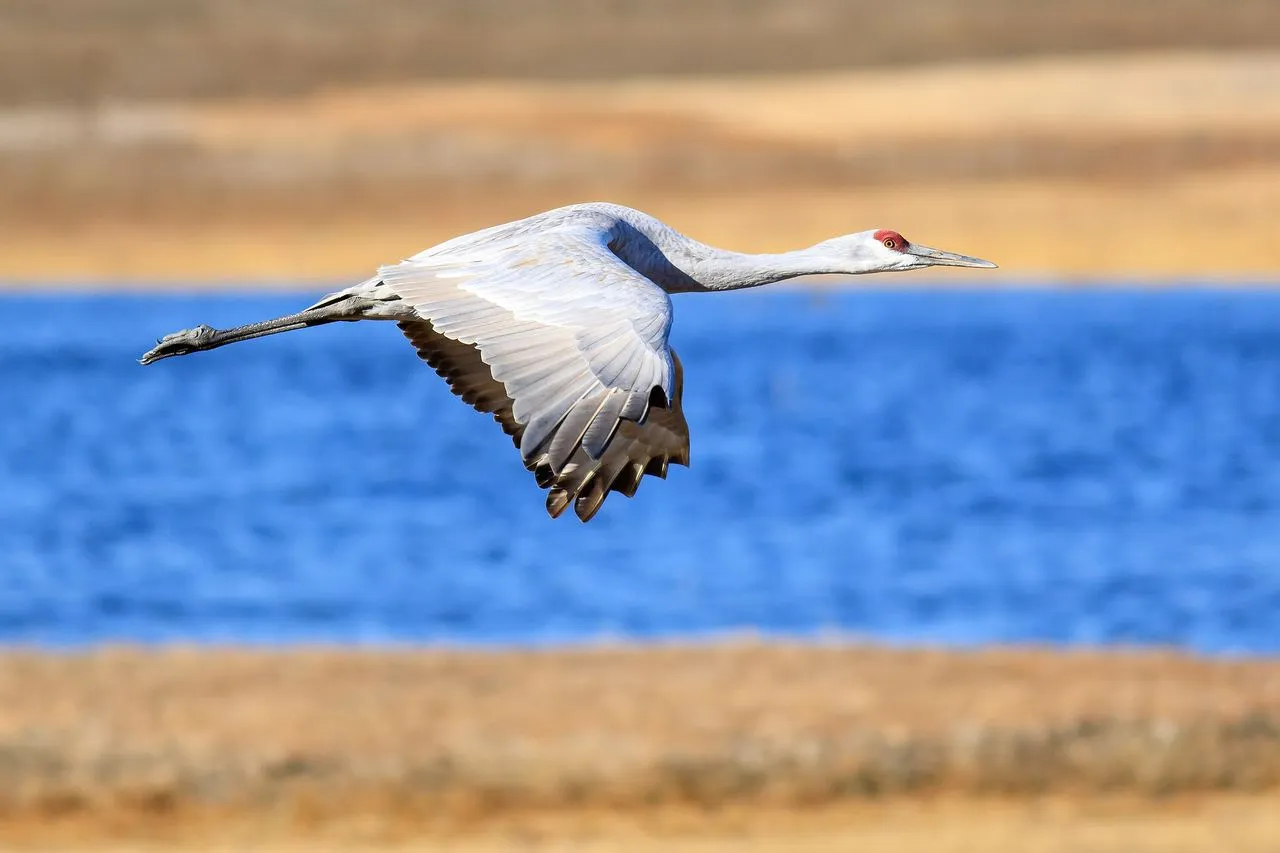
Antigone canadensis (Linnaeus, 1758), the Sandhill Crane, is North America's most numerous crane, with more than half a million birds across several migratory and resident populations.
Part of the Complete Waders & Herons Guide.
Identification at a glance
| Character | Sandhill Crane (Antigone canadensis) | Whooping Crane (Grus americana) | Great Blue Heron (Ardea herodias) |
|---|---|---|---|
| Height | 80–120 cm (31–47 in) | About 150 cm (59 in) | 97–137 cm (38–54 in) |
| Body colour | Grey, often rusty-stained | White with black primaries | Blue-grey with chestnut shoulders |
| Flight neck | Fully extended | Fully extended | Folded S-curve |
| Crown | Bare red patch | Red crown and facial patch | White crown; black supercilium |
| Voice | Loud rolling bugle | Clear bugle or whoop | Low croaks |
Identification
Visual
Adults are large, long-legged, long-necked birds, typically 80–120 cm depending on subspecies. Plumage is grey, often stained rusty by iron-rich mud preened into the feathers. The forehead and crown show bare red skin in adults. The bill is straight and medium-length, not spear-like in the manner of a heron. The rear body forms a drooping bustle of tertial feathers.
Juveniles lack the red crown and are warmer brown or cinnamon, especially on the head and neck. During their first year they gradually acquire greyer plumage. In flight, all cranes hold the neck fully extended and the legs trailing straight behind. This is the immediate separation from herons, which fly with the neck folded.
Whooping Crane is much larger, white, and shows black wingtips. Great Blue Heron is superficially similar at distance but folds the neck and has a slower, more bowed wingbeat.
Audio
The call is a loud, rolling bugle, produced by a long trachea coiled within the sternum. It carries over several kilometres under good conditions. Pair duets are coordinated: one bird gives a lower, longer call, the other shorter notes. Migrating flocks are often heard before they are located overhead.
Distribution
Sandhill Cranes breed from Siberia and Alaska across Canada and the northern United States, with resident populations in Florida, Mississippi, Cuba, and other regions. Major migratory populations winter in the southern United States and northern Mexico. The Mid-Continent Population, staging heavily in Nebraska, is the largest.
The species declined locally through wetland loss and hunting pressure but has recovered strongly in many regions under regulation and habitat protection. Some populations remain vulnerable, especially isolated resident forms. The Mississippi Sandhill Crane is federally endangered in the United States.
Habitat
Breeding habitat includes marshes, bogs, wet meadows, sedge wetlands, muskeg, prairie potholes, and shallow tundra wetlands. Wintering and migration habitats include river sandbars, wet meadows, agricultural fields, playa lakes, and open grasslands. Roost sites usually require shallow water or open sandbars that reduce predator access.
The species has adapted extensively to agricultural landscapes. Waste corn is a major migration and winter food in many regions, but safe roosting wetlands remain essential. Fields alone do not make crane habitat.
Diet and Foraging
Sandhill Cranes are omnivorous. They eat grains, seeds, tubers, berries, insects, earthworms, snails, frogs, small mammals, reptiles, and waste corn. Foraging is done by walking and probing or picking from the surface. The bill is not a tactile ibis probe or a heron spear; it is a generalist tool.
In agricultural regions, cranes feed in harvested cornfields by day and return to wetlands or rivers to roost at night. In breeding marshes they take more animal prey, especially during chick rearing. Colts feed themselves soon after hatching but are guarded and brooded by adults.
Foraging flocks maintain spacing through calls and threat postures. Territorial pairs in breeding season are much less tolerant of close conspecifics.
Breeding Biology
Sandhill Cranes are monogamous, often maintaining pair bonds for years. Courtship dancing includes leaps, bows, wing spreads, stick tossing, and running steps. Dancing occurs outside the breeding season as well, especially among young birds, but pair formation and maintenance are central functions.
Nests are large mounds of marsh vegetation built in shallow water or wet ground. Clutch size is usually two eggs. Incubation lasts about 29–32 days and is shared by both sexes. Chicks, called colts, are precocial and leave the nest within a day, following adults through marsh and meadow. Usually one or two young fledge; in poor years, one chick often outcompetes the other.
Fledging takes about 65–75 days. Family groups remain together through migration and winter, which is why autumn flocks often include visibly brown-headed juveniles with adults.
Notes
The Platte River in Nebraska is the best-known staging site. Hundreds of thousands of Sandhill Cranes use the central Platte Valley in late winter and early spring, roosting on river channels and feeding in surrounding fields. The spectacle is a consequence of geography, hydrology, agriculture, and migration timing, not merely flocking instinct.
Sandhill Cranes belong in a wader guide only with a caveat: they are cranes, family Gruidae, not herons or ibises. Their field overlap with long-legged wetland birds makes them essential comparison species, especially for the neck-in-flight rule.
Subspecies complicate size impressions. Lesser Sandhill Cranes breeding in the Arctic are smaller and migrate long distances; Greater Sandhill Cranes are larger and breed farther south in many interior wetlands; resident Florida birds are darker and non-migratory. Field identification to subspecies is often unsafe away from known breeding or wintering context, but awareness of variation prevents miscalling small cranes as something rarer.
Crop depredation and hunting policy make the species politically visible. Some populations are hunted under regulation, while others remain protected because they are small or endangered. Conservation status therefore cannot be summarised by one global abundance figure.
For migration counts, distinguish birds on the ground from birds passing overhead; turnover at staging sites can make a single-day flock count a poor estimate of seasonal use.
See Also
Frequently Asked Questions
How do I tell a Sandhill Crane from a Great Blue Heron?
In flight Sandhill Cranes hold the neck fully extended; Great Blue Herons fold the neck into an S-curve. Cranes also have a bare red crown patch and a drooping tertial feather bustle; herons have a thinner, more dagger-like bill. Voice differs sharply: cranes give a loud rolling bugle, herons low croaks.
Where do Sandhill Cranes stage in migration?
The Platte River in Nebraska is the best-known staging site. Hundreds of thousands of Mid-Continent Population birds use the central Platte Valley in late winter and early spring, roosting on river channels and feeding in surrounding harvested cornfields. The spectacle reflects geography, hydrology, and migration timing combined.
Why do Sandhill Cranes dance?
Dancing includes leaps, bows, wing spreads, stick tossing, and running steps. Although associated with courtship, it also occurs outside the breeding season, especially among young birds. The species forms long-term monogamous pair bonds, and dancing functions in both pair formation and bond maintenance.
Are all Sandhill Crane populations doing well?
Most migratory populations have recovered strongly and the Mid-Continent Population is hunted under regulation. However, some resident forms remain vulnerable. The Mississippi Sandhill Crane is federally endangered in the United States. Conservation status cannot be summarised by a single global abundance figure.
Sources & References
- Cornell Lab of Ornithology. (2024). All About Birds: Sandhill Crane. birds.cornell.edu
- Sibley, D.A. (2014). The Sibley Guide to Birds (2nd ed.). Knopf.
- Gerber, B.D., Dwyer, J.F., Nesbitt, S.A., et al. (2014). Sandhill Crane (Antigone canadensis). Birds of North America Online, Cornell Lab of Ornithology.
- Krapu, G.L., Brandt, D.A., Jones, K.L. & Johnson, D.H. (2011). Geographic Distribution of the Mid-continent Population of Sandhill Cranes. U.S. Geological Survey.