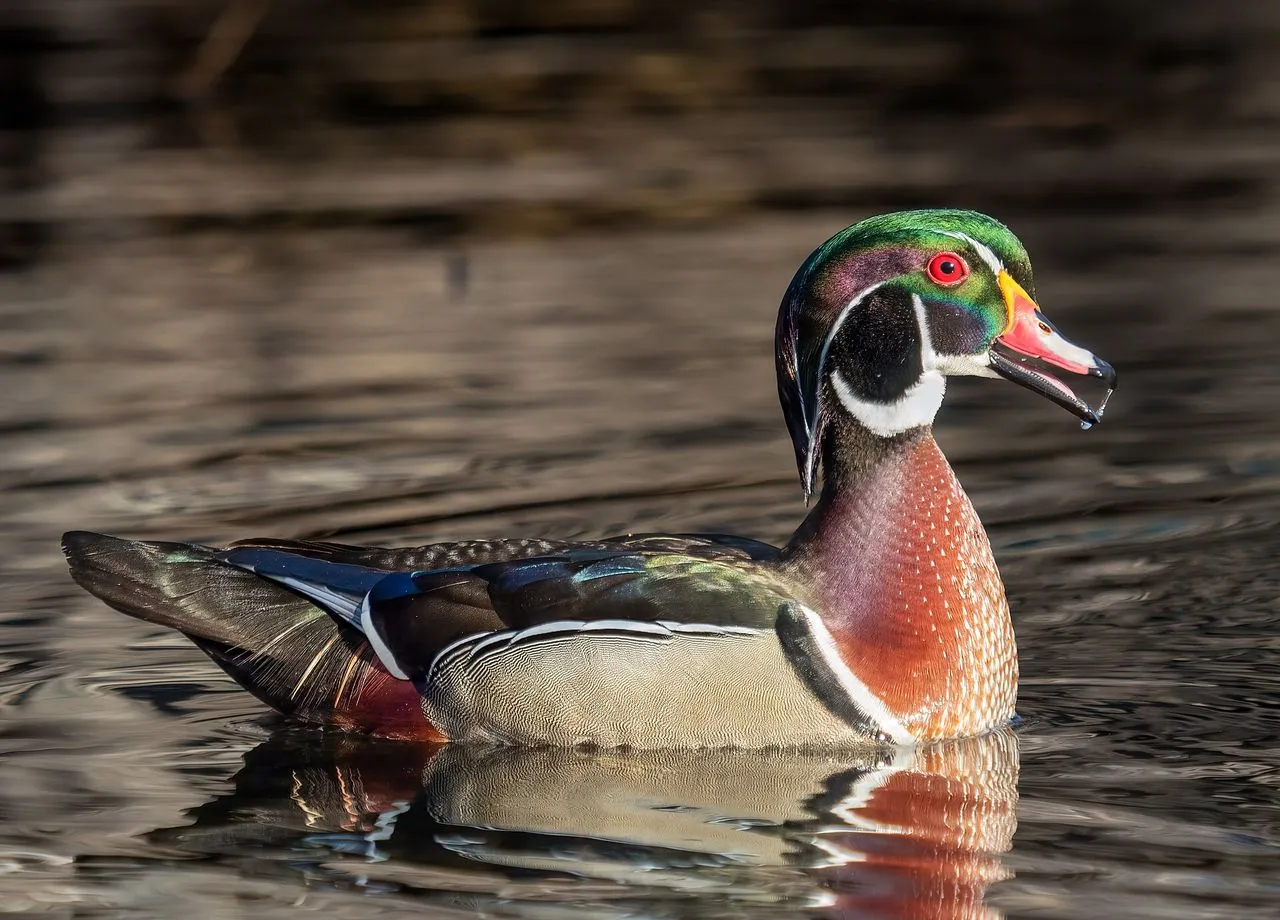
Wood Duck (Aix sponsa) is North America's perching duck (40–50cm). Males have elaborate multi-coloured plumage; females grey-brown with distinctive white teardrop eye patch. Cavity nester, requires nest boxes.
Aix sponsa (Linnaeus, 1758), the Wood Duck, is a perching duck whose recovery in the eastern United States became one of the clearest demonstrations that nest-site limitation can suppress a waterfowl population. The species requires cavities large enough for a duck of roughly 540-860 g; where old riparian timber was cut, boxes with entrances near 10 x 7.5 cm replaced a structural feature the landscape had lost.
Part of the Complete Waterfowl Guide.
Identification at a glance
| Character | Male Wood Duck | Female Wood Duck |
|---|---|---|
| Length | 40–50 cm (16–20 in) | 40–50 cm (16–20 in) |
| Head | Iridescent green-purple crest; white facial lines | Grey-brown crest; white teardrop eye-ring |
| Bill | Red at base with ornate pattern | Narrow, duller than male |
| Body | Chestnut breast; buff flanks; vertical white bar | Grey-brown, delicate, less Mallard-like |
| Wing | Broad, rounded, dark upperwing | Broad, rounded, dark upperwing |
Identification
Visual
The breeding male is compact, high-crested, and structurally unlike a Mallard: short neck, squared tail, deep chest, and a head carried with a swept-back profile. The head combines iridescent green and purple, white throat, white chin strap, and thin white lines extending behind the eye and along the crest. The breast is chestnut with small pale spotting; the flanks are buff, sharply separated from the dark back by a vertical white bar. The eye and bill base are red.
Female Wood Duck is greyer and more delicately marked than a female Mallard. The most useful mark is the complete white teardrop-shaped eye-ring tapering rearward. The head is grey-brown with a slight crest, the throat pale, and the bill narrow compared with a dabbling duck. In flight both sexes show broad, rounded wings and a dark upperwing without the bold blue-purple Mallard speculum.
Eclipse males, from late summer into early autumn, lose much of the ornate body pattern but retain red in the eye and bill, stronger head pattern than females, and a more pronounced crest. Juveniles resemble females but are duller and have less sharply defined eye-rings.
Audio
The female's alarm call is a sharp, rising oo-eek or squealed whoo-eek, often given when flushed from wooded water. Males produce a thin, high whistle during courtship, much less audible at distance than the quacks of Anas dabblers.
Distribution
Wood Duck is native to North America, strongest in the eastern deciduous forest belt from the Great Lakes and New England south through the Mississippi Alluvial Valley and Atlantic Coastal Plain. Western populations occur along the Pacific states, especially wooded river systems in California, Oregon, and Washington. Northern birds are migratory, moving down the Atlantic and Mississippi flyways; southern populations are resident or make short regional movements. In Britain and western Europe it is an escapee from collections, not an established native waterfowl.
Habitat
The species is tied to wooded wetlands rather than open lakes: bottomland hardwood swamp, beaver ponds, oxbows, wooded sloughs, slow rivers, and flooded timber. Nesting habitat must supply cavities or boxes close enough to brood water. Feeding habitat is often shallow, shaded, and structurally cluttered, where the bird's ability to perch on branches and launch through trees matters more than long-distance open-water swimming.
Diet and Foraging
Wood Duck is not a classic open-water dabbler, although it feeds at the surface and in shallow water. Acorns are a major autumn and winter food in oak-dominated floodplains; small hard mast explains why wooded bottomlands can hold high densities outside the breeding season. Seeds of sedges, smartweeds, duckweeds, and aquatic plants are taken, with aquatic insects, snails, and other invertebrates more important for females before laying and for growing ducklings.
The bill is shorter and less broadly spatulate than in Mallard. It can sieve fine material, but the species often picks, nips, and gleans rather than sweeping large volumes of water through dense lamellae. Ducklings feed heavily on animal material in their first weeks, when protein demand is high.
Breeding Biology
Pairing begins in autumn and winter. The female selects the cavity, usually in a living or dead tree, commonly 2-15 m above ground but sometimes much higher. Natural cavities are old Pileated Woodpecker holes, broken-limb hollows, or decay chambers. Nest boxes reproduce only part of this environment; predator guards and proper placement are decisive.
Clutch size usually falls between 9 and 14 eggs, but dump-nesting can produce cavities with 20, 30, or more eggs laid by multiple females. Very large clutches hatch poorly because eggs are unevenly incubated. Incubation lasts about 28-37 days, by the female alone. Within roughly 24 hours of hatching, ducklings climb to the cavity entrance and jump to the ground or water. The fall can exceed 10 m; the low mass, flexible skeleton, and downy body make the drop survivable. The female calls from below and leads the brood to feeding cover.
Notes
Wood Duck was reduced severely by market hunting and loss of mature floodplain forest in the late 19th and early 20th centuries. Legal protection under the Migratory Bird Treaty Act and widespread nest-box programmes allowed rapid recovery. The lesson is precise rather than sentimental: where adult survival is adequate and brood habitat remains, adding safe cavities can raise local recruitment. Poor boxes without predator guards, placed too densely or over land with high raccoon access, can become ecological traps.
For field work, separate true habitat use from ornamental familiarity. Wood Ducks on a city pond may appear tame, but breeding populations are limited by wooded corridors, cavity density, brood cover, and acorn-producing bottomlands. A spring male loafing on open water does not prove local nesting. Evidence is a female entering a cavity, a brood on wooded water, or repeated use of a nest box with successful hatch remains.
See Also
- Mallard: comparison species for dabbling duck size and structure; note the different perching habit and wooded habitat association
- Bufflehead: small cavity-nesting diver that may share nest-box programmes and wooded wetlands
- Hooded Merganser: fellow cavity-nesting waterfowl of wooded freshwater; different feeding ecology but often shares habitat and boxes
- Attracting Woodpeckers: directly relevant to the cavity supply Wood Duck depends on
- The Complete Waterfowl Guide: full family overview including cavity nesting, nest-box ecology, and perching duck classification
Frequently Asked Questions
How do I identify Wood Duck?
Male: intricate pattern, iridescent green/purple head, red eyes, white facial stripes, chestnut breast. Female: grey-brown with distinctive white teardrop eye patch. Both have crested head.
Why do Wood Ducks need nest boxes?
They're cavity nesters, need tree cavities (old woodpecker holes). Loss of riparian trees caused decline. Nest boxes with 10x7.5cm entrance replaced lost habitat, led to population recovery.
What are 'brood jumps'?
Ducklings leave nest 1 day after hatching, they jump from cavity to ground (can be 50+ feet), then follow mother to water. This is normal behaviour.
Do Wood Ducks use feeders?
Rarely, they eat seeds, nuts, aquatic plants, insects. More likely to use natural wetlands than ornamental ponds.