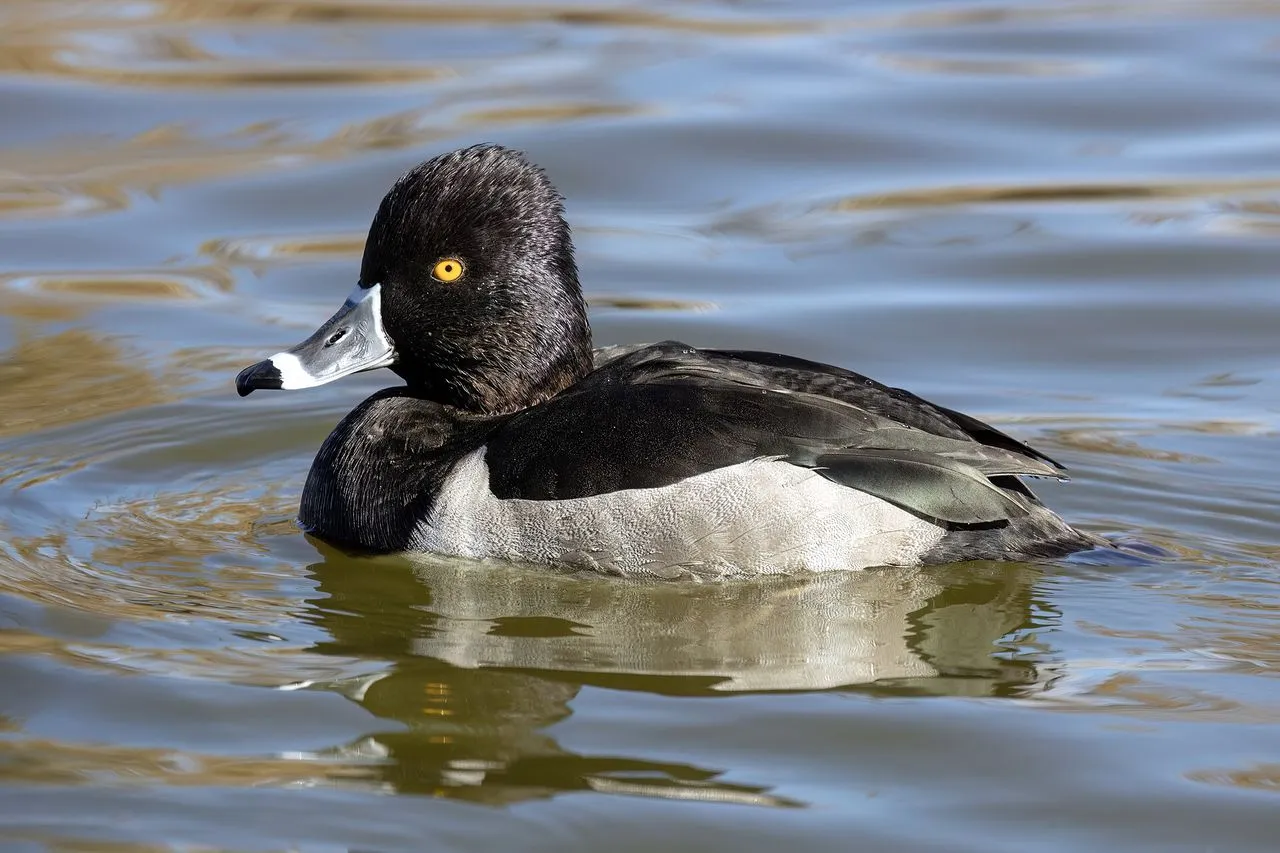
Aythya collaris (Donovan, 1809), the Ring-necked Duck, is misnamed for field purposes. The chestnut neck ring exists but is usually invisible except at close range in good light. The useful marks are the peaked head, grey bill with white ring near the tip, black breast, grey flanks, and the angular forecrown that separates it from the rounder scaup complex.
Part of the Complete Waterfowl Guide.
Identification at a glance
| Character | Ring-necked Duck | Lesser Scaup | Tufted Duck |
|---|---|---|---|
| Length | 39–46 cm (15–18 in) | 39–46 cm (15–18 in) | 40–47 cm (16–19 in) |
| Head shape | Peaked rear crown | Rounder to slightly peaked | Steep forehead; small crest |
| Male bill | Grey with white ring near tip | Blue-grey with black nail | Blue-grey with black nail |
| Female face | Pale eye-ring and bill-base pattern | Diffuse pale bill-base blaze | Plainer face; crest may show |
| Habitat | Vegetated freshwater | Larger lakes, reservoirs, bays | Freshwater lakes and reservoirs |
Identification
Visual
The breeding male has a glossy black head, breast, and back; pale grey flanks with a white vertical spur rising at the front; yellow eye; and a blue-grey bill marked by a white ring near the black tip and a pale band at the base. The head is not smoothly rounded: it peaks toward the rear crown, giving a distinctive angular profile.
The female is brown with a peaked head, pale eye-ring, pale line behind the eye, whitish area around the bill base, and a grey bill with a pale ring near the tip. Compared with female Lesser Scaup, she often looks warmer brown, more angular-headed, and more clearly marked around the face. Compared with female Tufted Duck in Europe, she lacks a true crest and shows a stronger pale bill-base pattern.
Eclipse males become duller but retain the bill pattern, head shape, and flank spur. Juveniles resemble females with weaker facial contrast.
Audio
Generally quiet. Males give soft whistles and grunts in display; females can produce rough scolding calls. Voice is rarely the primary identification route.
Distribution
Ring-necked Duck breeds mainly in boreal and parkland wetlands of Canada and the northern United States, especially where shallow lakes have emergent vegetation and adjacent forest or shrub cover. It winters across the southern United States, Mexico, Central America, and the Caribbean, with birds also on both coasts. It is a regular transatlantic vagrant to Britain and Ireland, often found among Tufted Ducks or scaup on reservoirs and gravel pits.
Habitat
Breeding sites are shallow freshwater lakes, bog ponds, marsh-edged pools, and beaver wetlands with emergent vegetation. In migration and winter it uses lakes, reservoirs, wooded ponds, cypress swamps, sewage lagoons, and slow rivers. It is more tolerant of small, vegetated freshwater than Greater Scaup, which is more marine and open-water in winter.
The species is often found on waters that also hold Lesser Scaup, but it is not simply a scaup substitute. Ring-necked Ducks frequently feed close to emergent vegetation, flooded timber, or sheltered coves. During migration, small groups may appear on municipal ponds or gravel pits for a day and then move on. A lone bird among Tufted Ducks in Britain should be watched through several dives, because the peaked head can flatten when relaxed.
Diet and Foraging
Ring-necked Duck is a diving duck, but it often feeds in shallower water than scaup. Diet includes seeds, tubers, leaves, and stems of aquatic plants, plus snails, clams, aquatic insects, and crustaceans. Plant material can dominate in winter, especially in freshwater wetlands rich in submerged vegetation.
Dives are usually short. Birds tip forward and submerge cleanly, using rear-set legs and lobed hind toes. They also take some food by surface dipping in very shallow water, but the body plan is that of a diver: low carriage, laboured take-off, and feet set well back.
Breeding Biology
Pairs form in late winter and spring. Nests are built in emergent vegetation over or near water, often in sedge, cattail, or flooded shrub cover. Clutches commonly contain 8-10 eggs. Incubation lasts about 25-29 days and is by the female alone.
Males depart during incubation. Ducklings feed themselves on aquatic invertebrates and plant material in sheltered marsh edges. Fledging occurs at roughly 7-8 weeks. Like other Aythya, brood survival depends on vegetated nursery water that provides both food and concealment.
Notes
For British birders, Ring-necked Duck is a realistic rarity rather than a remote possibility. Most records involve males, but females occur and are overlooked. The name should not guide identification. Look for the bill rings, peaked head, pale facial arcs on females, and the male's white flank spur. A claimed Ring-necked Duck without a careful scaup and Tufted Duck comparison is unfinished work.
Hybrids with scaup and other Aythya are rare but relevant to vagrant assessment. Intermediate head shape, blurred bill pattern, or an abnormal flank spur should slow the identification. Photographs taken from only one angle can exaggerate the crown peak; useful documentation includes side profile, front profile, open-wing view if possible, and comparison shots with nearby ducks.
Moult can also alter apparent flank contrast. A male not yet in full breeding plumage may show brownish flanks, duller head gloss, and reduced spur definition. The bill pattern usually remains visible and is often the safest mark. In female-plumaged birds, the pale eye-ring and rear eye line should be assessed with caution in harsh light, which can create false pale arcs on wet feathers.
The species' preference for freshwater helps in mixed winter settings. Aythya flocks on inland reservoirs, wooded ponds, or sewage lagoons are better candidates than exposed marine bays. Habitat is never diagnostic, but a Ring-necked Duck associating with Tufted Ducks on a sheltered gravel pit fits the expected vagrant pattern in Britain.
See Also
- Bufflehead: small diving duck often found on similar freshwater habitats; compare size and head shape
- Common Goldeneye: another winter diver with a clean structural silhouette on reservoirs
- Hooded Merganser: cavity-nesting diver of wooded waters; useful comparison for size and shape
- Attracting Woodpeckers: relevant to the cavity-nesting wetland habitats Ring-necked Duck uses
- The Complete Waterfowl Guide: full family overview including Aythya identification and diving duck structure
Frequently Asked Questions
How do I identify a Ring-necked Duck?
The peaked head profile is key, it angles upward toward the rear crown. Males have a glossy black head, black breast, grey flanks with a white vertical spur, yellow eye, and a blue-grey bill with white ring near the tip. The chestnut neck ring is usually invisible at normal viewing distance.
How do I separate Ring-necked Duck from scaup?
Ring-necked Duck has a more angular, peaked head compared to the rounder head of scaup. The bill pattern (white ring near tip) differs from scaup. Ring-necked is more often found on freshwater; scaup more marine in winter.
What do Ring-necked Ducks eat?
They are diving ducks that feed on seeds, tubers, leaves, and stems of aquatic plants, plus snails, clams, aquatic insects, and crustaceans. They often feed in shallower water than scaup and are more tolerant of vegetated freshwater.
Where do Ring-necked Ducks breed?
They breed mainly in boreal and parkland wetlands of Canada and the northern United States, especially where shallow lakes have emergent vegetation and adjacent forest or shrub cover.
Sources & References
- Ehrlich, P.R., Dobkin, D.S. & Wheye, D. (1988). The Birders Handbook. Simon & Schuster.
- Cornell Lab of Ornithology. (2024). All About Birds: Ring-necked Duck. birds.cornell.edu
- Sibley, D.A. (2014). The Sibley Guide to Birds (2nd ed.). Knopf.
- Carboneras, C. & Kirwan, G.M. (2024). Ring-necked Duck (Aythya collaris). Birds of the World.