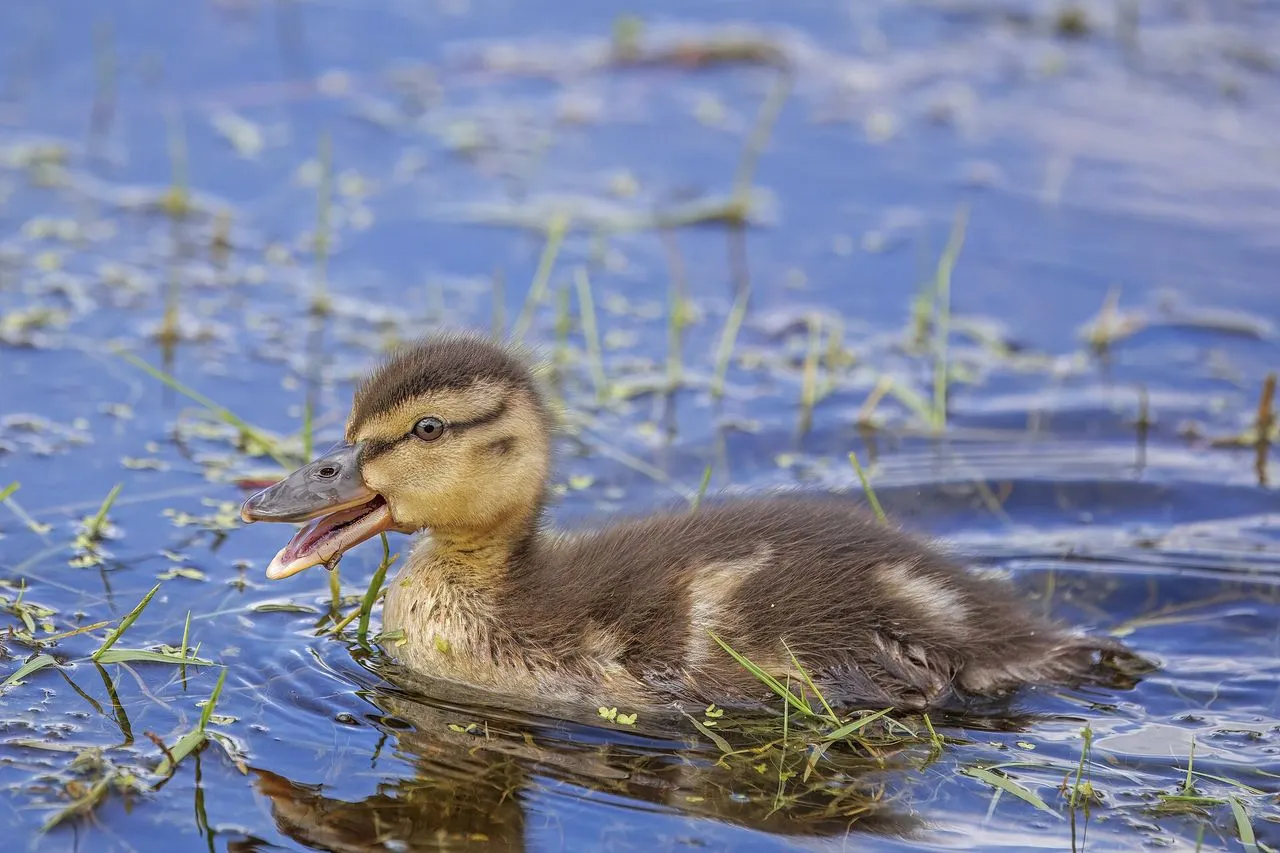
Mallard (Anas platyrhynchos) is the most abundant dabbling duck (50–65cm). Males have iridescent green head, yellow bill; females mottled brown. Ancestor of all domestic ducks. Hybrids with domestic birds cause identification problems.
Anas platyrhynchos, the Mallard, is the most abundant dabbling duck in the northern hemisphere, breeding across the Holarctic from western Ireland to the Pacific coast of North America and south into the subtropics. It is also the most genetically consequential waterfowl species alive: the ancestor of all domestic ducks except the Muscovy (Cairina moschata), a lineage that now complicates wild-bird identification wherever feral and semi-domestic birds share water with wild populations.
Part of the Complete Waterfowl Guide.
Identification at a glance
| Character | Breeding male Mallard | Eclipse male Mallard | Female Mallard |
|---|---|---|---|
| Length | 50–65 cm (20–26 in) | 50–65 cm (20–26 in) | 50–65 cm (20–26 in) |
| Bill | Olive-yellow | Olive-yellow | Orange with dark mottling |
| Body | Grey flanks; chestnut breast | Brown female-like body | Brown, heavily streaked |
| Head | Iridescent green with white neck ring | Brownish with possible green wash | Brown, streaked, no neck ring |
| Wing | Purple-blue speculum with white borders | Same speculum | Same speculum |
Identification
Male in Breeding Plumage
The male in breeding dress (December through May) is unmistakable in reasonable light: iridescent green head, the metallic sheen requires direct light; in overcast conditions it reads dark brown, a narrow white neck ring, chestnut-brown breast, grey flanks and back, black-and-white tail, and two curled central uppertail coverts that are a male-specific character. The single most reliable field mark across all plumages and seasons is the olive-yellow bill. It does not change through eclipse, through age, or through moult. Any large dabbling duck with an olive-yellow bill is a male platyrhynchos or a male platyrhynchos hybrid.
Female
Brown, heavily streaked throughout, with an orange bill mottled with dark blotching. The mottling pattern, dark saddle marks on an orange base, is diagnostic and separates female Mallard from female Gadwall (grey-orange bill, less mottled), female Wigeon (grey-blue bill), and female Pintail (plain grey bill). In flight both sexes show a purple-blue speculum bordered by white on both leading and trailing edges; this wing patch is consistent across sexes, ages, and plumages and is more reliably visible in flight than at rest.
Body size: 50–65 cm, wingspan 81–98 cm. Substantially larger than Teal, noticeably larger than Gadwall, broadly comparable to Pintail but stockier, with a shorter tail.
Eclipse Plumage
From late May through September, adult males moult into eclipse: a female-like body plumage worn during the post-nuptial flight-feather moult, when all primaries and secondaries are shed simultaneously and the bird is flightless for three to four weeks. Eclipse males retain the olive-yellow bill throughout, the field mark that matters most at this time of year. Additional, subtler clues: eclipse males tend to show a faint iridescent wash on the crown in direct sunlight, and carry slightly more uniform buff tones where a female would show crisp, dark-centred streaking.
Behaviour and Diet
Mallard are generalist omnivores. Aquatic invertebrates and their larvae, seeds, grain, plant stems, and small amphibians all enter the diet depending on season and availability. The tip-up upending posture, rear end vertical, bill reaching the substrate, allows foraging in water up to roughly 40 cm deep; in shallower margins, surface-skimming with the bill drawn just below the water film is the standard foraging mode.
Pair bonds form on the wintering grounds from October onward. Communal courtship display, multiple males displaying simultaneously to a single female, is conspicuous on any park lake from November through January. The female initiates the pair bond by following a chosen male; the male then defends her from persistent pursuit by rival males. Incubation is entirely by the female (26–28 days); the male deserts at or shortly after the start of incubation and moves to a moulting area with other males.
Hybridisation
The Mallard's readiness to hybridise with its closest relatives is documented extensively and presents a real identification challenge wherever the species occurs.
American Black Duck (Anas rubripes): the nearest North American relative; plumage is very dark brown with a violet-purple speculum bordered by black only, lacking the white borders of Mallard. Male Black Duck has the same olive-yellow bill as male Mallard. Hybrids show intermediate speculum bordering (partial or indistinct white borders), variable head gloss, and intermediate bill markings. Back-crossing is now common enough in the northeastern United States and eastern Canada to have measurably narrowed the genetic distance between the two species.
Mottled Duck (Anas fulvigula): South Atlantic US coast and Gulf Coast marshes. Paler than Black Duck, closer to Mallard in tone, but with a clean buffy throat unmarked by streaking. Feral Mallard introductions in Florida have produced introgression substantial enough that Mottled Duck is now listed as a conservation concern partly on genetic grounds.
In Europe, the concern is not with wild congeners but with the domestic and feral gene pool. Urban waterbodies anywhere in Britain will contain birds ranging from wild-type Mallard through various degrees of domestic admixture; curled tail feathers on a female-type bird, white plumage patches, and aberrant bill colour are the most reliable signs.
Any large brownish duck on an urban lake should be assessed for hybrid characters before being recorded. A plumage that doesn't quite fit any established profile is more often a hybrid than a rarity.
Mallard as Ancestor of Domestic Ducks
With the exception of the Muscovy, every domestic duck breed, Pekin, Rouen, Indian Runner, Khaki Campbell, Call Duck, Cayuga, and several dozen others, derives from Anas platyrhynchos. Domestication occurred independently in China and in Europe, beginning at least 2,000 years ago.
The curled central tail feathers retained in most domestic male breeds are a visible marker of platyrhynchos ancestry: this character is specific to males of the platyrhynchos complex and does not appear in other Anatidae. Its presence on a brown, female-type bird indicates domestic or hybrid ancestry and is worth noting when recording a bird of uncertain status.
See Also
- Canada Goose: large waterfowl of comparable suburban abundance
- American Wigeon: kleptoparasite that steals food from diving birds; often found alongside Mallard in winter
- Northern Pintail: slender long-tailed dabbler of the same shallow wetlands; compare female bill colour and body shape
- Winter Feeding Strategies: useful background on how generalist waterbirds exploit seasonal food pulses
- The Complete Waterfowl Guide: dabbler vs diver, eclipse plumage, and the full family overview
- Mallard vs American Black Duck: speculum borders and sex-similarity as the diagnostics; hybridisation across the Atlantic flyway.
- Gadwall: the understated dabbler with the diagnostic white speculum; often misidentified as a Mallard hen.
Frequently Asked Questions
How do I identify Mallard?
Male: iridescent green head, yellow bill, grey body, white tail edges. Female: mottled brown with orange-brown bill. Both have blue speculum (wing patch) with white borders.
What is eclipse plumage?
Males lose breeding colours in summer, becoming mostly brown like females but with different bill colour (yellow vs orange-brown). They regain colours in fall.
Why do Mallard hybrids cause problems?
Domestic Mallard breeds (Pekin, Rouen, etc.) interbreed with wild Mallards, producing hybrid offspring with mixed characters. These can be confusing to identify.
Do Mallards migrate?
Northern populations migrate south in winter; southern populations may be resident. They migrate at night in loose flocks.
Sources & References
- Ehrlich, P.R., Dobkin, D.S. & Wheye, D. (1988). The Birders Handbook. Simon & Schuster.
- Cornell Lab of Ornithology. (2024). All About Birds: Mallard. birds.cornell.edu
- Sibley, D.A. (2014). The Sibley Guide to Birds (2nd ed.). Knopf.
- Carboneras, C. & Kirwan, G.M. (2024). Mallard (Anas platyrhynchos). Birds of the World.