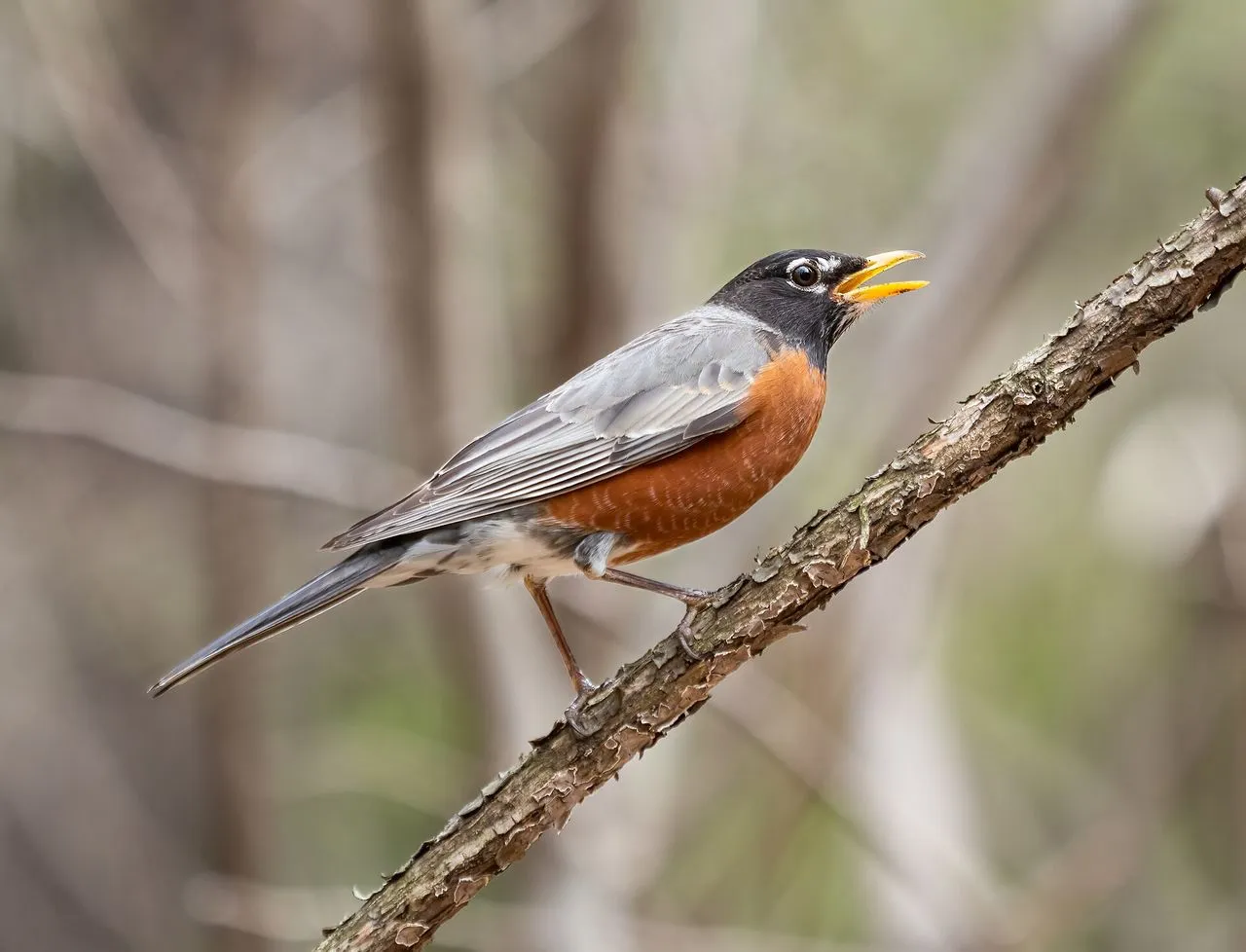
American Robin (Turdus migratorius) is North America's most abundant thrush (23–28cm). Grey-brown above, orange-red breast, white eye ring. Not related to European Robin, much larger. Hops on lawns hunting earthworms.
Turdus migratorius Gmelin, 1789, the American Robin, is the most abundant thrush in North America and, by some estimates during post-breeding congregations, the most abundant landbird on the continent by raw numbers.
Part of the Complete Thrushes & Robins Guide.
Identification at a glance
| Character | American Robin (T. migratorius) | Common Blackbird (T. merula) | European Robin (E. rubecula) |
|---|---|---|---|
| Length | 23–28 cm (9.1–11 in) | 23–29 cm (9.1–11.4 in) | 12–14 cm (4.7–5.5 in) |
| Breast | Brick-red to orange-red | Male black; female mottled brown | Orange-red face and breast |
| Structure | Large upright thrush | Similar large lawn thrush | Small, round flycatcher |
| Foraging | Runs and stops on lawns | Runs and tosses leaf litter | Hops near low cover |
| Social pattern | Flocks after breeding | More territorial | Solitary, territorial |
Identification
Adult male: dark grey-brown above, with a clearly defined brick-red to orange-red breast and belly. The head is blackish, contrasting sharply with a broken white eye ring that does not complete a full circle. The throat is white with dark streaking. The bill is yellow in the breeding season, duller in winter. Total length 23–28 cm; weight 72–94 g.
Adult female: structurally identical but consistently paler, particularly on the head and back. The breast colour is often a washed-out brick-orange rather than the deep red of the male, and the head reads brown rather than blackish. At distance, a bird with a notably pale head and soft breast colour is almost certainly female.
Juvenile: the source of most identification errors involving this species. The underparts are buff-washed and heavily spotted dark brown, with no trace of the adult brick-red. The upperparts carry pale spots on the wing coverts. The posture and foraging behaviour are already fully formed at fledging and are the most reliable guides before the plumage gives any clear indication.
Key marks at distance. The run-and-stop foraging sequence across short grass is more diagnostic than plumage at 30 m or more. White tail corners flash briefly when the bird takes flight, a useful confirmatory character.
In song. The American Robin sings from an elevated perch: a sustained rolling carolling of clear, slurred notes in variable sequences, operating primarily in the 2–8 kHz range. It is reliably among the first voices of the North American dawn chorus, typically beginning 30–40 minutes before sunrise, and continues into late evening.
The Head-Cocking Behaviour
The lateral head-tilt that most observers interpret as "listening for worms" is the most frequently misexplained behaviour in the species' repertoire. The explanation still printed in many popular field guides is wrong.
An American Robin working a lawn holds the head tilted at roughly 90° to the horizontal, sometimes for up to four seconds, before either lunging or moving on to a new spot. The mechanism is visual, not auditory. Each eye is positioned laterally on the skull with a high-acuity foveal zone at a fixed angular orientation. By tilting the head sideways, the bird aligns that foveal region downward and forward, directly at the soil surface, maximising its ability to detect the movement or colour contrast of an earthworm near the surface. Studies using sound-masking treatments (placing foraging robins over substrates that blocked any airborne vibrations from prey) did not reduce foraging success. The visual anatomy of T. migratorius, which shows a foveal structure consistent with near-ground visual sampling, is the more parsimonious and better-supported explanation.
The practical implication is straightforward: American Robins move to lawns after rain not because wet soil makes earthworms louder, but because wet soil draws earthworms to or near the surface, where they are visible. A dry, compacted lawn will not hold foraging robins regardless of how many earthworms are present below.
Why the American Robin is Not Like the European Robin
The naming history and taxonomic background are covered in the family guide. The practical behavioural differences are worth laying out directly.
Turdus migratorius is a colonial breeder that tolerates high nest densities in suburban and urban settings, often nesting within a few metres of other pairs. Erithacus rubecula is strongly territorial year-round, defends individual winter territories, and is rarely found near conspecifics outside the breeding season.
The American Robin forms post-breeding flocks of hundreds or thousands of individuals that shift nomadically in response to fruit supply. European Robins are solitary through most of the year and will chase conspecifics from feeding areas well into winter.
American Robins nest at 1.5–5 m height on open horizontal surfaces: building ledges, tree branches, fence rails. European Robins nest low and in concealed positions (dense ivy, a cavity in a bank, a hedgerow base), and they respond very differently to garden structure.
Diet in the Garden
Earthworms dominate the breeding-season diet, supplemented by beetles, caterpillars, and grasshoppers. Earthworm availability is directly tied to soil moisture: well-watered lawn with low compaction supports the highest prey densities. American Robins read moisture conditions accurately and shift between patches as the soil dries or is re-watered.
From late summer onward, fruit becomes increasingly important. Native dogwoods (Cornus florida, C. alternifolia), serviceberries (Amelanchier spp.), winterberry (Ilex verticillata), and native hawthorns (Crataegus spp.) are all taken readily. The species is not deterred by human proximity and will strip fruiting trees in residential gardens without hesitation.
At supplementary feeders: platform or ground-level feeders work; enclosed hoppers and tube feeders do not. Soaked raisins, halved apples, and live or dried mealworms are all accepted. Dry raisins are worth avoiding. They can absorb water in the digestive tract and cause crop impaction.
Breeding in the Garden
American Robins nest readily in garden settings, often choosing sites on building ledges, in climbing plants against walls, or on horizontal branches at 1.5–5 m. The nest follows the family pattern described in the pillar: outer coarse material, internal mud plaster, fine inner lining. It is rigid and durable once dry, and the same site is sometimes reused between broods of the same season or between years.
Three points for garden managers. First, the female alone builds the nest and incubates; disturbance at the nest site during construction or early incubation causes abandonment more reliably than disturbance at later stages. Second, fledglings spend 1–2 weeks on or near the ground before flight is reliable. They look abandoned but are actively attended by the adult male while the female begins a second clutch. Third, domestic cats account for a disproportionate share of fledgling mortality during this ground-bound period.
See Also
- Eastern Bluebird (Sialia sialis)
- European Robin (Erithacus rubecula)
- Wood Thrush (Hylocichla mustelina)
- The Complete Attracting Guide
- The Complete Thrushes & Robins Guide
- American Robin vs European Robin: not the same bird; different families. The naming history and the plumage and size differences.
- Dawn Chorus and Bird Watching Times: the robin's role in the morning chorus and best observation windows.
Frequently Asked Questions
How do I identify American Robin?
Grey-brown upperparts, orange-red breast, white eye ring. Juveniles have spotted breast. Walks/hops on ground with head-cocking. Not related to European Robin, compare size.
What does American Robin eat?
Earthworms, insects, berries. Forages on lawn by sight, runs, stops, cocks head, grabs worms. Fruit in late summer/fall, juneberries, crabapples, holly.
Does American Robin use feeders?
Rarely eats seed, more likely to take fruit on platform feeders or mealworms. Attract with mealworms, fruit, or a lawn (they hunt earthworms).
How is American Robin related to European Robin?
Not close, American Robin is a true thrush (Turdidae); European Robin is a flycatcher (Muscicapidae). The American Robin is closer to European Blackbird.