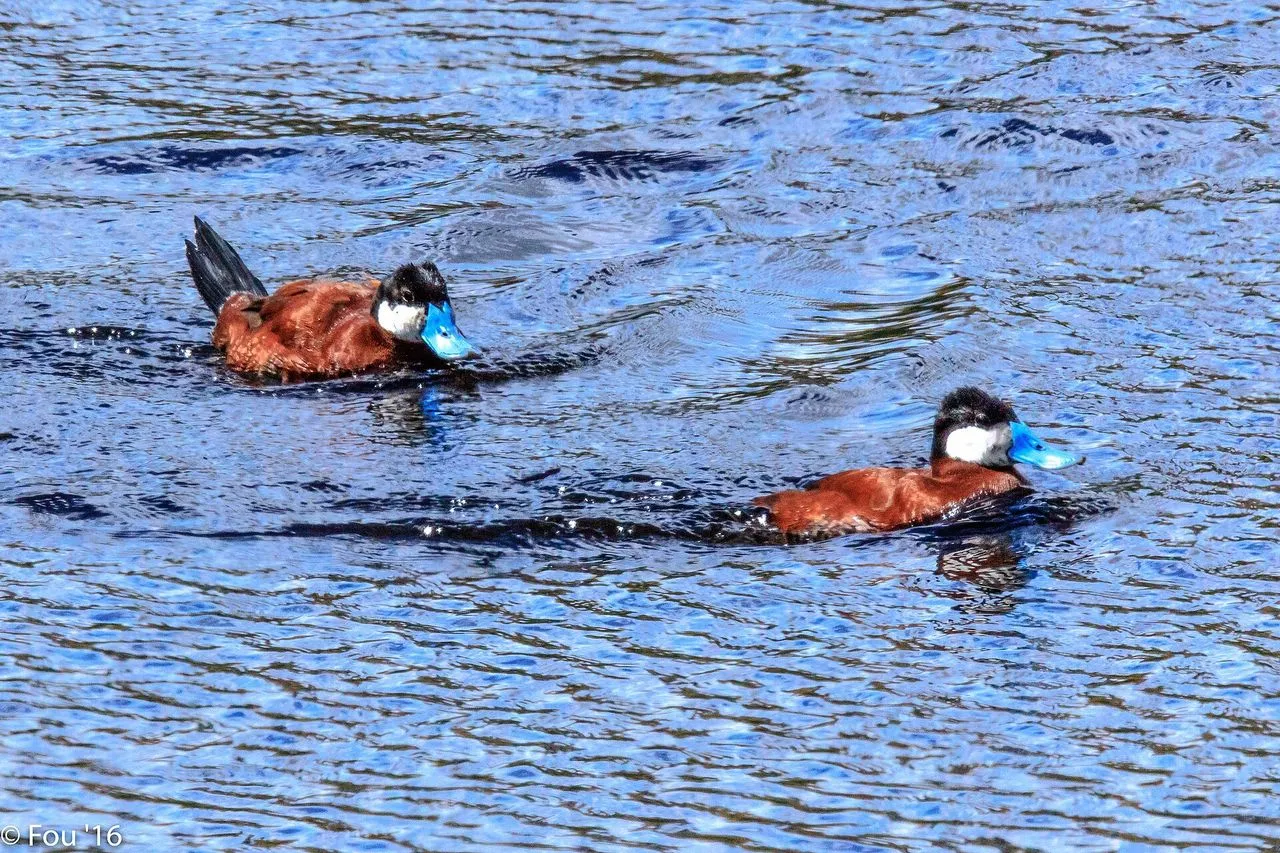
Oxyura jamaicensis (Gmelin, 1789), the Ruddy Duck, is a stiff-tailed diving duck: the tail feathers are narrow and rigid, often cocked upward at a steep angle. The breeding male's sky-blue bill is one of the most conspicuous bare-part colours in North American waterfowl, but the structural marks--thick neck, low body, and raised tail--identify the species even when the bill is dull.
Part of the Complete Waterfowl Guide.
Identification at a glance
| Character | Breeding male Ruddy Duck | Female or non-breeding Ruddy Duck |
|---|---|---|
| Length | 33–36 cm (13–14 in) | 33–36 cm (13–14 in) |
| Bill | Sky-blue in breeding condition | Dark to slate-grey |
| Face | Black cap and white cheek | Pale cheek crossed by dark line |
| Body | Rich chestnut, compact, thick-necked | Brown, compact, thick-necked |
| Tail | Narrow, stiff, often cocked upward | Narrow, stiff, often cocked upward |
Identification
Visual
The breeding male has a rich chestnut body, black cap, white cheek, blue bill, and stiff black tail usually held above the water. Outside breeding, males become greyer-brown, the bill dulls, and the contrast softens. The body remains compact and heavy-necked.
Females are brown with a darker cap, pale cheek crossed by a darker horizontal line, and a dark bill. Juveniles resemble females. The tail is often cocked, though not always; birds resting or alarmed may lower it. In flight the wings are small and the flight direct, but Ruddy Ducks more often dive than flush when disturbed.
Eclipse males are female-like but can retain a plainer cheek and heavier bill. Full breeding colour develops in spring.
Audio
Males are most vocal on breeding territories. Display includes bubbling, belching notes produced during a display in which the male beats the bill against the inflated neck and breast, creating a rapid pattering on the water. Females are quieter, giving harsh calls near broods.
Distribution
Ruddy Duck is native to North America, breeding from the prairie potholes and western marshes south locally into Mexico and the Caribbean. It winters on open freshwater and brackish water across the southern United States, Mexico, and coastal regions. The species was introduced to Britain in the 20th century through escapes from wildfowl collections and bred successfully from the 1960s onward.
Habitat
Breeding habitat is dense freshwater marsh with open pockets: cattail, bulrush, sedge, and reedy ponds. The bird needs cover for nesting and display but open water for diving. Wintering birds use reservoirs, lakes, sewage lagoons, coastal lagoons, and sheltered estuaries, often forming loose groups in deeper water than used during breeding.
The ideal breeding marsh has a fine interspersion of vegetation and water rather than a solid reedbed or an open lake. Males display in small open pockets, females nest in cover, and broods move through sheltered channels. Water-level changes during incubation can flood low nests or leave them exposed to terrestrial predators, so managed wetlands with stable late-spring levels are disproportionately valuable.
Diet and Foraging
Ruddy Duck is a diver feeding on aquatic invertebrates, chironomid larvae, crustaceans, molluscs, seeds, and submerged plant material. It dives frequently, propelling itself with the feet and using the stiff tail as a stabiliser. Feeding often occurs in shallow to moderate depths, with birds surfacing briefly before the next dive.
Animal food is especially important during breeding and for ducklings. In winter, seeds and plant material may form a larger share depending on site. The bill is broad but not a shoveler-like filter; prey is taken from the water column and substrate during dives.
Breeding Biology
Males defend small territories and perform conspicuous displays. Nests are built low in emergent vegetation, often over water, from marsh plants and down. Clutches commonly contain 6-10 eggs, but brood parasitism and egg dumping occur. Incubation lasts about 23-26 days and is by the female alone.
Young leave the nest soon after hatching and feed themselves. Females may become less attentive earlier than in many ducks, and young can be quite independent. Fledging takes roughly 7-8 weeks.
Notes
The UK Ruddy Duck eradication programme was driven by conservation genetics, not dislike of an introduced bird. British Ruddy Ducks dispersed to Spain and hybridised with the globally threatened White-headed Duck (Oxyura leucocephala). Because hybrids were fertile and backcrossing threatened the genetic integrity of the Spanish population, the UK carried out a government-backed control programme beginning in the 1990s and intensified after 2005. It remains one of the most cited European examples of invasive waterfowl management.
In North America, Ruddy Duck is native and should be evaluated in that context. The same species can be a normal component of prairie marshes in Saskatchewan and a conservation problem in western Europe. Field notes should therefore include location and status, not just identification. A stiff-tailed duck on a British reservoir after the control programme is now a notable record requiring documentation.
The blue bill of the male is seasonal and hormone-linked; outside breeding it can be slate or dark grey. Relying on bill colour alone causes missed records in winter. The cheek pattern of females and non-breeding males, the thick neck, the compact body, and the habit of sinking low before a dive are more durable field marks. A bird asleep with the tail lowered may look ordinary until it becomes active.
Ruddy Ducks often avoid flight when disturbed, preferring to dive repeatedly or swim into cover. This behaviour differs from dabblers, which usually flush readily. On a busy reservoir, a bird that vanishes under the surface rather than lifting with Mallards deserves a second look, especially if the tail is stiff and the body rides low.
See Also
- Hooded Merganser: fellow marsh-nesting diver; compare tail posture, bill shape, and feeding method
- Ring-necked Duck: another compact diving duck of vegetated freshwater wetlands
- Northern Shoveler: shallow-water specialist that shares marshy breeding habitat in parts of the range
- Dealing with Invasive Birds: relevant to the UK eradication programme and introduced-population context
- The Complete Waterfowl Guide: full family overview including stiff-tailed duck structure and introduced species context
Frequently Asked Questions
How do I identify a Ruddy Duck?
The stiff tail held at a steep angle is diagnostic. Males in breeding plumage show a chestnut body, black cap, white cheek, and sky-blue bill. Females and non-breeding birds are brown with a darker cap, pale cheek with a dark horizontal line, and a dark bill.
Why was there a Ruddy Duck eradication programme in the UK?
British Ruddy Ducks dispersed to Spain and hybridised with the globally threatened White-headed Duck. Because hybrids were fertile and backcrossing threatened the Spanish population's genetic integrity, the UK carried out a control programme beginning in the 1990s.
What do Ruddy Ducks eat?
They dive for aquatic invertebrates, chironomid larvae, crustaceans, molluscs, seeds, and submerged plant material. Animal food is especially important during breeding and for ducklings. They often feed in shallow to moderate depths.
Where do Ruddy Ducks nest?
They nest in dense freshwater marsh with open pockets, cattail, bulrush, sedge, and reedy ponds. The bird needs cover for nesting and display but open water for diving. Nests are built low in emergent vegetation, often over water.
Sources & References
- Ehrlich, P.R., Dobkin, D.S. & Wheye, D. (1988). The Birders Handbook. Simon & Schuster.
- Cornell Lab of Ornithology. (2024). All About Birds: Ruddy Duck. birds.cornell.edu
- Sibley, D.A. (2014). The Sibley Guide to Birds (2nd ed.). Knopf.
- Carboneras, C. & Kirwan, G.M. (2024). Ruddy Duck (Oxyura jamaicensis). Birds of the World.