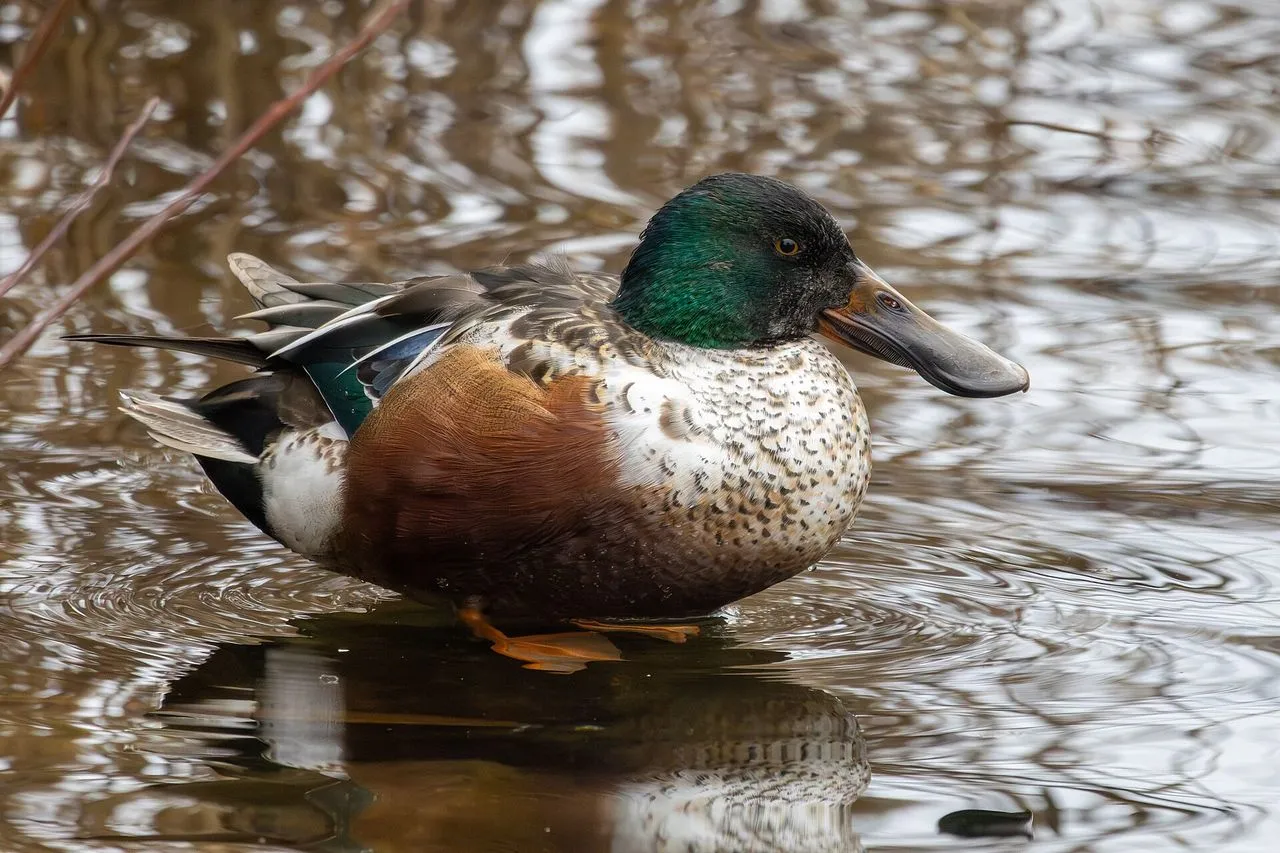
Spatula clypeata (Linnaeus, 1758), the Northern Shoveler, carries one of the most specialised bills among dabbling ducks: a long spatulate structure with dense comb-like lamellae, commonly cited at more than 100 fine projections along the bill margins. The bill is not ornamental. It is a plankton and small-invertebrate filtering device.
Part of the Complete Waterfowl Guide.
Identification at a glance
| Character | Northern Shoveler | Mallard |
|---|---|---|
| Length | 44–52 cm (17–20 in) | 50–65 cm (20–26 in) |
| Bill | Long, broad, spatulate | Broad but not spoon-shaped |
| Female bill colour | Orange-brown to dark | Orange with dark mottling |
| Wing | Pale blue forewing and green speculum | Purple-blue speculum with white borders |
| Feeding | Surface filtration in shallow water | Upending and surface-skimming |
Identification
Visual
The bill identifies the species before plumage does. It is long, broad, and spoon-shaped, making the head look front-heavy. The breeding male has a glossy green head, white breast, chestnut flanks and belly, black back, yellow eye, and orange legs. In flight the upperwing shows pale blue forewing coverts, a green speculum, and white separating lines.
The female is brown and mottled but still unmistakable if the bill shape is seen. The bill is orange-brown to dark, broad throughout, and much longer than the head appears able to carry. Female Mallard can show orange in the bill but never the shoveler's spatulate outline. Juveniles resemble females.
Eclipse males are brownish like females, but usually retain brighter yellow-orange iris, richer flank tones, and male wing pattern. Bill structure remains diagnostic in every plumage.
Audio
Males give a low, nasal took-took or short chuckling note during display. Females quack, but the voice is quieter and less resonant than Mallard. Large feeding groups are often nearly silent.
Distribution
Northern Shoveler breeds widely across the Holarctic: prairie wetlands of North America, Iceland and northern Europe, and temperate to boreal Asia. It winters south to the southern United States, Mexico, Central America, western and southern Europe, Africa, the Middle East, India, Southeast Asia, and East Asia. In Britain it is both a local breeder and a more numerous winter visitor, especially on managed marshes and shallow reservoirs.
Habitat
The species prefers shallow, nutrient-rich wetlands rather than clear, deep lakes. Good sites include prairie potholes, eutrophic pools, sewage lagoons, flooded meadows, coastal marshes, brackish lagoons, and reserve scrapes. Water depth is usually low enough for surface filtering and occasional tipping, with abundant suspended organisms. It is often scarce on oligotrophic upland reservoirs with little planktonic productivity.
Diet and Foraging
Northern Shoveler is the clearest example of lamellar filtration in a familiar duck. It swims with the bill partly submerged, pumping water through the bill and retaining zooplankton, midge larvae, small crustaceans, seeds, and fine plant material. Birds often feed in rotating groups. One bird's paddling stirs suspended food into the water column, and a loose circle of shovelers filters the disturbed water.
Upending occurs, but the species is less dependent on reaching the substrate than Mallard or Pintail. The feeding apparatus works best where small prey and plant particles are suspended in shallow water. During breeding, animal food supports egg formation and duckling growth; outside breeding, seeds and plant fragments increase.
This feeding mode explains the species' fondness for water that may look turbid or over-enriched. A clear gravel pit with steep sides can be poor shoveler habitat, while a shallow sewage lagoon or muddy scrape may be productive. The bird is not simply dabbling at random; it is processing water. The broad bill is moved laterally and forward, with the tongue helping pump water across the lamellae.
Breeding Biology
Pairs form in winter and during spring migration. Nests are shallow scrapes on the ground, usually in grass or sedge cover near water. Clutches commonly contain 8-12 eggs. Incubation lasts about 22-25 days and is done by the female alone.
Males leave during incubation and gather at moulting wetlands. Ducklings feed themselves in shallow productive water and use emergent vegetation for cover. Fledging occurs at about 6-7 weeks. The species can respond quickly to good wetland conditions in prairie landscapes, but nest success falls where grassland cover is fragmented.
Notes
Observers sometimes overemphasise the male's green head and miss eclipse or female birds. Bill shape is the primary field character. A shoveler asleep with its bill tucked can be surprisingly inconspicuous; wait for it to lift its head. The feeding circles are also diagnostic at distance: few other dabblers form such deliberate rotating filters.
Northern Shoveler is also a good species for learning wing pattern in dabblers. The pale blue forewing links it visually with Blue-winged and Cinnamon Teal within Spatula, while the green speculum can mislead observers toward Mallard if the bird is seen only briefly. Record the bill first, then the wing. Plumage colour is secondary to the feeding apparatus.
Sex and age ratios on winter wetlands can be misleading because females and eclipse males are overlooked when the bill is hidden. A flock asleep on a bank may appear to contain fewer shovelers than it does. Wait for feeding or preening, then count again. The repeated head-low filtering posture and oversized bill are more reliable than trying to separate brown birds by flank tone at long range.
In breeding surveys, pairs may be missed if observers scan only open water. Females can sit tight in grass near shallow pools, and males may loaf separately after pairing. A complete survey includes the muddy corners, flooded hoof prints, and vegetated ditches where filtration feeding is most efficient.
See Also
- Blue-winged Teal: close relative within Spatula sharing the blue forewing panel; compare bill shape and size
- Green-winged Teal: smaller dabbler often found on the same shallow productive wetlands
- Mallard: common dabbler for contrast in bill shape, feeding mode, and flock behaviour
- Winter Feeding Strategies: helpful context for seasonal use of shallow productive water
- The Complete Waterfowl Guide: full family overview including spatulate bill ecology and filter-feeding adaptations
Frequently Asked Questions
How do I identify a Northern Shoveler?
The spatulate bill is diagnostic, long, broad, and spoon-shaped, making the head look front-heavy. Males have a glossy green head, white breast, and chestnut flanks. Females have an orange-brown bill that is still noticeably spatulate even when duller than the male's.
How does the shoveler's bill work?
The bill has dense comb-like lamellae that filter zooplankton, midge larvae, small crustaceans, seeds, and fine plant material. The bird swims with the bill partly submerged, pumping water through and retaining small organisms. This is the clearest example of lamellar filtration in ducks.
What is the feeding behaviour of shovelers?
They often feed in rotating groups where one bird's paddling stirs suspended food into the water column, and a loose circle of shovelers filters the disturbed water. They prefer shallow, nutrient-rich wetlands with abundant suspended organisms.
Where do Northern Shovelers nest?
They breed across the Holarctic in prairie wetlands, eutrophic pools, sewage lagoons, flooded meadows, and coastal marshes. Nests are shallow scrapes on the ground in grass or sedge cover near water.
Sources & References
- Ehrlich, P.R., Dobkin, D.S. & Wheye, D. (1988). The Birders Handbook. Simon & Schuster.
- Cornell Lab of Ornithology. (2024). All About Birds: Northern Shoveler. birds.cornell.edu
- Sibley, D.A. (2014). The Sibley Guide to Birds (2nd ed.). Knopf.
- Carboneras, C. & Kirwan, G.M. (2024). Northern Shoveler (Spatula clypeata). Birds of the World.