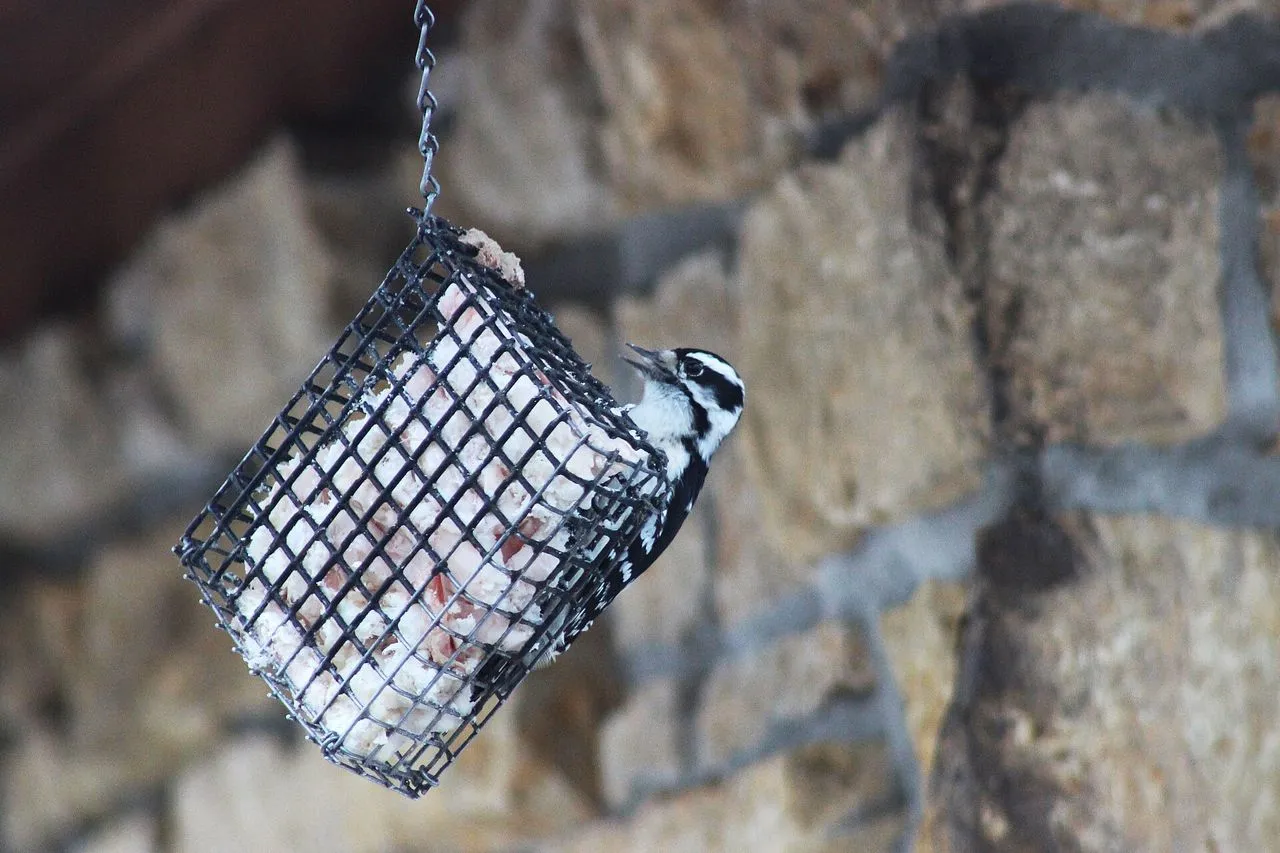
Woodpeckers need dead wood (snags) for foraging and nesting, Downy uses 50mm branches, Pileated needs 300mm+ trunks. Suet attracts visits but dead trees create territory. Leave dead branches, plant native oaks, provide water, and avoid removing dead trees.
A Downy Woodpecker can use a dead branch only 50 to 75 mm in diameter; a Pileated Woodpecker may need a decayed trunk over 300 mm wide. "Leave dead wood" is true, but diameter determines which woodpecker it serves.
Most advice reduces woodpeckers to suet. Suet attracts visits; dead wood and insect-rich trees create habitat. A garden with a suet cage and no snags is a snack stop. A garden with standing dead timber, native trees, and water can become part of a territory.
Specifications / Recipes / What Actually Works
| Resource | Useful specification | Main users | Failure point |
|---|---|---|---|
| Small dead branch | 50–75 mm (2–3 in) diameter | Downy Woodpecker (Dryobates pubescens), nuthatches | Removed during tidying |
| Medium snag | 75–150 mm (3–6 in) diameter | Hairy Woodpecker (D. villosus), flickers | Placed where it threatens structures |
| Large trunk | 300 mm+ (12 in+) diameter | Pileated Woodpecker (Dryocopus pileatus) | Rare in small gardens |
| Suet cage | Steel cage, 1.5–2.5 m (5–8 ft) high | Woodpeckers, chickadees | Rancid in heat |
| Drumming block | 300 mm × 75–100 mm (12 × 3–4 in) | Territorial males | Too close to siding |
Snags: Retain safe standing dead wood wherever possible. A 2 to 4 m snag in a back corner is valuable even when the top has been reduced for safety. Leave side limbs shortened to 150 to 300 mm stubs; those stubs hold beetle larvae and give birds purchase. Keep snags at least their height away from roofs, parked cars, and play areas unless assessed by an arborist.
Dead branches: Do not remove every dead limb under 75 mm. Small woodpeckers, chickadees, nuthatches, and wrens forage heavily on dead twigs and branchlets. If a branch is not over a path or structure, it is often better habitat alive as dead wood than chipped as waste.
Native trees: Oaks, birches, willows, maples, pines, and native cherries host the insects woodpeckers excavate from bark and cambium. The point is not simply seed or fruit; it is larvae. For the wider plant logic, see Native plants for birds.
Suet: Use a steel cage, not soft plastic. Mount 1.5 to 2.5 m high on a trunk, pole, or under a limb. Upside-down cages select for Downy Woodpeckers, Hairy Woodpeckers, chickadees, and nuthatches while reducing European Starling use. Plain rendered suet, peanut suet, and insect suet are adequate. Avoid cakes bulked with milo, cracked corn, and bright artificial colouring.
Temperature rule: Pull conventional suet when daytime highs exceed 30 to 32 °C. Rancid fat fouls feathers and attracts mammals. In warm climates, offer suet only in cool months or use small 40 to 60 g portions removed daily.
Drumming posts: Woodpeckers drum to advertise, not to feed. A resonant dead limb, hollow trunk, or even a mounted cedar block can draw display activity away from gutters and siding. Fix a dry cedar or pine block, roughly 300 mm long and 75 to 100 mm thick, to a post away from the house. It will not solve every drumming problem, but it gives the bird a better instrument.
Water: Woodpeckers use shallow moving water more than deep baths. A basin 20 to 40 mm deep with a rough stone and a dripper is enough. Place it within 3 m of trunk or shrub cover, not in the centre of open lawn. For cold-weather feeding that keeps visitors coming to the garden, see Winter feeding strategies.
For a species-level account of the smallest common North American visitor, see the Downy Woodpecker.
Common Mistakes
- Removing all dead wood for neatness. A sterile garden with a suet feeder is still poor woodpecker habitat. Dead wood is the pantry and the workshop.
- Hanging suet from flimsy branches. Swinging cages favour starlings and squirrels. Woodpeckers feed best from a stable vertical or semi-stable surface.
- Using warm-weather suet carelessly. Melted fat can coat facial feathers. If the cake is greasy to the touch at noon, remove it.
- Expecting nest boxes to replace cavities. Most woodpeckers excavate their own cavities in softened wood. A box may help flickers in some settings but does not replace snags.
- Treating drumming as damage feeding. Drumming on metal flashing or gutters is communication. Spraying insects will not stop it because insects are not the cause.
Maintenance & Hygiene
Inspect suet cages weekly. Scrape old fat from corners, wash with hot soapy water, disinfect with 10% bleach for 10 minutes, rinse, and dry. In freezing weather the interval can stretch to two weeks; in damp mild weather keep it weekly.
Check mounting hardware monthly. Squirrels loosen hooks, raccoons bend cages, and wind saws hangers into bark. Use steel cable or chain where mammals are common. Avoid wrapping wire tightly around growing branches; it girdles them. Use an adjustable strap or a pole mount.
For snags, maintenance means risk management, not tidiness. Once a year, preferably after leaf fall, look for splitting bases, fungal conks at ground level, or a lean that has changed. Reduce height rather than remove the whole stem when possible. A 2 m trunk with decay is still useful to Downy Woodpeckers and nuthatches.
If woodpeckers begin drilling siding, identify whether they are feeding, drumming, or excavating. Feeding holes are small and irregular; drumming leaves little damage; cavity excavation is larger and persistent. Cover the target area immediately with netting held 75 mm off the surface, then provide suet and a drumming block elsewhere. Delay lets the behaviour become a routine.
See Also
- Suet Feeders and Rendered Fat: the full guide to suet cage design, temperature rules, and summer hazards.
- Native Plants for Birds: the insect-supporting trees that create the bark habitat woodpeckers feed in.
- The Complete Attracting Guide: the full cross-species reference for garden bird management.
- Downy Woodpecker: the smallest common woodpecker and the entry point for bark-foraging ecology.
- How to Make Homemade Suet: rendered-fat recipe for cold-weather woodpecker feeding, with safety limits and what to avoid.
Frequently Asked Questions
What size dead wood do different woodpeckers need?
Downy Woodpeckers use small dead branches (50–75mm diameter). Hairy Woodpeckers need slightly larger (75–100mm). Pileated Woodpeckers require large dead trunks (300mm+). The diameter determines which species your dead wood will serve.
Is suet enough to attract woodpeckers?
Suet attracts visits but not territory. A garden with only suet is a snack stop. To create territory, provide standing dead trees (snags), native trees with bark insects, and water. Woodpeckers need昆虫-rich habitat, not just fat.
Should I create a drumming post?
A dead sapling or log (25–50mm diameter, 1–2m tall) makes a natural drumming post. Woodpeckers use dead wood for territorial displays. Leave dead branches in the garden, they serve as both foraging substrate and drumming posts.
Are dead trees dangerous to keep?
Healthy dead trees rarely fall, a decayed trunk is structurally weak and often breaks high, not far. A snag in the back 40% of a property is generally safe. Leave dead wood in place where it doesn't threaten structures or people.