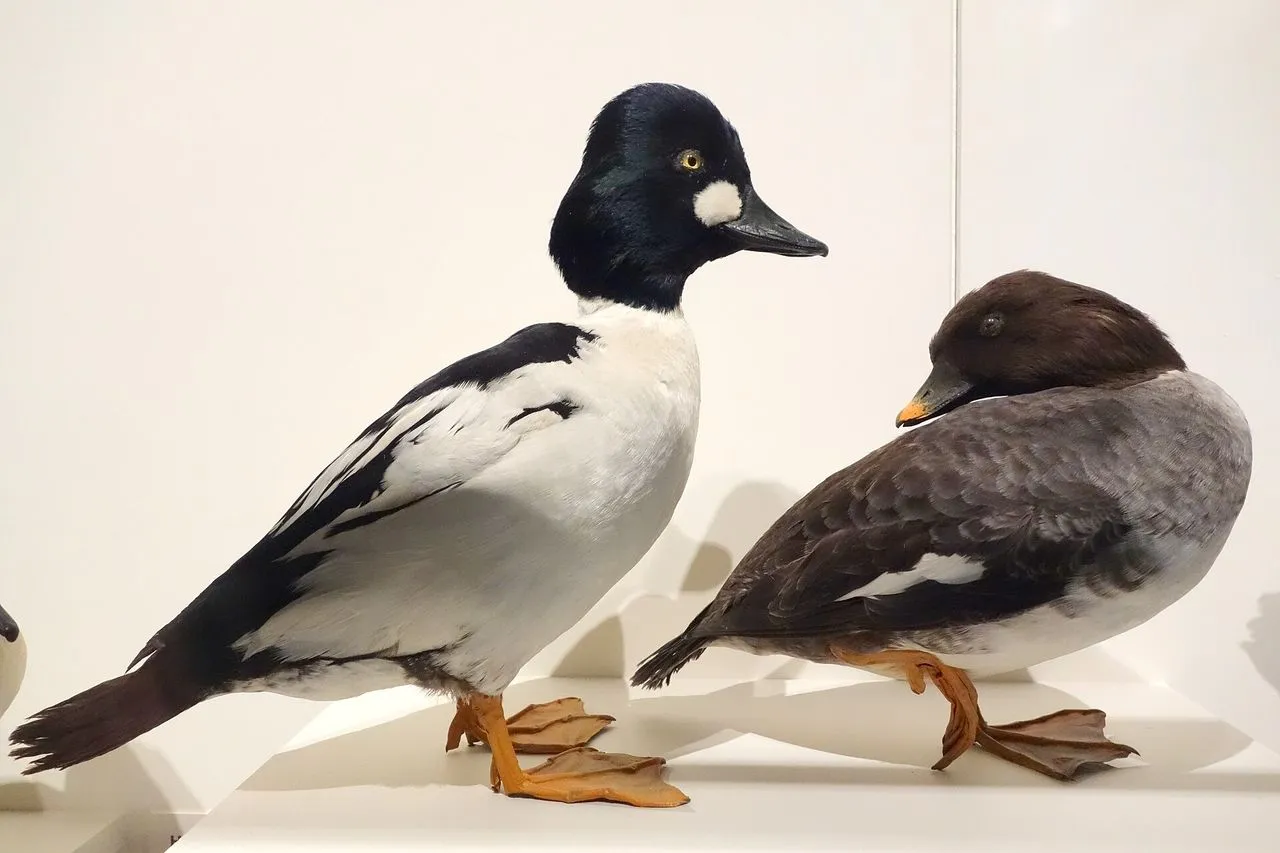
Bucephala clangula (Linnaeus, 1758), the Common Goldeneye, is named partly for the yellow iris but often detected by sound before detail is visible: the wings of males produce a clear whistling in flight, generated by narrow, stiff primaries and rapid wingbeats. Body length is about 40-51 cm; the head is large enough to give the genus name, from Greek roots meaning bull-headed.
Part of the Complete Waterfowl Guide.
Identification at a glance
| Character | Common Goldeneye | Bufflehead |
|---|---|---|
| Length | 40–51 cm (16–20 in) | 32–40 cm (13–16 in) |
| Male face mark | Round white spot between bill and eye | White wedge wrapping around rear head |
| Female head | Chocolate-brown with white collar | Grey-brown with oval white cheek patch |
| Head shape | Triangular to blocky; steep forehead | Round, large-headed, tiny-billed |
| Flight | Ringing male wing-whistle | Rapid, usually quiet wingbeats |
Identification
Visual
The breeding male has a glossy dark green head that can look black in dull light, a round white spot between bill base and eye, golden-yellow eye, white body, black back, and extensive white in the wing. The head shape is triangular to blocky, with a steep forehead. The bill is short and dark.
The female has a chocolate-brown head, grey body, white collar often visible at close range, yellow to pale eye, and dark bill that may show yellow near the tip in adult females. Juveniles are duller, with less clear eye colour and reduced contrast. Barrow's Goldeneye is the principal confusion species in western North America and Iceland: male Barrow's has a crescent rather than round face spot and a steeper forehead; females require attention to head shape and bill colour.
Eclipse males lose the crisp black-white breeding pattern but retain male-like head structure and much white in the wing.
Audio
The famous wing whistle is most obvious in male flight: a high, ringing, mechanical sound from fast wingbeats. Vocalisations are less often heard; display includes harsh notes and grunts, but winter identification is usually visual and acoustic from flight.
Distribution
Common Goldeneye breeds across boreal forest zones of North America and Eurasia, using tree cavities near lakes and rivers. North American birds winter on ice-free lakes, reservoirs, large rivers, and coastal bays across southern Canada and the United States. Eurasian birds winter in western Europe, the Baltic, the North Sea, the Mediterranean region, and temperate Asia. In Britain it is mainly a winter visitor, with a small Scottish breeding population associated with nest boxes.
Habitat
Breeding requires clear freshwater with adjacent mature woodland or installed nest boxes. Winter habitat is broader: reservoirs, gravel pits, estuaries, sheltered sea lochs, large lowland rivers, and coastal bays. It favours water deep enough to dive but not necessarily marine; many inland reservoirs hold regular wintering birds.
On winter water, Common Goldeneye often keeps to open zones away from dense marginal vegetation, surfacing repeatedly in the same feeding patch until disturbed. Birds may drift downwind between dives, so a flock can appear to move steadily across a reservoir without flying. In cold weather, distribution tightens around ice-free inflows, outflows, and deeper basins where benthic prey remains accessible.
Diet and Foraging
Common Goldeneye is a diving duck. It feeds on aquatic insects, molluscs, crustaceans, small fish, fish eggs, and plant material in smaller quantities. Freshwater birds often take caddisfly larvae, dragonfly larvae, beetles, and snails; coastal birds take mussels, amphipods, and other benthic invertebrates.
Dives are typically short to moderate, often under 30 seconds in shallow water but longer where prey lies deeper. Birds spring slightly before submerging and surface with a compact, buoyant posture. The lobed hind toe and rear-set legs are evident in the running take-off across water.
Breeding Biology
Courtship is conspicuous in late winter and spring. Males perform head-throw displays, snapping the head backward until it nearly touches the rump, then kicking water. Nesting is in tree cavities, old Black Woodpecker holes in Europe, broken trunks, or boxes, sometimes more than 10 m above ground. Females show strong natal and nest-site fidelity.
Clutches usually contain 8-11 eggs; dump-laying can enlarge clutches. Incubation lasts about 28-32 days. Young jump from the cavity shortly after hatching and follow the female to water, where they dive and feed themselves. Fledging occurs around 8-9 weeks.
Notes
Goldeneye nest-box programmes in Scotland and Scandinavia show the same principle as Wood Duck boxes: adding cavities can increase local breeding where food and brood habitat are already adequate. Boxes do not create habitat by themselves. For field observers, the roundness of the male cheek spot is important; a crescent-shaped mark should prompt consideration of Barrow's Goldeneye where range permits.
The head-throw display is useful because it can be seen at long range when colour is poor. Males snap the head back, open the bill, and kick water in a stereotyped sequence. Mixed winter groups may include immature males with reduced face patches and female-like body tones; these birds should be aged cautiously. The white wing panel in flight remains broad and bright even when body plumage is not fully adult.
Females deserve more careful treatment than they usually receive. Bill colour changes with age and season, and some adult females show a yellow band or tip while first-winter birds may have darker bills. Head shape, body size, and association with displaying males should be considered together. On European reservoirs, female Common Goldeneye is common enough that a claimed female Barrow's Goldeneye needs detailed structural evidence.
During severe freezes, goldeneye may concentrate below dams, at power-station outflows, or in tidal sections of rivers. These cold-weather aggregations are not necessarily evidence of a larger regional population; they may represent birds compressed from many smaller frozen waters into the few remaining feeding sites.
See Also
- Bufflehead: smaller Bucephala relative; compare size, head pattern, and cavity-nesting ecology
- Hooded Merganser: cavity-nesting diver often found on the same wooded freshwater wetlands
- Common Merganser: larger sawbill that can overlap on rivers, reservoirs, and winter bays
- Attracting Woodpeckers: nest-cavity context for the flicker holes and boxes goldeneye use
- The Complete Waterfowl Guide: full family overview including diver identification and winter distribution
Frequently Asked Questions
How do I identify a Common Goldeneye?
Males have a dark green glossy head with a round white spot between bill and eye, yellow eye, and white body with black back. Females have a chocolate-brown head with a grey body and white collar. The triangular or blocky head shape is distinctive.
What is the wing whistle of goldeneyes?
Male Common Goldeneyes produce a clear whistling sound in flight, generated by their narrow, stiff primaries and rapid wingbeats. This distinctive sound is often heard before the bird is visible.
How do I separate Common Goldeneye from Barrow's Goldeneye?
Male Barrow's Goldeneye has a crescent-shaped face spot instead of round, and a steeper forehead. Females require attention to head shape and bill colour. Range differs: Barrow's is primarily western North American.
Do Common Goldeneyes use nest boxes?
Yes, they are cavity nesters that will use nest boxes, particularly in Scotland and Scandinavia where nest-box programmes have supported breeding populations. They require cavities near clear freshwater with adjacent woodland.
Sources & References
- Ehrlich, P.R., Dobkin, D.S. & Wheye, D. (1988). The Birders Handbook. Simon & Schuster.
- Cornell Lab of Ornithology. (2024). All About Birds: Common Goldeneye. birds.cornell.edu
- Sibley, D.A. (2014). The Sibley Guide to Birds (2nd ed.). Knopf.
- Carboneras, C. & Kirwan, G.M. (2024). Common Goldeneye (Bucephala clangula). Birds of the World.